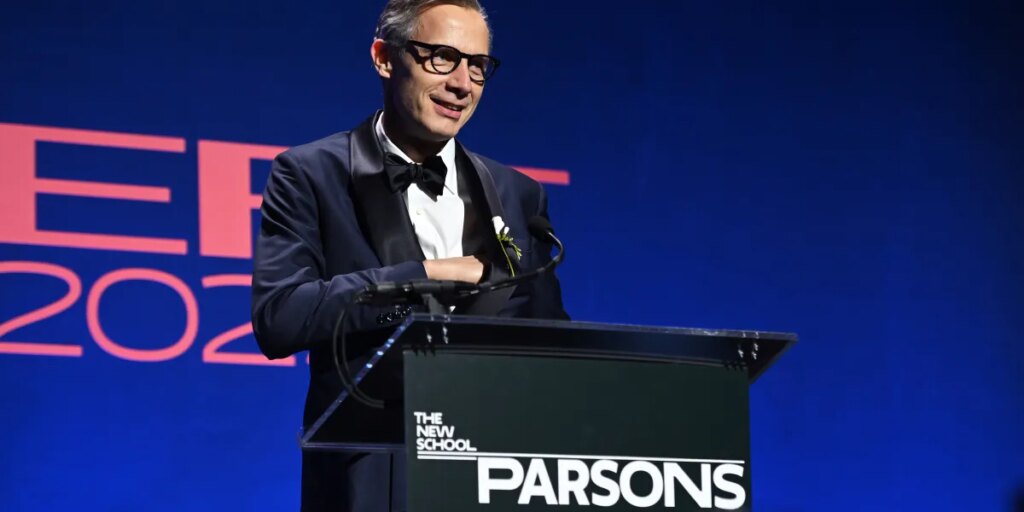
For the second time in his career, luxury executive Geoffroy van Raemdonck has been tasked with fixing an iconic department store company brought low by financial engineering. In 2018, he was hired to fix Neiman Marcus Group, which was struggling to to keep up with shifting consumer trends and unprofitable under the weight of heavy debt from years of private equity ownership.
This time, the job is twice as big. On Tuesday, Van Raemdonck was appointed CEO of Saks Global, the same day as the luxury department store giant, which includes Neiman Marcus Group (and its Bergdorf Goodman division) and Saks Fifth Avenue, filed for Chapter 11 bankruptcy protection.
Saks Global is the result of a $2.7 billion deal in 2024 masterminded by real estate scion Richard Baker—one that failed spectacularly because of the confluence of slumping sales and sky-high debt, leaving in its wake angry vendors, empty shelves, and AWOL consumers.
Former Saks Global executive chairman Baker has the opposite of the “Midas Touch” when it comes to dealmaking, as I wrote last week—with most of the retailers he’s bought ultimately failing. And Baker left his successor (after a two-week stint where he stepped into the CEO role) with quite a mess to clean up. But van Raemdonck does seem to understand the assignment when it comes to reviving a high-end department store brand.
During his six years as Neiman CEO, during which he led the company through a pandemic and later returned it to profitability, van Raemdonck spoke often of “leading with love,” and the importance of remembering that luxury retail has to be about much more than completing transactions. In late 2024 at the WWD CEO conference, shortly before the Saks acquisition closed, van Raemdonck recalled how at the start of his tenure, he had challenged his Neiman Marcus C-suite with the question, “How do we reignite customers’ emotions?” That’s arguably the same question Van Raemdonck faces today. (He did not respond to a request for comment from Fortune.)
Instilling positive emotions in customers—and convincing them to act upon them—will be essential in Saks Global’s bankruptcy era. And it will have to begin with winning over the company’s beleaguered vendors. Between sluggish business and heavy debt, Saks has in the last two years delayed payments to many vendors. Bloomberg News reported on Wednesdaythat Chanel, and conglomerates Kering and LVMH were owed a combined $225 million—so Van Raemdonck has a lot of fences to mend.
Many of those vendors have stopped shipping to its stores, which has led to empty shelves and stale inventory, the antithesis of what a luxury department store should offer and certainly not a way to inspire a shopper’s love. It was one of the reasons for a 13% drop in quarterly revenue for the quarter ended August 2, 2025. Those moves reflected Baker’s priorities, including deploying funds to make acquisitions or to conserve cash for debt payments resulting from his dealmaking.
One key lesson in the past few years for these department stores is that they are no longer indispensable to brands. And stiffing the creators of the stuff they sell is not a way to attract the hot brands, especially newer ones, that make a retailer feel buzzy and relevant.
The changing relationship between department stores and brands can’t all be blamed on mismanagement; it’s also the result of a cultural shift. “Historically, the way you discovered an amazing new luxury brand was that a curator at a Saks or a Neiman would pick a product and merchandise it beautifully,” said Jason Goldberg, chief commerce strategy officer at Publicis Groupe, a global advertising and communications firm. “Now, consumers are much more likely to discover new fashion trends from influencers on social media.”
That’s not to say there won’t be need for Saks and Neiman in the luxury market. The U.S. market for personal luxury products is about $100 billion, and the chains rang up a combined estimated $8 billion in revenue last year, meaning they remain important. The recent success of Nordstrom and Bloomingdale’s—strong sales growth for several quarters, in good part at Saks’ expense—are further proof that upscale department stores are still valuable. But that depends on good relations with brands.
Early Wednesday, in its statement announcing the bankruptcy filing, Saks said it had lined up $1.75 billion in financing that among other things would make go-forward payments to vendors, a key step in repairing relations.
Indeed, one of the reasons van Raemdonck got the job, on top of his experience heading Neiman, was his many years of management experience as a vendor, including years at Ralph Lauren and Louis Vuitton, so he understands their priorities and concerns.
He also understands the value of key employees, from store workers to those who bolster a retailer’s “fashion authority,” a number of whom have recently left Saks Global: Catherine Bloom, a superstar personal shopper for Neiman Marcus, and Yumi Shin, Bergdorf Goodman’s merchandising director, recently left for Nordstrom. Van Raemdonck will certainly work to soothe the nerves of other such stars, and seek to avoid more defections.
Another reason van Raemdonck was named CEO was his hands-on experience with guiding a company through a bankruptcy reorganization, having done so with Neiman Marcus Group in 2020, when the pandemic hit sales so badly that it became impossible to meet the company’s service of its massive debt.
This is likely to be a painful process. Though the company did not directly mention store closings in the announcement of its bankruptcy, Saks Global did say it “is evaluating its operational footprint to invest resources where it has the greatest long-term potential.” Saks has about 33 stores and Neiman 36, with some overlap in the same malls or same neighborhoods, meaning they are cannibalizing each other’s sales. Some culling of weak locations is almost certain.
Under van Raemdonck, Neiman Marcus did well protecting its market share from the headwinds buffeting luxury department stores. And while turning Saks Global into a fast growing retailer is a long shot, many in retail feel he is the man for the moment.
“He understands retail, luxury, and the brands the group owns. Even so, he will have his work cut out for him to get things back on track,” said Neil Saunders, a managing partner at GlobalData. “Ultimately, the lesson from Saks is that retailers should be run as retailers, and not used as financial playthings.”
The post Can Saks’ new CEO repair the damage done to the luxury retailer by years of being treated as a ‘financial plaything’? appeared first on Fortune.