If Grateful Dead fans are good at saying goodbye, it is thanks to decades of practice.
They said goodbye in 1995, when Jerry Garcia died at 53 years old. They said goodbye again 20 years later in a series of shows that were the last to feature the band’s four remaining core members — Mickey Hart, Bill Kreutzmann, Phil Lesh and Bob Weir. They said goodbye to an incarnation of the group called Dead and Company when it made a “final tour” in 2023 — and then again last year when it played three stand-alone shows in honor of the 60th anniversary of the Dead’s founding. In 2024, they said goodbye to the bassist Lesh and his own long-tenured successor act, Phil Lesh and Friends, when he died at 84.
Weir’s death Saturday at 78 was the latest occasion for a farewell. “The voices are gone,” Dennis McNally, the Dead’s former spokesman and biographer, said this week, referring to the band member who, after Garcia, wrote and sang the most songs.
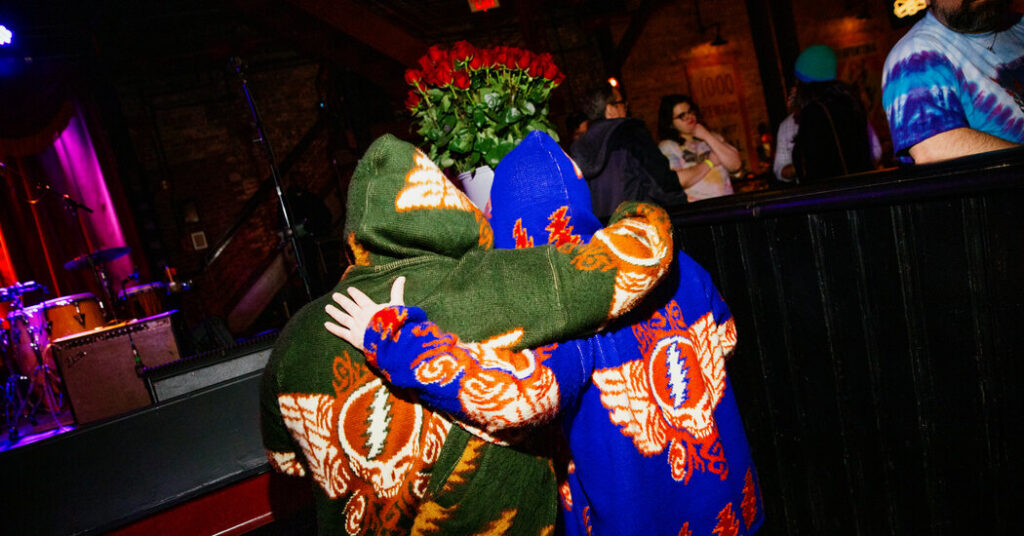
But a counterpoint to the mourning came Tuesday night at Brooklyn Bowl, where hundreds gathered for a free tribute concert.
“Bob Weir is here,” Sarah Elaz, the bassist for the evening’s cover band, Bushwick’s Dead, announced as the group took the stage and started up Weir’s most famous song, the one the Grateful Dead used to play at midnight every New Year’s Eve, “Sugar Magnolia.”
The statement about Weir pointed to a remarkable aspect of the Dead: As the core members fade away (just Hart and Kreutzmann are still alive among them), the phenomenon continues. Like perhaps no other act, the Dead have evolved into an idea and a songbook.
This would have seemed implausible 30 years ago when Garcia, the band’s musical soul and a cultural icon, died. But in the ensuing decades a ream of archival recordings, official side projects, touring cover bands, local tribute acts and an infusion of new young fans have meant that the music — to borrow from a Dead song — never stopped.
“My parents would talk about the Grateful Dead world as an old oak tree,” Grahame Lesh, son of Phil, said in an interview this week. “The roots are the American music that the band drew from and synthesized into the Grateful Dead’s music. The band members themselves were the trunk of the tree. And all of us continuing it on, that played with them later, the cover bands in every city — they’re the branches and the leaves.”
Nobody was as committed to this concept as Weir, who was just 17 when he and four other musicians formed the Dead in the Bay Area in 1965. Weir was a part of numerous successor acts featuring original band members after Garcia’s death ended the original incarnation.
Eleven years ago Weir co-founded Dead and Company, which featured Hart and sometimes Kreutzmann but also new musicians — most notably John Mayer in the Garcia role. Dead and Company achieved immense popularity in its own right, introducing a new generation to the group’s music and lore. culture.
For many in the young-skewing crowd at Brooklyn Bowl, the wake for Weir on Tuesday was as much about memorializing Dead and Company as the original band.
“He is my Jerry,” Sara Dennis, 32, said of Weir before the concert began. “Had he not had the open-mindedness and foresight to bring in someone like John, it might not have gotten to people my age.”
Ashley Duncan, 30, who had come to Brooklyn Bowl as a “plus-one,” said that her boyfriend cried when he learned of Weir’s death. “I wouldn’t say they worshiped him,” she said of her Deadhead friends. “He was more like a friend.”
The evening was celebratory, not funereal.
The reggae artist Matisyahu sang on “Estimated Prophet,” an intricate song set to 7/4 time. The soul-inflected guitarist Robert Randolph played on “Samson and Delilah.” After “Truckin’” — with its famous tagline, “What a long, strange trip it’s been” — closed the second set, Brooklyn Bowl impresario Peter Shapiro and others from the venue distributed roses to the audience, which were held for a moment of silence and then tossed in the air.
Despite this latest loss, 2026 is on track to be another year in the continuing life of the Dead. Official releases of archival shows continue apace, with two announced for the coming months. Dozens, if not hundreds, of cover bands dot the landscape. Phil Lesh and Friends is gone; Grahame Lesh and Friends has several gigs on the books.
Chris Foretti, 54 and a Deadhead straight from central casting — the former owner of a brown-and-beige Volkswagen bus, on Tuesday night dressed as a psychedelic Uncle Sam in a nod to the Dead song “U.S. Blues” — would not count the Brooklyn Bowl tribute concert among the 504 shows he has attended by the Dead and its official successors. But he was pleased to be there and surrounded by people half his age.
“That’s the thing about the Dead,” Foretti said. “You’re never the oldest, but you’re never the youngest.”
Marc Tracy is a Times reporter covering arts and culture. He is based in New York.
The post Bob Weir Is Gone, but the Dead’s Music Plays On appeared first on New York Times.