When it comes to the genre of sci-fi time-loop stories, I believe that filmmakers should follow campsite rules: Leave things better than you found them. It’s a deceptively tough ask for a genre that has repetition baked into the plot by design. And it’s even trickier with a story that has already been adapted multiple times. That’s unfortunately the case with the anemic new anime film adaptation of “All You Need Is Kill,” about a girl who finds herself stuck repeating the day of a mass alien attack.
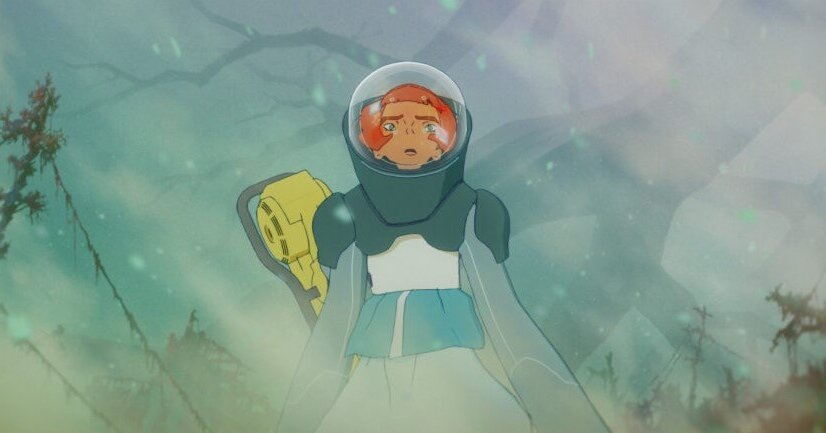
The story of “All You Need Is Kill” begins on the one-year anniversary of the arrival of Darol, a giant iridescent space fern, on Earth. Rita (voiced by Ai Mikami), a lonely girl with some residual personal trauma, is a volunteer worker who has suited up to rebuild Japan after the seemingly dormant extraterrestrial plant found its new home. When Darol suddenly unleashes an army of monsters that attack the human population, Rita dies — only to awake in her bed on the morning of that same day, over and over again. She eventually finds another person, a skittish boy named Keiji (Natsuki Hanae), also stuck in the loop, and the two of them work together to find a way to break free of their apocalyptic “Groundhog Day.”
Initially a Japanese light novel by Hiroshi Sakurazaka, “All You Need Is Kill” was later adapted into a manga, a graphic novel and a 2014 American film called “Edge of Tomorrow” starring Tom Cruise and Emily Blunt. Unlike the original story and those other incarnations, this adaptation, directed by Kenichiro Akimoto, follows Rita’s perspective and streamlines much of the detail around the workings of Darol and how this futuristic world has adjusted to the unknown threat.
By narrowing the scope and condensing the logic of the action, this film undermines the excitement of the story, so even the day of an alien apocalypse starts to get tedious. That’s a great misfortune given the movie’s funky style: Sometimes backgrounds are rendered in robustly detailed 3-D, but there are also luminous blue and purple watercolor streaks across Darol’s leafy fronds and brightly colored Pollackesque alien vegetative ground. The multipetaled monsters look like they’ve ventured in from the Upside Down, and the character designs are rigid, with a sparse, angular line style that gives even the humans an odd, otherworldly quality.
Akimoto’s direction shines through in moments when the plot and pacing take on more urgency, as in a scene from one of Rita’s early loops, when she anxiously watches from an alleyway as the tragedy unfolds. People race by, blasts resound in the distance, lights flash, all while the camera, set at a tilt, gradually creeps closer to the action.
There’s an obvious “If at first you don’t succeed …” moral at the heart of the film, as Rita and Keiji train to fight the alien threat through more than 100 time loops. Their relationship grows and evolves along with their tactical abilities. But the deeper character work underlying the video-game-style repeating action — Rita and Keiji’s mental health struggles, their responses to past trauma — is brushed by too quickly. Early in the film, remembering a time from her youth when she nearly died, Rita says, “I’ve been submerged ever since then.” Beyond alien plant-life, beyond a never-ending battle for humanity, lies the resilience of these characters, who are forced to face death continuously today, yet still strive to live for tomorrow.
All You Need Is Kill Rated R for bloody plant-caused deaths. Running time: 1 hour 22 minutes. In theaters.
Maya Phillips is an arts and culture critic for The Times.
The post ‘All You Need Is Kill’ Review: It Doesn’t Bear Repeating appeared first on New York Times.