Now what?
That’s what Greenlanders are asking.
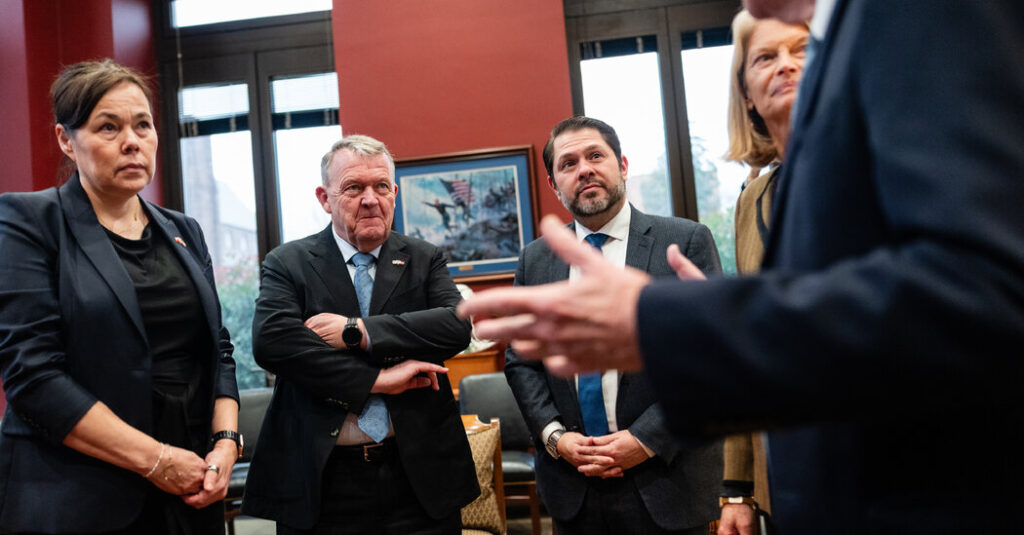
The big meeting in Washington over Greenland’s future happened on Wednesday. It was historic because Greenland was included for the first time at such high levels. Its foreign minister sat down with Vice President JD Vance and Secretary of State Marco Rubio to talk about the gigantic icebound island that has been part of Denmark for more than 300 years but that President Trump insists the United States should take over, possibly with military force.
The hope was to work out a compromise, find some path forward. But the conclusion from Denmark’s foreign minister, who was also there, was that a “fundamental disagreement” remained.
“Honestly, I feel flat. And I’m disappointed,” said Paalo Kuitse, a mechanic in the southern town of Qaqortoq. “What we are missing are answers about what will happen next.”
“I’m afraid the next step from the U.S. will be harsh,” he said, adding, “The U.S. has the biggest military machine in the world.”
The Danish political establishment, even opposition parties, has tried to put the best face on the meeting. Some politicians even called it “diplomacy at its best.”
“It would have been completely naive to believe that the threat of taking over Greenland would go away,” said Rasmus Jarlov, a conservative lawmaker. But, he said, at least the officials didn’t start arguing.
Greenland’s 57,000 people have been watching all this unfold in disbelief. For generations, they have mostly been left alone to survive in one of the coldest, most barren and remote places on the planet. They have built a blended lifestyle, adhering to traditions like hunting seals and whales while also enjoying a high Scandinavian standard of living. Polls and interviews indicate that most don’t want to ditch their free education and free health care for an American system of vast inequality.
Many took great pride in seeing their foreign minister, Vivian Motzfeldt, standing in Washington on Wednesday and speaking Greenlandic to a bank of reporters, saying it was important for her to communicate to her people back home.
As a cafe in Nuuk broadcast the news live, people started clapping when she spoke.
“You feel relieved when you hear it, but you never really know what will happen,” said Agnetha Mikka Petersen, who was watching the broadcast with a friend.
Trump Administration: Live Updates
Updated
- Trump cheers ‘good news’ after Iran says a prominent protester isn’t set to be executed.
- Machado will meet Trump, after offering to share her Nobel.
- Trump vows to make Venezuela rich, but it will take more than U.S. cash.
She said she had a dream that American ships and planes bombed Nuuk’s airport. “I’m afraid of what could happen to Greenland — and what could happen to Denmark,” she said.
Many Greenlanders say what people all over the world say about Mr. Trump: that he’s highly unpredictable. On Wednesday, the president seemed to strike a more measured tone. When asked by a reporter if he would use force to acquire Greenland, a threat he has repeatedly made, he said: “You’re saying that. I didn’t say it.”
He emphasized — again — that Greenland was crucial for the United States’ security and that Denmark can’t defend it in today’s world.
“There’s not a thing that Denmark can do about it if Russia or China wants to occupy Greenland, but there’s everything we can do,” he said on Wednesday.
But he added: “I have a very good relationship with Denmark, and we’ll see how it all works out. I think something will work out.”
Mr. Trump consistently glides past the fact that because Greenland is part of Denmark, and Denmark part of NATO, the United States would in any case be obliged to defend Greenland if Russia or China attacked, something analysts say is remote.
Foreign policy scholars tried to find some positive embers. The meeting might not have broken the impasse, said Penny Naas, senior vice president at the German Marshall Fund of the United States, a policy organization focused on trans-Atlantic cooperation.
“But it also didn’t result in the worse-case scenario,” she said. “It bought time for each side to explore the issue further and to see where there might be potential compromises that don’t violate anyone’s red lines.”
Denmark’s foreign minister, Lars Lokke Rasmussen, came out of the meeting looking deflated and said that a “working group” would convene in the coming weeks. Marisol Maddox, a senior fellow at the Institute of Arctic Studies at Dartmouth University, called that “a positive, concrete step.”
One possible compromise, she said, would be to “tweak” the existing America-Danish defense agreements that already give the United States sweeping military access to Greenland and “develop something the Trump administration could own.”
Many Greenlanders aren’t so hopeful about all this working out.
“We need economic security and lower costs of living. Those are the things we have to deal with together — instead of being spectators,” said Jens Peter Lange, a dental technician in Illulissat, a town in western Greenland, who also works as a commercial fishermen to make ends meet.
He dismissed the working group as “just a talking club for civil servants” that would rack up high bills flying between capitals and buying duty-free goods.
“If they can’t give me a tool to sell my fish at a better price,” he said, “then it’s not for me.”
Jeffrey Gettleman is an international correspondent based in London covering global events. He has worked for The Times for more than 20 years.
The post After an Inconclusive Meeting, Greenlanders Ask: Now What? appeared first on New York Times.