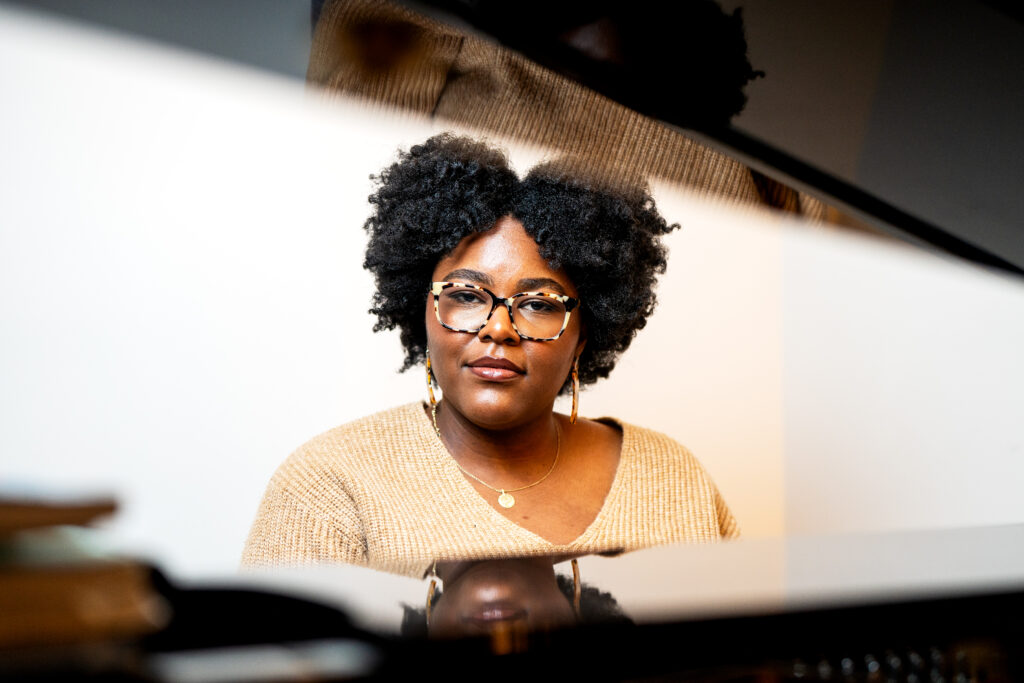
The song that made Christie Dashiell want to be a jazz singer was Sarah Vaughan’s 1962 rendition of “When Sunny Gets Blue,” a sparse guitar and double bass arrangement about a man whose failed love affair dulls his summery demeanor. Vaughan’s voice pushes and pulls the phrases in a glowy vibrato that sounds less like sunlight and more like moonlight.
As a child, Dashiell thought it was the most beautiful singing she’d ever heard.
“There’s a sadness in the lyrics,” she says. “But there was also a joyful sound in the music, the joy that oftentimes is juxtaposed with sadness when it comes to blues music.”
That persisting attraction to the bittersweet has been a guide to Dashiell, a renowned jazz vocalist and educator, through much of a career spent slathering her silken voice on top of swing, blues, soul and R&B. The yin and yang of happiness and grief, triumph and dejection, has been a through line of her two solo albums. And that emotional stirred brew was a catalyst for the record that recently earned the 37-year-old Howard University adjunct lecturer her second Grammy nomination in two years.
First, a quick jazz history lesson relevant to Dashiell’s present.
Almost 30 years before Dashiell was born, drummer and bebop pioneer Max Roach released an album called “We Insist!,” subtitled the “Freedom Now Suite.” Roach and his companions conceived of the album in the late 1950s as a centennial celebration of the Emancipation Proclamation, with an eye toward performances in 1963. Roach couldn’t wait that long; the civil rights movement was rapidly taking shape around him. The album was released in late 1960 with a photo of three Black men at a lunch counter on its cover.
“We Insist!” became a vocal-instrumental, somewhat avant-garde suite that dealt in themes of Black history and current reality. Controversial in its time, it was later recognized by the Library of Congress as one of America’s most essential jazz albums. In one song, a White overseer rapes enslaved women and whips enslaved men. Another song was written in direct response to the Sharpeville massacre in South Africa. The unyielding rage and catharsis of Black protest are embodied when poised singer Abbey Lincoln devolves into screams on “Triptych: Prayer, Protest, Peace.”
Dashiell deals in anniversaries, too. She was drafted into the making of “We Insist! 2025,” a reimagining of Roach’s original meant to commemorate his own centennial birthday. It’s a celebration of what Black social movements have accomplished since the 1960s, a mourning of what they’ve lost and a look at what is left to do. Terri Lyne Carrington, award-winning jazz drummer, composer and Dashiell’s co-leader in the project, chose Dashiell as the album’s voice.
“She encapsulates the sound of Black music to me, through the various styles and idioms, even through time and generations,” Carrington says. “She sounds like an old soul, yet young and contemporary. Gospel and blues is foundational to her sound, but jazz — or freedom music — allows her the platform to be creative without boundaries.”
She simply had to be all things, you see. No pressure.
When Dashiell feels anxious, she hums. She always has.
“I played violin very early, and I played a little piano. I still do,” she says on a Zoom call from Argentina, where she’s playing a handful of gigs. It’s freezing in the DMV but balmy there, and she’s wearing a tank top and a striking smile as she speaks. “But singing, out of everything I tried, was the thing that brought me the most joy and calm. It always brought me back to my center.”
Dashiell has a soothing speaking voice and a tendency to pan history for nuggets that relate to whatever she’s discussing. You can imagine how she entrances a classroom.
She is the third of four artistic children of Carroll Dashiell Jr., a seasoned jazz bassist and fellow educator. Her mother was the first person to recognize her vocal talents, but it was her father who encouraged her to deepen the craft.
“One of the main things that I remember my dad impressing upon me was how to take whatever craft or discipline that you do very seriously and treat the history with the reverence that it deserves,” she says.
He was a player in that ranging history himself — he toured with funk legend Maceo Parker, but he also taught Count Basie and Duke Ellington. Christie Dashiell, born in D.C. but raised in North Carolina, grew up listening to country, too.
“Part of honing my sound and defining my sound has always been about exploring all sounds,” she says.
She continued to fine-tune that noise — clear, precise, casually elegant — as a student at Howard. She noticed, again, the diversity of Black experiences and how they fed into music making. During her master’s program at Manhattan School of Music, a conservatory she describes as “all music, all the time,” she dove into composition and opened her ears to new sounds, like Indian melodic frameworks. She came back to D.C. for a residency at Strathmore. New York was fiery; Washington was home.
“D.C. is part of why my music is so open in terms of its sound,” she says. “Because when I think about D.C., I think about gospel, I think about soul, I think about jazz, I think alternative music. … It’s where I’ve lived the majority of my life, and music is really just a snapshot of our lives.”
When she returned to Washington, she thought she was going to be famous — traveling the world, singing jazz. Music was a lifelong passion. Teaching sneaked up on her. She was still in her 20s and weary of academia when she started as an adjunct professor at Snow College in Utah. But “once I leaned into that part of my purpose, everything else started opening up,” she says. (Reminder: She is calling now from South America.) Besides, the history of jazz is oral.
“Before jazz education got into the institution, the way you were taught was by finding a mentor, being in their band, and them inadvertently teaching you through their way,” she says. “It’s important to learn from the people that are actively pursuing the thing you want to do.”
In early 2020, she took a position at Howard, her alma mater and where her father has since become chair of the music program. (She also teaches at the University of the District of Columbia.) The pandemic forced her out of proximity of her students but into closer communication: “I feel like I was talking to my students like friends,” she says. “I was like, ‘I am depressed.’ They were like, ‘Okay, how do we make this music? How do we sing and get this out in our music?’”
Those lockdown reflections — on the murder of George Floyd, on the friends she lost, on the husband she loves — became the foundation for “Journey in Black,” her second solo album, released in 2023. On an early November morning a year later, she rushed home from a late-night gig in Philadelphia to watch the 2025 Grammy nominations. When her name and album flashed on the screen, her body couldn’t believe it, she says. But her soul, her spirit, could.
Christie Dashiell doesn’t sound much like Abbey Lincoln. But “We Insist! 2025” is about freedoms beyond emancipation and the civil rights movement: the freedom of women to embody space, the freedom of sensuality and autonomy. Unlike Roach, Carrington listed her singer as a bandleader on the new “We Insist!” cover. So Dashiell took liberties with her voice.
“I thought, ‘Do I want to mimic her sound? Or do I do the thing that I think she would want me to do, which is sing it in my own way?’” she says. “That felt like the best way to honor her, especially when you’re talking about the freedom to be myself, to choose how I show up in the world.”
In addition to the tracks on “We Insist!,” the new album adds original compositions, like “Boom Chick,” an ode to Roach’s dizzying bebops, and “Dear Abbey,” a spoken-word love letter to the declarative singer who helped define women’s role in jazz. Carrington, founder of the Berklee Institute of Jazz and Gender Justice, included two versions of “Freedom Day,” originally written about Emancipation Day. She encouraged Dashiell to sing with sensuality: “What does it mean to have the autonomy to be liberated as a woman?” Carrington asked her. Its second version, arranged by Dashiell, incorporates elements of D.C. go-go.
Next month, Dashiell will return to the Grammys for her second-year-running nomination in the jazz vocal album category for “We Insist! 2025.” If the first time felt like a fluke — she blames impostor syndrome — this nomination cements her lengthening legacy.
The final and most distinctive track is “Joyful Noise,” which posits freedom as exuberance, smiling in the face of adversity and “knowing that everything is gonna be all right,” punctuated by Dashiell’s cheerful scatting. It feels like a fitting end to a Christie Dashiell album.
Recorded before the 2024 presidential election, the album has been received in a drastically different political landscape than the one that created it. Dashiell hopes this dichotomy will make audiences listen with greater intent. She talks now about “senseless killings and these invasions of other people’s spaces and countries.”
“It makes me feel afraid sometimes,” she says. “But [Carrington] reminded me that joy is our birthright, and many things can exist at the same time. The music can be deeply sad and deeply in your face about some horrific things, but we still have joyful moments throughout our lives.”
As she looks around at her country, she’s still finding beauty in the bittersweet, happiness made richer because of the sorrow. Like Sarah Vaughan. “The ancestors created jazz music and blues out of deeply oppressive times,” she says. Still, she adds, “there’s nothing but joy when I sing.”
Jan. 18 at 4 and 7 p.m. at the Music Center at Strathmore, 5301 Tuckerman Lane, North Bethesda. strathmore.org. $38.
The post With a revived civil rights album, Christie Dashiell sings her resistance appeared first on Washington Post.