What happens in Greenland doesn’t stay in Greenland.
Turns out, the fate of the world’s largest island has outsize importance for billions of people on the planet. That’s because of the one thing that Greenland is quickly losing: ice.
Most of Greenland’s landmass, which takes up about two million square kilometers in all, or nearly 840,000 square miles, is covered in ice. That ice is melting rapidly because the polar regions of the world are warming rapidly, with wide-ranging consequences for the stability of the Earth’s climate.
Blame the burning of coal, oil and gas. Their emissions have driven up global temperatures, most strikingly in the Arctic, which is warming at least twice as fast as the rest of the planet.
As the Arctic warms, potential new trading routes open up, as well as access to mineral riches, including those that are vital for clean energy technologies useful for slowing climate change. In short, climate change makes the Arctic more accessible and more of a strategic target for world powers, a fact not lost on President Trump.
“His fixation on Greenland is an admission that climate change is real,” said John Conger, a former Pentagon official in the Obama administration who is now an adviser to the Center for Climate and Security, a research institute.
Trump administration officials, who have made repeated threats to seize the territory, are due to meet with officials from Greenland and Denmark on Wednesday. Here are three things related to the global climate to keep in mind.
Ice and Its Consequences
In the 12 months ending on Aug. 31, 2025, Greenland lost 105 billion metric tons of ice, according to scientists at the Danish Meteorological Institute, who published their findings in Carbon Brief, an online publication.
That was no anomaly. Greenland’s ice sheet has been thinning for the past 29 years.
It shrank by nearly 2,000 square miles from 1985 to 2022, according to a study published in Nature.
Melting ice means more fresh water in the ocean, which raises sea levels, which can be dangerous for coastal regions all over the world. The global sea level has gone up by about four inches since 1993.
If all the ice of Greenland were to melt — albeit an impossible proposition during this century — that could result in 23 feet of sea-level rise, or 7.4 meters, scientists say. Rising sea levels makes flooding worse during storms and high tides.
“Greenland is sort of on an unstoppable trajectory to melt,” Sarah Das, a glaciologist who is a scientist emeritus at the Woods Hole Oceanographic Institution.
The loss of sea ice has another effect. As it melts, it reduces the total bright surface area that can reflect sunlight back to the atmosphere. More of the sun’s heat is absorbed by the ocean and, in turn, the ocean warms even more.
Then there’s the effect on ocean circulation patterns. Recent research suggests that the melting Greenland ice sheet is helping to slow a network of ocean currents, with the potential to affect weather patterns even in the southern Hemisphere.
Greenland’s Riches
Greenland, a semiautonomous territory of Denmark, sits on an array of minerals, including graphite, zinc and rare earths. Many of those are important to European Union nations as they try to expand their adoption of renewable energy technologies. A majority of what the 27-country bloc has identified as critical raw materials can be found in Greenland.
Graphite is critical for batteries, for instance, and China dominates the global graphite market.
Some of Mr. Trump’s allies have invested in mining interests in and around Greenland.
Trump Administration: Live Updates
Updated
- An initial review finds no widespread illegal voting by migrants, puncturing a Trump claim.
- Trump’s threats to Greenland raise serious questions for NATO.
- Tensions are high as officials from Denmark and Greenland prepare to meet with Vance and Rubio.
Extracting these minerals is no easy task because of all that ice. Also, the government of Greenland has banned uranium mining, citing the risk of environmental damage.
Then there’s oil.
Oil companies have tried for 50 years to extract oil in the ecologically sensitive Arctic waters off the coast of Greenland.
The government in 2021 said it would stop granting oil exploration licenses, citing “climate considerations, environmental considerations and economic common sense.”
New Shipping Lanes
The warming Arctic is already causing trouble for Greenlanders. Harbors tend to become shallow as ice melts, and melting permafrost can damage roads.
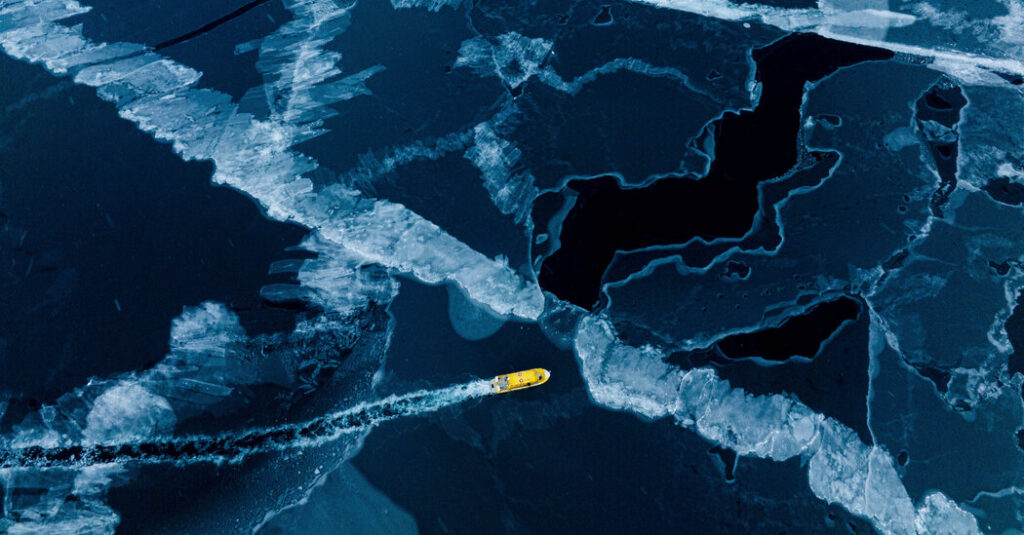
But climate change is also opening up a new shipping route along the Northern Sea. China is keen to exploit that route, as it would shorten trade to Europe significantly. Beijing calls it “Polar Silk Road,” a shipping corridor that passes through Russia’s northern coast and is open only a few months of the year.
Environmentalists warn of grave ecological risks from increased shipping, including from the black carbon that’s produced by the heavy fuel oil that powers ships.
The prospect of a new and faster shipping route has spurred a race to build icebreakers. Russia has the largest fleet, followed by a number of NATO members, including Canada, Finland and Sweden.
Mr. Conger, the former Pentagon official, said that made it all the more worthwhile for Washington to strengthen its ties with NATO rather than pick a fight over Greenland with a NATO ally like Denmark.
“The United States gains strength from being a part of NATO,” Mr. Conger said. “It has allies with capability.”
Somini Sengupta is the international climate reporter on the Times climate team.
The post Why Greenland Matters for a Warming World appeared first on New York Times.