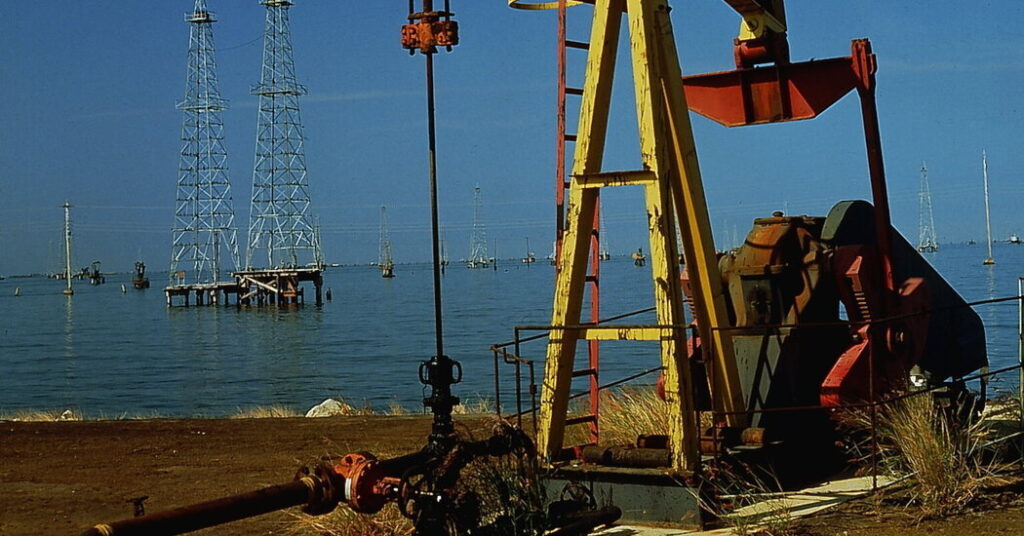
It was the 1970s, and Venezuela was awash in oil money. A lavish metro system was being dug out of the soil in Caracas, fit with air conditioning. Skyscrapers were rising in the capital and other cities as foreign companies sought to muscle their way into a bonanza. ¡’Tá barato, dame dos! was the catchphrase of the time: “It’s cheap. Give me two.”
Not everyone thought the boom would last, but the man who put it best may have been Juan Pablo Pérez Alfonzo, a former Venezuelan oil minister. He predicted a collapse — all because of the bonanza. “Ten years from now, 20 years from now, you will see: Oil will bring us ruin,” he warned. “It is the devil’s excrement. We are drowning in the devil’s excrement.”
Though it took longer than that for these words to come to pass, Venezuela’s ruin was most likely far more spectacular than what Pérez Alfonzo had in mind. Over the course of two decades, the country went from democracy to dictatorship. Its government nationalized foreign-owned assets and began a dangerous sparring match with the United States — only to run out of cash when oil prices crashed. The economy collapsed amid hyperinflation, millions fled on foot and the entire country buckled under rafts of American sanctions.
In the end, Venezuela’s leaders had picked a fight they wouldn’t win. On Jan. 3, President Trump ordered the abduction of Venezuela’s president, Nicolás Maduro, to face trial in the U.S. on drug trafficking charges. Trump vowed that the United States would “run” Venezuela for years to come. And while it is uncertain how this would happen with no American occupying force — Trump has said he wants to govern the country through the threat of military action alone — it is clear that Trump wants a near-personal control of Venezuela’s oil, the world’s largest proven reserves of petroleum.
Venezuela was once a titan among Latin American nations; now Trump has said he wants to turn it into what amounts to a vassal state. Historians will spend decades debating what created such a spectacular collapse. Was it hyperinflation that weakened Venezuela? Was it populists like Hugo Chávez who sought to start a revolution? Or was it America’s new imperialist ambitions?
But what if all these calamities — the dictatorship, the inflation, American warships — came from the same root cause? What if it was the “devil’s excrement” that Alfonzo warned about more than 50 years ago — the oil that was meant to make Venezuela prosper?
The ‘Paradox of Plenty’
I first came to Venezuela in 2016, to take the post of bureau chief at The New York Times’s office in Caracas. It was a time of deep suffering in the country. Shortages of basic foods left families waiting hours in line for coffee and eggs at state-controlled grocery stores. Hospitals had run out of the most basic supplies.
When I asked my predecessor, Willie Neuman, to recommend something to read that might explain the situation, I had expected a biography about Chávez, the populist president who had recently died. Instead, he suggested a book by a Stanford political economist named Terry Lynn Karl called “The Paradox of Plenty.”
Karl’s book begins in 1973, the year that the members of the Organization of Petroleum Exporting Countries, OPEC, managed to set prices for the first time — “bringing about the most radical transfer of wealth ever to occur without a war,” according to Karl. Petroleum prices rose from $3 to $10 a barrel, and would eventually hit $40 by the 1980s. Foreign powers had dominated the world’s oil fields for generations, but that era seemed to be ending. From Mexico to Nigeria, a new set of economies would enjoy stability, prosperity and influence, it was thought.
That’s not what happened. In Nigeria, petroleum’s rapid expansion in the 1960s made the country rich, but it also left its economy almost unrecognizable from what came before. The booming sector began to absorb an outsize slice of the state budget and skilled labor force, while at the same time high oil prices caused Nigeria’s currency to rise in value. Agriculture was the hardest hit. Nigeria exported cocoa, ground nuts and palm oil, but its neighbors could no longer afford to buy them because of its pricey currency.
It wasn’t just Nigeria that was feeling its economy become distorted this way: Far-flung countries like Algeria, Indonesia and the Netherlands each saw similar trends after oil and gas discoveries, leaving economists calling the trend the “Dutch Disease” to this day. “Just as gold had once tainted King Midas’ life, oil seemed to ‘petrolize’ the economy and polity of these countries,” Karl wrote.
The bonanza created easy government windfalls for oil-producing states that proved toxic for politics. In 1979, the Shah of Iran was overthrown by a revolution, and an Islamist regime was swept into power. The Shah’s oil money had allowed him to run the country as a personal fief. Iran’s new leaders, swept into power by resentment against the Shah, ended up following a repressive path as well. In a state able to fund itself largely without taxes paid by citizens, neither regime was ever incentivized to obey Iranians that didn’t support them. The same was soon the norm in other oil-rich states.
Chávez Takes Control
Venezuela would suffer from both the political and economic aspects of the oil curse. The country had been a poor backwater until the discovery of a major gusher in 1922 — meaning that while Venezuela would eventually see riches, the manufacturing and industrial development that occurred in other Latin American nations was driven in Venezuela by state-led projects fueled by oil rents. While by the 1960s, Venezuela stood out as a democracy in the region, declines in oil prices destabilized the country — like in 1989, when falling oil prices earlier that decade led to government cuts, protests and a deadly crackdown, events known today as the “Caracazo.”
In 1992, a young army officer named Hugo Chávez led a coup attempt. After a stint in prison, Chávez ran for president on a populist platform in 1998, capitalizing on the anger of many Venezuelans that their government had spent decades ignoring their concerns. In office, Chávez began an ambitious series of social programs aimed at improving the lives of the poor, underwritten by a spike in oil prices which rose from around $10 a barrel during his first years and to record highs of nearly $150 in 2008.
The petroleum industry had left decades of ties between Venezuela and the U.S. — chains like McDonald’s and Burger King were staples in Venezuela, and baseball, not soccer, is still the national pastime. But Chávez began to ally with Cuba, sending oil there in exchange for Cuban assistance, and famously said the podium “smells like sulfur” after George W. Bush spoke at the United Nations. Chávez also said American companies were to blame for exploiting the country’s natural resources. In 2007, he expropriated billions of dollars of assets belonging to Exxon Mobil and ConocoPhillips after the companies refused to accept reduced stakes in ventures they once controlled.
Chávez was a deeply popular president not just because of the nationalist emotions he stirred, but because of the fact that he had more money to lavish on voters than anyone who opposed him. “Populists often burn out naturally, but Chávez had a continually expanding budget,” said David Smilde, a sociology professor at Tulane University who studies Venezuela.
But in 2013, Chávez died of an illness leaving Maduro as his successor. The next year, the price of oil began to suffer catastrophic declines, going from over $100 a barrel in 2014, to around $30 a barrel by 2016. Venezuela’s economy, hollowed out by the so-called Dutch Disease, collapsed: It no longer manufactured many of the most basic items, and it couldn’t afford to import them from abroad anymore. Years of price controls meant it was more expensive to produce many items than to sell them. Toilet paper disappeared from shelves. Eggs were no longer available — not because there were no chickens, but because there wasn’t enough chicken feed or egg cartons.
In many ways, it seemed the oil curse had truly come to roost as economic declines set off political instability — a downward spiral from which the country seemed unable to recover. Maduro inherited a presidency whose power had greatly expanded during the oil boom, but he quickly became unpopular because he lacked resources with which to govern. In 2017, he superseded the opposition-controlled congress with a group of loyalists charged with rewriting the constitution. He violently cracked down on protesters and jailed political opponents.
In 2024, after banning his opponent María Corina Machado from running against him, he declared himself winner of an election that outside observers insisted he lost. The government was hanging on by a thread.
The Curse Continues?
Smilde, the Tulane sociologist, told me he doesn’t use the term “curse” when it comes to oil in Venezuela, but instead sees petroleum as more of a double-edged sword. He said it was important to remember that while oil was linked to economic declines and authoritarianism more recently, in the last century it produced prosperity and contributed to a stable democracy for Venezuela.
But a return to those days anytime soon seems unlikely given Trump’s actions this month. He has thrown his support to Delcy Rodríguez, a longtime Maduro stalwart, as the country’s interim president. During Trump’s news conference announcing Maduro’s capture, the president sidestepped discussion about democracy in Venezuela to air grievances and promote U.S. oil firms re-entering the country. “We want it back. They took our oil rights,” he said.
It’s not clear who would want to invest in Venezuela at this moment of uncertainty. Exxon, having been burned before by Venezuela’s government, called the country “uninvestable” this month. There are many other places to produce oil that are more stable than Venezuela, including its neighbor Guyana. And every barrel of petroleum that leaves the country lowers prices worldwide — including those in the U.S., which became a net oil-exporter in 2020 largely because of the expansion of fracking in areas that supported Trump.
By intervening in Venezuela and asserting the United States’ right to exploit the country’s oil fields, Trump may now be forced to take some ownership of the country — not just its resources, but its broken politics, too. If oil has cursed Venezuela for decades, will Washington now be able to avoid being touched by the same curse?
Trump, for his part, seems to think he can take the oil without everything that comes along with it. When I asked Karl, the Stanford political economist, what she predicted for Venezuela, she saw a prospect much bleaker than the “paradox of plenty”: A return to the years before OPEC when foreign governments and companies ran oil-producing countries as virtual colonies. Very little might ever be invested to reconstruct the country, simply going to the United States instead.
“In that case, there’s no money to govern Venezuela,” she told me. “I don’t care who you put as a transition, there would be little for them to distribute.”
The post Venezuela Suffers From a Century-Long Curse. Will the U.S. Inherit It? appeared first on New York Times.