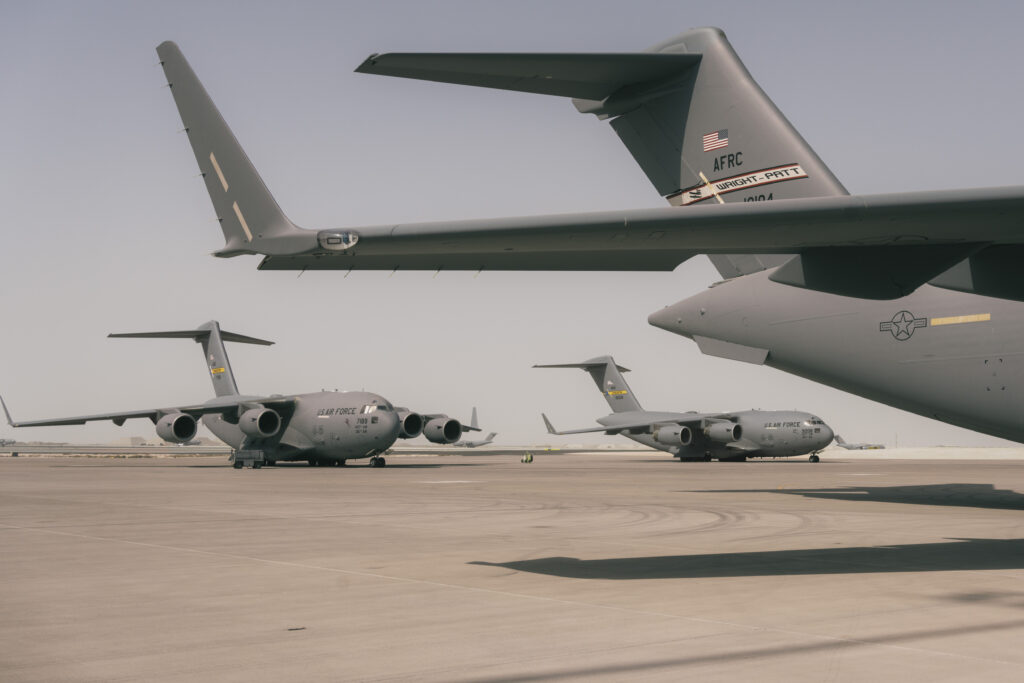
The Pentagon has begun withdrawing some U.S. troops and assets from a key base in Qatar as a precautionary measure while President Donald Trump weighs whether to take military action against Iran, officials said Wednesday.
The partial withdrawal from al-Udeid Air Base occurs as Trump broadcasts his administration’s support for Iranian civilians protesting the country’s leadership. The regime in Tehran has directed a brutal crackdown in response to the uprising, leaving potentially thousands dead. The exact death toll has been difficult to ascertain because the government has severed most means of outside communications.
Trump has warned that Iranian leaders “will pay a big price” for the deadly chaos engulfing the Islamic republic, declaring on social media this week that “HELP IS ON ITS WAY.”
The U.S. military uses al-Udeid Air Base to stage bombers, tanker aircraft, fighter jets, surveillance planes and drones. It was not immediately clear what specific assets were being removed from al-Udeid or what the Pentagon was moving into the region to assist in any operation targeting Iran.
In a statement posted on social media, the government of Qatar said the reduction in U.S. personnel and equipment was a necessary response to “the current regional tensions.” Two U.S. officials confirmed the movements, speaking like others on the condition of anonymity to discuss sensitive security matters.
Earlier Wednesday, the U.S. Embassy in Qatar sent an emergency notice to American citizens in the country urging them to register for mobile notifications, a person briefed on the matter said. The militaries of surrounding Persian Gulf nations also are on alert, this person said.
Tehran recently communicated to Doha that it will retaliate against Qatar if the United States strikes Iran, said a senior official. Iran conveyed that al-Udeid Air Base would be a primary target, the official said, a warning that underscores the threat to U.S. service members there.
U.S. Central Command, which oversees military activity throughout the Middle East, declined to comment on the developments.
The move to withdraw some forces is similar to protective measures the U.S. took ahead of its massive attack on Iran’s nuclear sites over the summer. Shortly after that operation, Tehran launched more than a dozen short- and medium-range ballistic missiles at al-Udeid. While most American personnel had been temporarily moved from the base, a U.S. Patriot air defense battery shot down almost all of the incoming missiles.
A person familiar with the situation said that handling an expected military response from Iran — if Trump does order strikes — has become a major consideration. “The issue is not the ability to strike targets, but managing and neutralizing the counterstrike,” this person said. Israel, a likely Iranian target, shares that concern, he added.
The U.S. has not had an aircraft carrier in the Middle East since Defense Secretary Pete Hegseth directed a surge of naval forces to the waters off Latin America, where they have participated in the military’s ongoing campaign to kill suspected drug smugglers and the dramatic capture of Venezuelan President Nicolás Maduro.
If the violence in Iran mushrooms into a larger military conflict, there is no quick option for the U.S. to get an aircraft carrier back to the region as a protective measure for American personnel and facilities there. There are three carriers currently deployed; the USS George Washington is in port in Japan, the Abraham Lincoln is in the South China Sea and the Gerald R. Ford is in the Caribbean.
The Ford, the Navy’s most advanced carrier, is near the end of its scheduled deployment. While it could be extended and sent back to the Mediterranean, where it was operating before November, the ship and its accompanying destroyers are in need of maintenance, Chief of Naval Operations Adm. Daryl Caudle told reporters at an event in Washington on Wednesday.
“If it requires an extension, it’s going to get some pushback from the CNO,” Caudle said, referring to the abbreviation for his title. “Let’s see if there’s something else I can do.”
Senior Trump administration officials met at the White House on Tuesday to weigh options. Vice President JD Vance led a National Security Council meeting, which was followed by an Oval Office session involving Trump. At the latter session, CIA Director John Ratcliffe showed the president clandestinely acquired videos of Iranian protesters being hanged by the regime and of protesters’ bodies on Iranian streets, as well as information on estimated death counts, one of the people familiar with the matter said.
The protests have generally subsided, one foreign diplomat in Iran told The Washington Post on Wednesday. “On the surface, everything is back to square one, except that there are security forces all over the town,” the diplomat said.
“I cannot believe that only a few days ago people were taking to the streets. This speaks to the severity of the crackdown by the regime. The fear factor has gained the upper hand over people’s urge and desire for change,” the diplomat said.
The diplomat said that Islamic Revolutionary Guard Corps military assets are not deployed. Rather, he said, “it is basically the security forces and the Basij,” an IRGC militia, that are mostly conducting the crackdown. “The IRGC is extremely stable and strong — no cracking, let alone defection,” the diplomat said. “Control over the system is kept tight. It is difficult to assess at this point whether the latest uprising was only a prelude to another big wave, or ‘the end’ of the story.’’
The diplomat said he expects the protests will not end, though, because the underlying cause, Iran’s economic collapse, is still there and worsening. “I would guess the silent majority are hoping for and would welcome a U.S. intervention,” he said.
Dan Lamothe and Susannah George contributed to this report.
The post U.S. withdraws some forces from Middle East as Trump weighs Iran strikes appeared first on Washington Post.