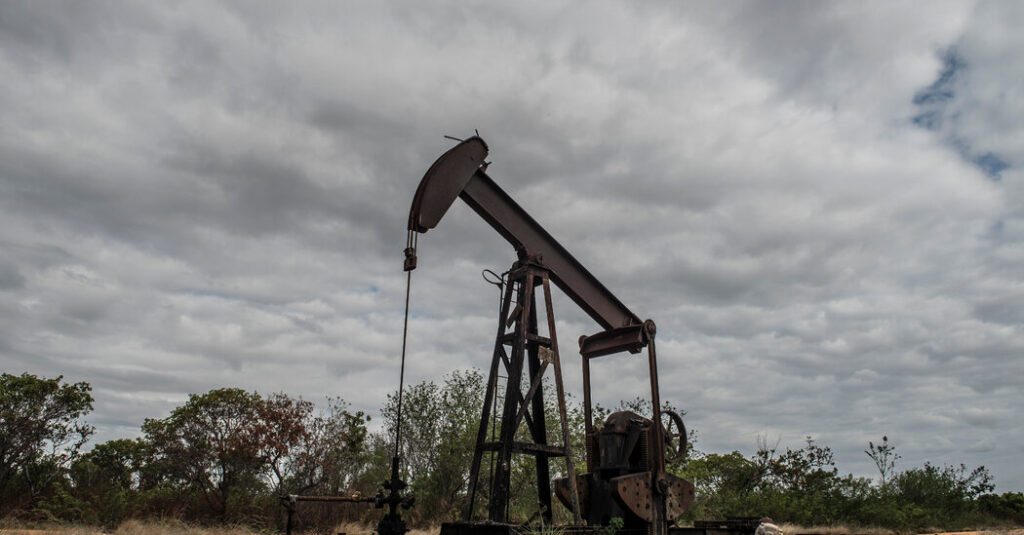
The United States government is brokering the sale of millions of barrels of Venezuelan oil, which have been trapped in the country since the Trump administration started a partial blockade against tankers carrying crude from Venezuela, according to people familiar with the deal.
The U.S. Department of Energy is orchestrating the effort to sell a total of about 50 million barrels of Venezuelan oil that has been stranded since President Trump imposed the partial blockade last month, according to the people, who were not authorized to speak publicly.
“The first sale has already occurred and the sales will continue indefinitely,” a spokesman for the Department of Energy said in a statement in response to questions.
Less than a week after ousting Venezuela’s leader, Mr. Trump announced the broad outlines of an oil sales deal last week but provided few details.
Selling the crude is crucial to stave off the collapse of Venezuela’s oil industry, its main source of revenue. A stabilized economy would give the country’s interim government a chance to meet Washington’s demands to open up Venezuela’s proven oil reserves, the world’s largest, to American investment, the people said.
Mr. Trump’s blockade has wiped out the bulk of the Venezuelan government’s revenues. Unable to sell its oil, the country’s limited oil storage facilities had filled to near capacity.
When U.S. Special Forces captured Mr. Maduro on Jan. 3, Venezuela’s state oil company was days away from shutting down the country’s main crude producing area, a move that would have caused some permanent damage to the oil fields, according to the people.
This assessment is in line with projections made by the Venezuelan government before the American attack. It estimated that the continuation of the blockade would set off a humanitarian crisis, by significantly reducing the government’s ability to import goods and maintain basic services.
Now, Venezuelan businessmen and investors are hoping that the near-bust of their country’s most important industry could turn into an economic boom.
“President Trump brokered a historic energy deal with Venezuela, immediately following the arrest of narco-terrorist Nicolás Maduro, that will benefit the American and Venezuelan people,” a White House spokeswoman, Taylor Rogers, said in response to questions for this article. “President Trump’s team is rapidly facilitating positive, ongoing discussions with oil companies that are ready and willing to make unprecedented investments to restore Venezuela’s oil infrastructure.”
Days after Mr. Maduro’s capture, U.S. officials approached two global commodity trading companies, Trafigura and Vitol, and asked them to execute the sale of trapped Venezuelan oil, according to the people familiar with the deal. Mr. Maduro is currently facing trial in New York on drug trafficking charges.
The two oil trading firms have already paid the Venezuelan government for a significant share of the allocated oil, and by Wednesday had shipped more than four million barrels, according to the people. Much of it has gone to storage facilities located on islands in the Caribbean, including Curacao, Saint Lucia and the Bahamas, though the oil is ultimately expected to end up in U.S. refineries, they added.
It is unclear what legal authority the Trump administration is using to broker oil deals.
“All of these transactions appear to be carried out in a legal vacuum that shields the companies from any type of oversight and accountability,” a prominent Venezuelan economist, Francisco Rodríguez, wrote on X on Wednesday, referring to the oil trading contracts. This makes the processes of bidding and awarding these contracts vulnerable to accusations of corruption, he added.
Venezuela’s communication ministry, which handles requests from news organizations, did not respond to request for comment.
The Trump administration picked Trafigura and Vitol because their size gave them a unique capacity to buy and ship large volumes quickly, the people said.
“At the request of the U.S. government, Trafigura and Vitol are providing logistical and marketing services to facilitate the sale of Venezuelan oil,” Trafigura, which is based in Singapore, said in a statement.
Vitol, based in Switzerland, did not respond to request for comment.
The people familiar with the deal said the traders have paid Venezuela about $50 for each barrel, a market price significantly above the roughly $30 that the country was getting paid for the oil that it previously exported to China in circumvention of American sanctions.
If the deal proves successful, its scope could be expanded beyond the barrels sitting in storage, the people said.
The White House press secretary, Karoline Leavitt, told Fox News on Tuesday that the energy deal with Venezuela was worth $500 billion.
People close to Venezuelan oil industry said she misspoke, and that the actual figure is $500 million, which represents roughly the amount that the oil traders have already paid for Venezuelan oil.
The people familiar with the oil deal said the U.S. and Venezuelan officials are now working to get the money from those sales from an escrow account and into the Venezuelan economy, which has been rattled by the uncertainly caused by Mr. Maduro’s ouster. This likely means loosening some U.S. sanctions on the country, a step that the U.S. Treasury Secretary, Scott Bessent, has said could happen in the coming days.
The government of Venezuela’s interim leader, Delcy Rodríguez, Mr. Maduro’s former vice president who took over with Mr. Trump’s blessing, needs dollars to stave off economic collapse and prop up the country’s national currency, the bolívar.
The bolívar’s value has collapsed since the start of Mr. Trump’s pressure campaign against Mr. Maduro in September, bringing the country close to another bout of hyperinflation and deepening uncertainty in the country
The main proposal considered by U.S. and Venezuelan officials involves re-establishing a financial arrangement pioneered by the U.S. energy giant Chevron, Venezuela’s largest private oil producer, under the Biden administration, according to the people familiar with the deal.
Until March, Chevron funneled the share of revenues it owed the Venezuelan government to the country’s private banks, which then sold the dollars for bolívars to local companies. Those companies used the hard currency to import goods and make investments.
Mr. Trump scrapped that system after returning to office last year, claiming, without providing evidence, that it benefited Mr. Maduro.
Venezuela’s central bank in recent days has been holding meetings with the executives of the country’s private banks to prepare for re-establishing the flow of petrodollars, according to multiple people who have participated in the meetings or have been briefed on their content. They requested anonymity to describe private discussions.
The rapid pace of the U.S.-brokered oil sales has already helped reduce the currency panic in Venezuela in recent days. Tamara Herrera, a prominent Venezuelan economist, expects the gap between the official and the black market dollar exchange rate, the core measure of financial stability, to narrow from more than 110 percent last Friday to about 80 percent by the end of this week.
The people familiar with the oil deal said the government expects to recover the lost production incurred during the blockade in about a month. They said the country’s oil output could grow to 1.5 million per day by the middle of the year, up from 1.2 million in December.
This growth is expected to fuel a wider reactivation of economic activity, said Asdrubal Oliveros, a veteran Venezuelan economist.
He estimates that the Venezuelan economy will grow 10 to 12 percent in 2026, though that large increase masks a low starting point for a country ravaged by years of financial crisis. Before the U.S. attack, most economists had forecast stagnation or a recession in the country this year.
“Recent events have completely changed the economic outlook,” Mr. Oliveros said in a phone interview. “Oil production could fuel a real economic takeoff.”
Tyler Pager contributed reporting from Washington and Rebecca F. Elliott and Christiaan Triebert from New York.
Anatoly Kurmanaev covers Venezuela and its interim government.
The post U.S. Races to Sell Venezuelan Oil, Transforming Ties With Former Foe appeared first on New York Times.