White House Middle East envoy Steve Witkoff on Wednesday announced the long-delayed launch of Phase 2 of President Donald Trump’s 20-point peace plan for Gaza, establishing a committee of Palestinian technocrats to administer the enclave and beginning the “full demilitarization and reconstruction.”
In a social media post, Witkoff said that the Hamas failure to disarm and return the last remaining deceased Israeli hostage from Gaza would bring “serious consequences.” But he provided no details on how those elusive goals would be accomplished or on the membership of the technocratic committee.
In a news conference in Cairo, Egyptian Foreign Minister Badr Abdelatty said consensus has been reached on the composition of the 15-member body. “This will pave the way for deploying this committee to the Gaza Strip to assume responsibility for managing daily life and providing basic services to the steadfast Palestinian people in Gaza,” he said.
A statement by governments involved in negotiating membership of the committee — Egypt, Qatar and Turkey — said it would be headed by Ali Abdel Hamid Shaath, a civil engineer from Gaza who has held senior roles in the Palestinian Authority governing the West Bank. Although other members reportedly also have been chosen, no other names have been publicly confirmed.
“This step constitutes an important development that is expected to contribute to strengthening efforts aimed at consolidating stability and improving humanitarian conditions in the Gaza Strip,” the mediators’ statement said.
Israel and Hamas have agreed to a full list of members, said a former Egyptian official familiar with the discussions, who spoke on the condition of anonymity to discuss sensitive diplomacy.
In a statement to The Washington Post, Taher El-Nounou, a senior Hamas official, welcomed establishment of the committee, saying it was “scheduled to begin its work in the coming days, as part of the committee members are already in the Strip, while another part, who are from Gaza, are outside.”
“We will facilitate all efforts for it to take over its responsibilities in all ministries, all different administrations and all matters related to public affairs without exception,” he said. “All governmental and official functions will be transferred to the committee, including the Ministry of Interior with all its components, and certainly security is part of these tasks.”
With the formation of the committee, the two most immediate problems remaining are “Hamas arms and Israeli withdrawal,” the former Egyptian official said. “We don’t know how President Trump is going to solve” them.
Trump’s plan, first released at the end of September, called for an immediate ceasefire, the return by Hamas of all living and dead hostages, the release by Israel of 1,700 Palestinian prisoners and resumption of “full [humanitarian] aid to Gaza.”
Under the second phase, which includes the complete Israeli withdrawal from Gaza and the reconstruction of the destroyed enclave, all aspects of the plan are to be supervised by a Board of Peace, comprising yet-unnamed heads of state from various stakeholder governments in the Middle East and Europe and headed by Trump.
Bulgarian diplomat Nickolay Mladenov, a former U.N. coordinator for the Middle East peace process, is to serve as director general of the board, but its membership is now not expected to be announced until next week at the earliest. Security on the ground in Gaza is to be provided by an International Stability Force, although no country has yet publicly committed forces to participate.
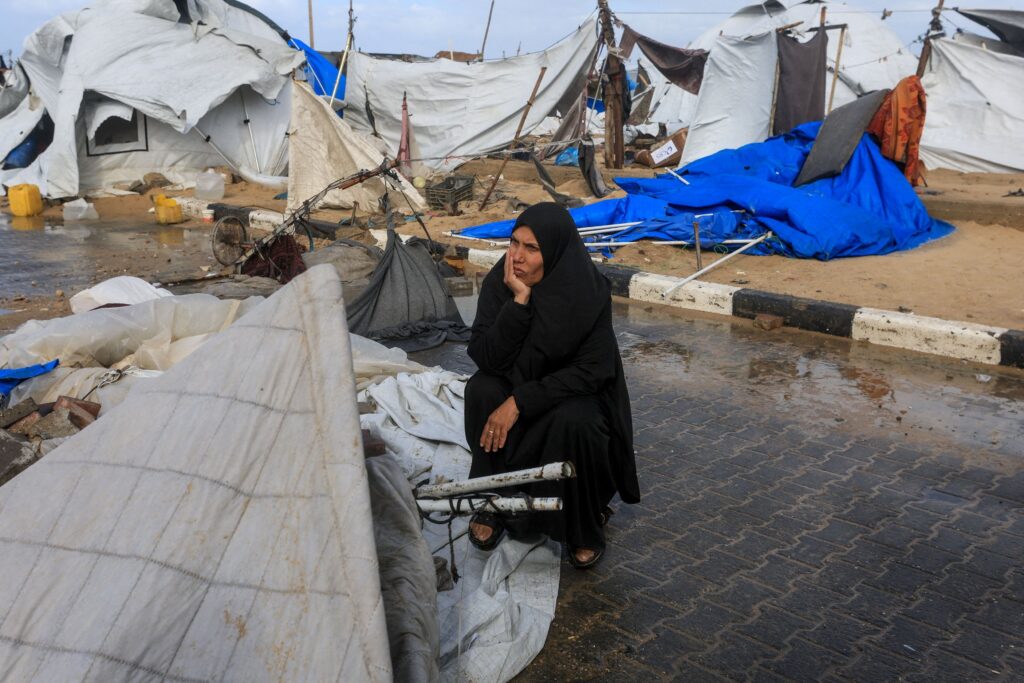
After the initial ceasefire in October and release of hostages, the situation in Gaza has been largely in stasis, with some improvement in humanitarian aid deliveries but a number of Israeli restrictions still in place. Israeli military forces remain stationed in more than half the enclave, where they have been carrying out demolitions of homes and buildings. In the roughly half still largely run by Hamas, Israel has launched regular air attacks against what it says are terrorist militants.
Trump’s son-in-law, Jared Kushner, has been heading an effort to begin reconstruction in areas still controlled by Israel, as well as a new aid distribution system, according to people familiar with that situation who spoke on the condition of anonymity about sensitive negotiations.
Those efforts have run into opposition from Arab partners, including Egypt. In his Wednesday news conference, Abdelatty reaffirmed Egypt’s “red lines regarding the Palestinian cause,” saying that what are now two halves of the enclave must be rejoined. “The issue of dividing the Gaza Strip … is something we cannot accept,” Abdelatty said.
“Accordingly, everything that will take place in the Gaza Strip — whether related to the deployment of the administrative committee, recovery programs or reconstruction — must be implemented across all parts of the Strip,” he added. Egypt wants to see Israeli forces withdraw in accordance with Phase 2 as outlined in the Trump plan.
Those principles were echoed in a statement by the Palestinian factions meeting Wednesday in Cairo to finalize the committee. The statement affirmed “the factions’ full commitment to continuing the implementation of the ceasefire agreement and the remaining stages of President Trump’s plan.” It called on the Board of Peace and mediating countries to pressure Israel to stop its attacks on Palestinians, open border crossings, allow more aid into the Gaza Strip and withdraw its army from the enclave.
The statement, forwarded to journalists by Egypt’s government press center in Cairo, did not specify which factions had signed on; the press center did not immediately provide clarity.
The post U.S. announces launch of second phase of Gaza peace plan appeared first on Washington Post.