President Trump said on Wednesday that the Iranian government appeared to have stopped killing protesters, though he did not say what that might mean for the possibility of U.S. military action against the country.
“We’ve been told that the killing in Iran is stopping — it’s stopped — it’s stopping,” he told reporters at the White House. “And there’s no plan for executions, or an execution, or execution — so I’ve been told that on good authority.”
Mr. Trump said that he had received the information from “very important sources on the other side” and that he would “find out” later if it was accurate. He did not disclose who had provided the account.
A day earlier, Mr. Trump signaled that he was leaning toward a military strike on Iran when he wrote on social media that the protesters, whom he called “Iranian patriots,” should keep up the demonstrations and that “HELP IS ON ITS WAY.”
Since Jan. 2, Mr. Trump has said he will attack Iran if the government harms protesters. Iranian security forces have cracked down on protesters for days, including by using lethal gunfire, killing hundreds or thousands of civilians, according to human rights groups and Iranian officials.
The Iranian government has cut off internet service across the country, and it was difficult on Wednesday to gauge to what degree the killings were still occurring. The protests appear to be smaller than they were last week.
When asked on Wednesday whether military action was now off the table, Mr. Trump said, “We’re going to watch and see what the process is, but we were given a very good statement by people that are aware of what’s going on.” He did not say what the statement said or who the people were.
Mr. Trump’s remarks could be interpreted as taking a step back from any imminent plans for attack. But in June, right before the U.S. military conducted airstrikes on three nuclear sites in Iran, Mr. Trump issued a statement that said he would make a decision “within the next two weeks.” In reality, he had largely made up his mind by then to strike.
Iran announced that it was closing air space across the country to commercial flights, according to a notice on Wednesday evening on the website of the Federal Aviation Administration.
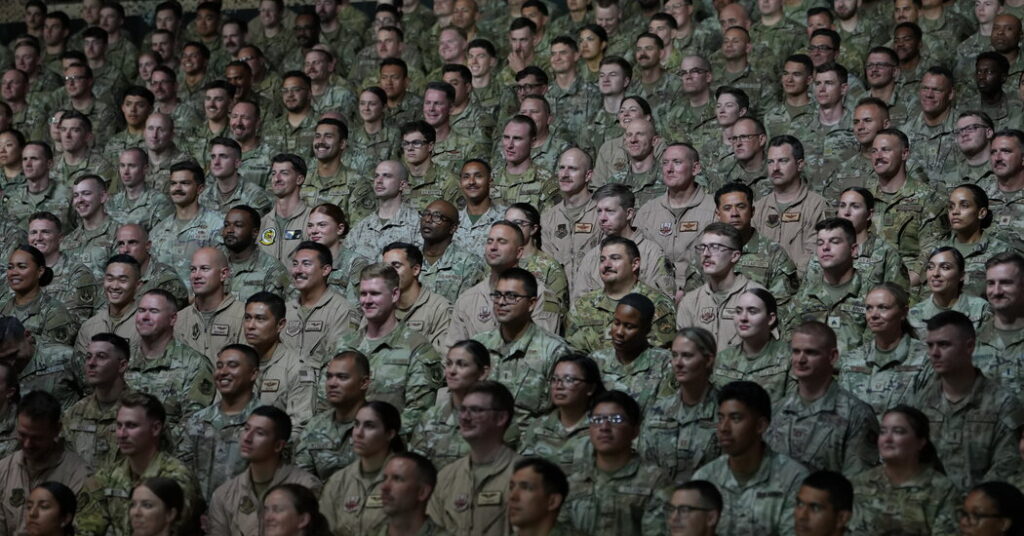
In Qatar, a tiny nation in the Persian Gulf, the U.S. military began evacuating an unspecified number of nonessential personnel from Al Udeid Air Base because of the rising tension, according to two U.S. military officials who spoke on the condition of anonymity to discuss operational matters. The Pentagon’s Central Command declined to comment.
But after Mr. Trump’s remarks on Wednesday afternoon, the Pentagon was ready to have troops return to the base, said a U.S. military official, who described the president’s comments as “an off-ramp.”
Long-range bombers in the United States had been put on alert to conduct secondary strikes if needed, but that appeared to have been paused as of Wednesday afternoon, another U.S. official said.
Britain is also withdrawing some of its military personnel at the base in Qatar, said a person briefed on the decision who spoke on the condition of anonymity to discuss operational matters. The British Defense Ministry declined to comment.
If Mr. Trump orders military strikes against Iran, his options are somewhat limited. Last fall, the Pentagon sent the carrier Gerald R. Ford and other escort warships from the eastern Mediterranean to the Caribbean.
Even so, the Navy has three missile-firing destroyers in the Middle East region now, including the Roosevelt, which in recent days has steamed into the Red Sea, military officials said on Wednesday. The Navy also has at least one missile-firing submarine in the region, Pentagon officials said.
The Pentagon has presented a wide range of options to Mr. Trump. Possible targets for a strike include Iran’s nuclear program, going beyond the U.S. airstrikes that battered it in June, and ballistic missile sites, American officials have said.
But other options, such as a cyberattack or a strike against Iran’s domestic security apparatus, which is using lethal force against protesters, were more likely, the officials have said. Any attack is at least several days away, and could prompt a vigorous retaliation from Iran, officials said.
After the U.S. attack on three Iranian nuclear sites last June, Iran retaliated by firing missiles at Al Udeid, the biggest U.S. base in the Middle East. The base serves as the regional headquarters for the U.S. Central Command, and about 10,000 troops are stationed there.
U.S. intelligence has assessed that if the United States were to conduct a military strike against Iran, Tehran would retaliate by again attacking military bases in the region, according to U.S. officials briefed on the intelligence.
That assessment was discussed at the White House on Tuesday evening, according to an official briefed on the discussion. American spy agencies believe that in addition to the base in Qatar, Iran could possibly strike at U.S. forces stationed at bases in Syria and Iraq, one of those officials said.
The intelligence assessment is of little surprise. Iranian officials have publicly said they will retaliate against any American strike conducted in support of the protesters.
“The President of the United States, who repeatedly speaks about the unsuccessful attack on Iran’s nuclear facilities, would do better to also mention the Iranian missiles that crushed the U.S. Al-Udeid base,” Ali Shamkhani, a senior Iranian official and adviser to Iran’s supreme leader, said in a social media post on Wednesday. “This would certainly help create a more realistic understanding of Iran’s will and capability to respond to any aggression.”
American officials have said that the Iranian protests are the most significant since the 1979 revolution and a threat to the government. But it is not clear which side — the government or the protesters — has the upper hand, officials said.
A senior Iranian health ministry official, speaking on the condition of anonymity, told The New York Times on Monday that about 3,000 people had been killed across the country. The official said “terrorists” had fomented unrest, and asserted that hundreds of security officers had been killed.
Another Iranian official, also speaking on the condition of anonymity, said he had seen an internal report that referred to at least 3,000 dead. The toll could climb, said the official and human rights groups outside Iran.
Farnaz Fassihi, Julian E. Barnes and Christiaan Triebert contributed reporting.
Edward Wong reports on global affairs, U.S. foreign policy and the State Department for The Times.
The post Trump Says Iran Is Stopping Its Killings of Protesters as U.S. Moves Troops appeared first on New York Times.