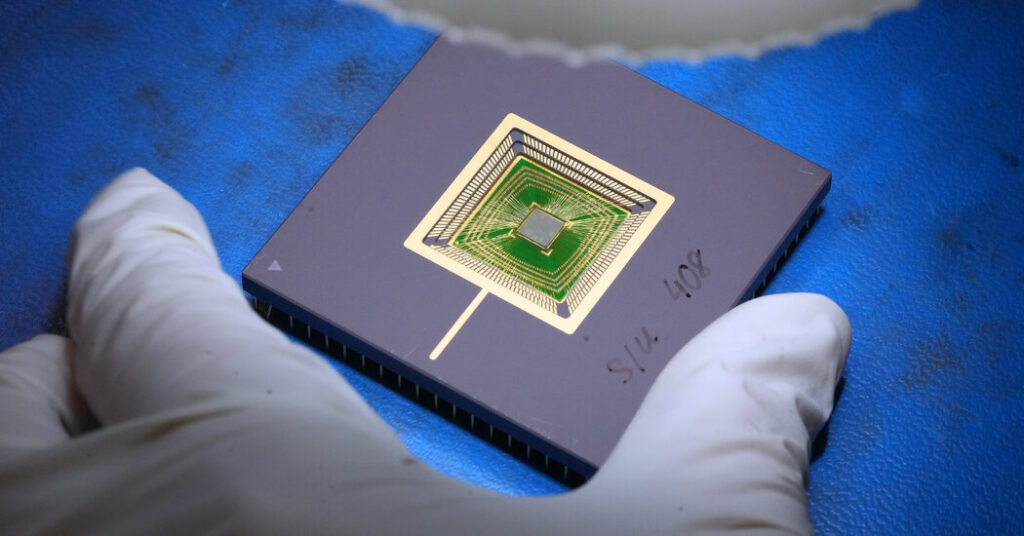
President Trump signed a proclamation on Wednesday to impose a 25 percent tariff on a narrow list of foreign semiconductors, providing a way for the government to earn revenue off the sale of lucrative chips used in artificial intelligence.
The tariff, which would take effect Thursday, is far more limited than what the president initially threatened. Last year, the administration began an investigation aimed at encouraging tech companies and chip makers to buy semiconductors made in America. But instead of approving sweeping tariffs that would affect the industry, Wednesday’s announcement showed the administration has settled for narrower levies that allow it to take a cut of artificial intelligence chips sold to China.
A document released by the White House said a 25 percent tariff would be put on A.I. chips made by companies like Nvidia and AMD that are imported into the United States and then re-exported to other countries. The tariff would not apply to semiconductors that are brought into the country to be used domestically in data centers or in products for American consumers, industry or the government. But it would allow the U.S. government to collect revenue from the sale of A.I. chips to China, an idea Mr. Trump proposed last year.
The president may still impose broader tariffs on semiconductor imports and products containing them in the near future, the White House said, including a program that would provide tariff relief for companies that manufacture chips domestically.
For now, though, the arrangement will very likely be welcomed by major chip companies that have lobbied fiercely to limit the scope of any tariffs. Most chip companies manufacture the bulk of their products in Taiwan or East Asia, where many of the world’s electronics are made, and only ship them into the United States if they are to be used domestically.
Mr. Trump threatened last August to impose a 100 percent tariff on foreign semiconductors unless manufacturers committed to invest in the United States. But chip tariffs had the potential to rankle foreign governments, as well as many of the tech companies that have grown close with the president. The administration has been particularly cautious of disrupting a trade truce that it reached last year with China, a major manufacturer of semiconductors.
The announcement Wednesday avoided any such impacts, while also allowing Mr. Trump to realize his plans to take a 25 percent cut of the revenue that Nvidia, the A.I. chip giant, will make from selling advanced chips to China.
Mr. Trump first floated the plan last August but was forbidden by U.S. law from taxing exports or export licenses. So administration officials proposed a circuitous solution where they would bring Nvidia chips manufactured in Asia into the United States and impose a 25 percent tariff on the imported chip, before re-exporting the products to China.
On Tuesday, the Department of Commerce issued a rule to permit the sale of a more advanced A.I. chip made by Nvidia, the H200, to China. Mr. Trump had banned the sale of those chips last year out of national security concerns, but abruptly reversed himself after Nvidia argued that exporting the chips was important for American global technology leadership. Nvidia’s chief executive, Jensen Huang, has become one of Mr. Trump’s closest allies in the tech world.
Mr. Trump started the chips inquiry under a national security-related law known as Section 232, which he has used to apply tariffs to other sectors, including a 50 percent tariff on all steel imports and a 25 percent tariff on all imported cars.
The White House also said Wednesday that it had concluded a Section 232 investigation into critical minerals, including lithium, gallium, germanium, cobalt and nickel. An executive order said the administration would refrain from putting tariffs on the sector for now.
Instead, the order directed officials to negotiate trade agreements that would provide the United States more access to critical minerals, which are used in things ranging from cars to airplanes to A.I. data centers. The United States is heavily reliant on other countries — including China — for those minerals.
Some analysts have questioned whether the Trump administration is backing away from heftier tariffs amid rising concerns among Americans about affordability. High prices were a key issue that helped propel Democrats to electoral wins in November. In an economic speech on Tuesday, Mr. Trump called affordability a “fake word by Democrats” but also detailed various steps his administration had taken to lower prices.
Because semiconductors are in almost everything with an on-off switch, chip companies had warned the administration that more expansive tariffs could lead to widespread price increases across the American economy.
Others have told the administration that a 25 percent surcharge on the machinery they need to manufacture chips, which can cost tens or hundreds of millions of dollars, would make semiconductor factories in the United States unviable.
Last year, the United States imported roughly $45 billion in semiconductor chips, primarily from Taiwan and Malaysia, according to Bernstein Research.
Mr. Trump had said companies that have committed to building in the United States wouldn’t pay tariffs, and Commerce Department employees have been working on an arrangement that would offer tariff exemptions to companies that invest domestically. Last year, the chief executives of Apple, Nvidia and Taiwan Semiconductor Manufacturing Company, the world’s largest semiconductor manufacturer, pledged more than $1 trillion in U.S. investments as they have sought to avoid fees.
Semiconductor companies have been forced to accept uncertainty under Mr. Trump. Since returning to office, he has threatened to take away government grants, restricted chip sales to China, demanded investments and he recommended that one company, Intel, fire its chief executive.
The intrusions have paralyzed an industry that less than a year earlier had signed contracts with the Biden administration to release tens of billions of dollars in subsidies to build factories. Mr. Trump immediately put the industry on edge by criticizing those programs as wasteful, and had his staff ask firms for more investments before releasing the money.
But Mr. Trump has also seemed attuned to the concerns of tech C.E.O.s, particularly Mr. Huang and Apple’s chief executive, Tim Cook. Last April, the administration gave the technology industry a lucrative carve-out from its global tariffs, saying that electronics would soon be subject to other tariffs under Section 232. No other industry has received such a broad exemption.
Ana Swanson covers trade and international economics for The Times and is based in Washington. She has been a journalist for more than a decade.
The post Trump Imposes Limited Tariffs on Foreign Semiconductors appeared first on New York Times.