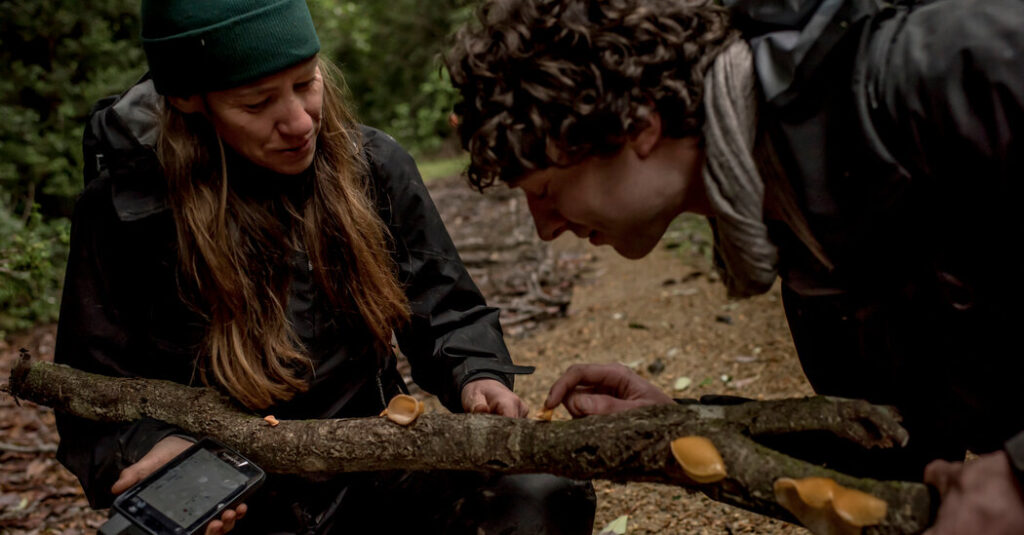
On Tuesday, the Tyler Prize for Environmental Achievement, sometimes described as the “green Nobel Prize,” was awarded to Toby Kiers, an evolutionary biologist at Vrije University Amsterdam who has spent the past three decades studying the workings and significance of the soil’s circulatory system.
Last year, Dr. Kiers won a MacArthur “genius” award, as well as the Climate Breakthrough Award, sharing it with Giuliana Furci, a fungi conservationist, and Merlin Sheldrake, a mycologist at the University of Oxford.
The fungal kingdom, which stands apart from plants and animals, contains anywhere from two million to five million species, including yeasts, mildew, lichens and mushrooms. Dr. Kiers studies mycorrhizal fungi, microbes that form vast, underground networks with carbon drawn from the roots of plants and trees, providing vital nutrients in exchange.
Dr. Kiers and her colleagues have calculated that these microbial filaments, laid end to end, would span half the galaxy and that they sequester 13 billion tons of atmospheric carbon dioxide — one-third of the world’s fossil-fuel emissions — in the soil each year.
These brainless, distributed organisms are also astonishingly strategic in their business dealings, her team has shown, imposing tariffs and inflating prices. In 2021, Dr. Kiers founded the Society for the Protection of Underground Networks, or SPUN, a global network of researchers and “underground explorers” that works to identify and protect hot spots of fungal diversity. Last year they unveiled the first ever global underground atlas. And a new initiative called Underground Advocates, developed with the More-Than-Human Life program at the New York University School of Law, helps train scientists in legal and policy skills.
In a recent video call, Dr. Kiers kvelled over her subjects and their “incredible moment” in the sun.
“OK, can we take a deep breath here for a second?” she said. “Fungi are usually the underdogs. The awards feel like an award for the invisible, the parts of the world that are challenging to understand, and a celebration of decentralized ways of thinking and operating that fungi have mastered.”
This conversation has been edited for clarity and brevity.
Why fungi?
These underground ecosystems play a crucial role in regulating the climate. Soils store about 75 percent of Earth’s terrestrial carbon and contain close to 60 percent of Earth’s biodiversity.
Mycorrhizal fungi form the basis of food chains for those aboveground organisms, which together generate more soil and nutrients. They draw carbon from plants and get it to stick to minerals underground, where it’s hard to release back into the atmosphere.
The vast majority of crops form partnerships with mycorrhizal fungi and rely on them for their nutrients. Some beautiful experiments have shown that when plants interact with mycorrhizal fungi, they make bigger, sweeter flowers, which attract more pollinators.
These fungi also hold soil together; their bodies are woven into the aggregate and produce sticky chemicals that are hard to break down. Take away that scaffolding and soils would erode and disappear.
People think they know what soil and dirt is. With high-resolution imaging, we’re starting to make it visible and show that it’s alive. These are ecosystems, with as much complexity as what’s happening aboveground. I think 2026 is really going to be the year where people start talking about fungal restoration. It’s not enough to just add native plants to restore ecosystems; it has to be native plants together with native fungi.
How do you pronounce “fungi”? Is it “fun-guy,” or “fun-jai,” or “fun-jee,” or “fun-ghee”?
I’m all over the place. I’ll start a sentence with “fun-jee” and by the end I’ll say “fun-ghee.” There’s no wrong answer!
How did you and fungi meet?
When I was 19, I became so enchanted by the idea of being a field biologist that I left college, not knowing if I’d come back, and spent a year at the Smithsonian Tropical Research Institute, a research station on an island in the middle of the Panama Canal.
I needed a niche. At the time, mycorrhizal fungi were pretty unknown there. The older scientists were studying everything aboveground — trees, bats, primates. I started wondering what generated all that diversity. So I did an experiment with researchers where we took soil from underneath the trees of one species and used it to inoculate other tree seedlings to see if it would affect their growth.
We stained the roots with a dye, and you could see this intricate weave of fungi inside the cells — they penetrate it — called an arbuscule; it looks like a mini tree. That’s where nutrient exchange happens. And I could see that happening in the roots with my own eyes.
For a long time, mycorrhizal fungi were viewed as pathogens, right?
I was there as the perception was starting to change. Studies were starting to show that plants actually get huge benefits from fungi.
Later, I realized that they’re powerful actors in their own right. My Ph.D. thesis explored whether noncognitive organisms can discriminate between good and bad partners. For instance, from experiments, we know that plants will digest one of those arbuscules if they’re not getting enough phosphorus from the fungus; they can abort the interaction.
But the fungi make choices as well. We found that a fungus can avoid trading with plants in the shade, which have less carbon to trade. They trade differently depending on how many other fungal competitors are present. They can hoard resources in their network and artificially inflate the price.
Trade wars! So a fungus is a bit like a stockbroker or merchant.
Exactly. We’ve been studying fungal trade as an underground market and developing techniques to track, in real time, when and where important exchange deals take place, how fungi navigate space, how they decide when and how much carbon to send down each pathway, how they build their road systems and how they optimize that supply-chain design.
Are fungi capitalists? No. They’ve developed a system that is much more sophisticated than the economic system humans use. But it has allowed us to use economics as a mathematical framework to analyze these trade strategies, to make predictions and to see if the fungi follow them. The frontier is linking what we’re seeing on the micron scale to the global data to understand the role of fungi in the carbon cycle.
Meanwhile, in SPUN, you’ve built a worldwide network of investigators to map the global distribution of networked microorganisms.
We wanted to turn the traditional approach on its head. SPUN has become a rambunctious, decentralized community of people working together to study and protect underground fungi. We’re slightly outside academia while still adhering to rigorous science and publishing in top journals.
In 2022, we set up the Underground Explorers Program. It’s a network of researchers who are dedicated to mapping fungal biodiversity in their local ecosystems. We’ve given away 137 grants across 58 countries, 80 percent of them to researchers in the global south and more than half led by women. It’s a fungi-without-borders approach. For these scientists, climate change is not an option to care or not care about; it’s their survival, their livelihoods, with consequences that their children will inherit.
There’s a researcher in Mongolia who is trying to map and protect fungal communities that are threatened by desertification — fungi that hold the grass down and enable nomadic herders to continue grazing their animals. In Nigeria, a scientist named Bolaji Thanni is studying the effects of textile effluents on soil health to help advocate for stricter waste disposal regulations and the use of eco-friendly dyes. In Mexico, there’s a professional climber who is mapping mycorrhizal fungi along cliffs — which is just so unknown, right?
We’re a really scrappy organization. We’re super lean and mean; we don’t even have an office. We are everywhere and nowhere. That really helps us. In an academic setting, you almost have to know what you’re going to find before you’re funded to find it.
I use the term “punk science.” We’re trying to cross boundaries and disciplines and not accept the state of the world as a given, while celebrating science that is rooted in creativity.
You’re the youngest woman to win the Tyler Prize, among recipients who have included Jane Goodall. But the road hasn’t been easy. In an essay in The Times in 2024, you described a startling moment early in your career: As you sat, visibly pregnant, in the front row of a departmental meeting, a senior member announced that pregnant women were a financial drain on the department. Later, in what you describe as “an act of academic defiance,” you made a point of taking your young children with you on field expeditions. Did that change how you work?
That was very hard to hear, not only for me but for other women in the audience who were thinking about sometime having kids and not necessarily thinking, ‘Oh, do I have to make a choice between being a scientist and being a parent?’
Bringing my kids into the field really forced a sort of humanity into my work. It’s this idea of bringing your full self to your science: showing the world that good science doesn’t require detachment, that we can expose our vulnerabilities, that we fail and that failure should be celebrated.
Fungi and children both require an incredible amount of patience. And that’s what science demands — patience, but also just awe. I’m getting goose bumps saying that because I believe it so firmly. With fungi and with children, too, we discover something every single day.
Barbara McClintock, the pioneering geneticist, famously described the importance of having “a feeling for the organism” — an intuitive connection to her subject born of long, close study. Do you have a feeling for mycorrhizal fungi?
Of course! I’ve been working with them so closely for so long. In the lab, you can lift a petri plate, and because fungi are so sensitive to the environment, just by blowing on it you can speed up or slow down the flow patterns inside it. You can’t help but feel a connection with it.
In the field it’s a different kind of intimacy. You don’t see the organism, but every time you go to put that core sampler in the earth, there’s this moment where you pause and think about all that you’re about to discover. I can almost hear the fungi saying, “Pick me, pick me!” I mean, the core could go anywhere, but you get to this one spot and whatever comes out is what’s going to characterize and represent this landscape. You’re bringing these fungi to life, and that’s a very intimate process.
Do you ever feel that in some ways you’re becoming a mycorrhizal fungus?
Ha-ha! I’m definitely not becoming a mycorrhizal fungus. But the way that I see the world is very much based on my science, just as the world I see around me affects the science I’m studying.
For instance, I take this idea of trade very seriously. I like to understand what partnerships are all about. What are people excited to share? What are they bringing to the table? What are they hiding? There’s something about tension and conflict that drives innovation and ideas; I don’t think we should be scared of it. Awkwardness, I love awkwardness!
That’s why I like to work across different fields, with economists, biophysicists, artists. It generates this tension that I think drives big ideas. We’re borrowing tools from other disciplines that allow us to see things in fungi that we had never seen before. We’re hacking the system.
I think these awards are recognizing that a different way of doing things is out there and that it’s time to push that frontier. Fungi allow us to do that.
Alan Burdick is an editor and occasional reporter of science and health news for The Times.
The post Toby Kiers, World Champion of Fungus appeared first on New York Times.