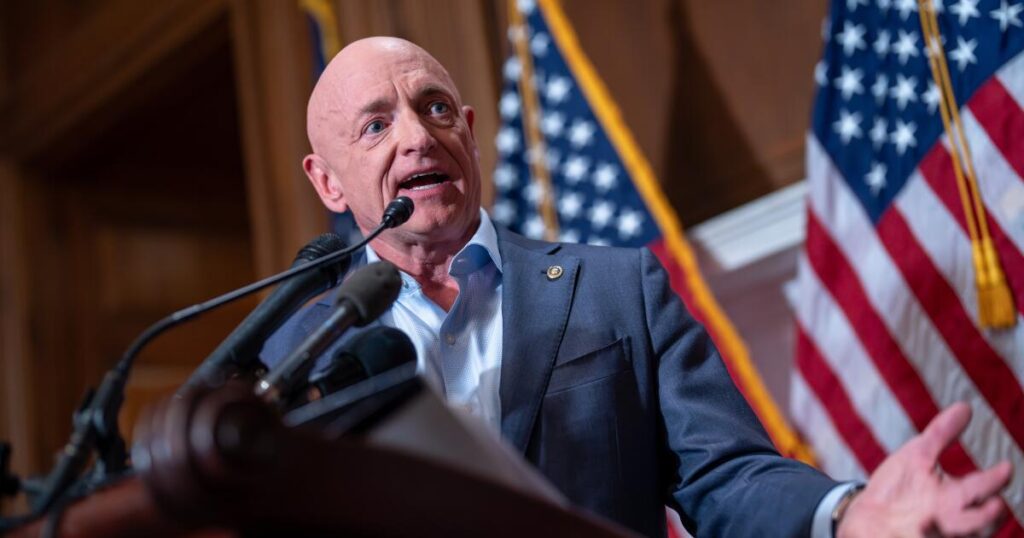
The dispute between Sen. Mark Kelly and Secretary of Defense Pete Hegseth is being told as a simple morality play. On one side, the claim that Kelly crossed a line and deserves punishment. On the other, the insistence that Kelly is a hero beyond reproach and that the administration’s response is villainy. Both frames are comforting. Both are wrong.
What matters most here is not who appeared righteous or reckless in the moment, but what happens when legality is left unresolved. In this case, junior service members are being placed in the position of exercising legal and moral judgment without meaningful authority, clarity or institutional backing. Those who make decisions remain insulated from consequence; those who execute them carry the risk.
The episode began with a short video released late last year by Kelly and several other members of Congress — all veterans of the U.S. military or intelligence community — reminding service members of their duty to refuse unlawful orders, a principle firmly embedded in U.S. military law. The video was a response to recent U.S. boat strikes in the Caribbean and Eastern Pacific that raised serious unresolved legal questions under both domestic and international law — questions that warranted a clear, public accounting from the Department of Defense.
That accounting never came. Instead, Hegseth labeled the video “seditious” and moved to censure Kelly, a retired Navy captain, triggering a review that could strip him of his rank and pension. Rather than lead, Hegseth escalated — a clear signal about how dissent would be handled.
Under U.S. military law, the duty to refuse unlawful orders is not designed to stand alone. It presumes a functioning system behind it — one in which legality is clarified through command and legal channels before an individual service member is forced into a moment of personal defiance. Refusal is meant to be a last safeguard, not the primary mechanism by which legality is enforced.
That design works only when institutions do their jobs. When legal guidance is sidelined and responsibility is avoided, the system breaks down. Judgment that should be resolved institutionally is deferred to individuals executing policy — often under pressure and with no institutional protection.
Over the last year, the structures meant to provide that clarity have been deliberately weakened. Senior military leadership has been removed. Legal advice has been sidelined or ignored. Public explanations of legal authority have been avoided. At the same time, senior civilian leaders have sent unmistakable signals that compliance matters more than clarity, and that dissent — even lawful dissent — will be met with punishment rather than engagement.
In that environment, telling service members to “refuse illegal orders” no longer functions as protection. It becomes a moral trap. Obedience carries both personal and professional risk; refusal can mean court-martial, loss of career and severe punishment if that judgment proves wrong. Individuals with limited authority are left to resolve ambiguity created far above them — often without legal backing or institutional cover.
Nothing about the video itself was illegal or seditious. Nor does this critique diminish Kelly’s legitimately heroic service to the country — a record that stands on its own. But legality is a low bar for leadership.
Service members are not children, and they do not need to be shielded from hard decisions. They are trained professionals, capable of recognizing and refusing unlawful orders when necessary. The failure here is not that they might be asked to make that judgment — it is that leaders have made such moments foreseeable, and increasingly routine.
What this episode ultimately reveals is not a disagreement over a video or a clash of personalities, but a convergence of leadership failures — each reinforcing the others. Members of Congress raised legitimate concerns, but largely chose performative expression over sustained institutional confrontation, even while tools remained available to them. In doing so, they avoided the difficult work of congressional oversight that often draws negative attention and carries political cost.
Hegseth failed to explain the legal basis for contested operations and reinforce command responsibility. He just imposed punishment. It was an abuse of his power, and when unresolved legal questions are met with retaliation rather than clarification, authority is no longer being exercised to protect the force — it is being used to shield those at the top from responsibility.
Senior uniformed leaders also bear responsibility. Flag and general officers are not mere conduits of orders. Their duty is to ensure that orders are lawful and defensible before they are carried out. When they remain silent in the face of ambiguity — whether from deference or careerism — they become complicit in a system that protects those who decide while exposing those who must act.
The result is predictable and corrosive. Junior service members are left navigating the combined effects of avoidance of responsibility and the abuse of authority. They are instructed to “refuse illegal orders” within systems that have stripped away legal backing and institutional cover — while watching leaders posture for constituencies and punish dissent.
For those executing policy, this is no academic debate. These are lived realities. Service members learn quickly whether legality will be clarified before action and whether judgment is expected to be exercised with institutional backing or alone. Those lessons shape behavior far more powerfully than any slogan or video ever could.
A professional military cannot function this way for long. It depends on leaders — civilian and military alike — who are willing to own their decisions before others are asked to carry them out. When that responsibility is abdicated or abused, the system orients itself around avoidance and silence. Once entrenched, those habits reshape institutions long after the moment that produced them.
Jon Duffy is a retired Navy captain. He writes about leadership and democracy.
The post Those who execute military orders carry all the risk appeared first on Los Angeles Times.