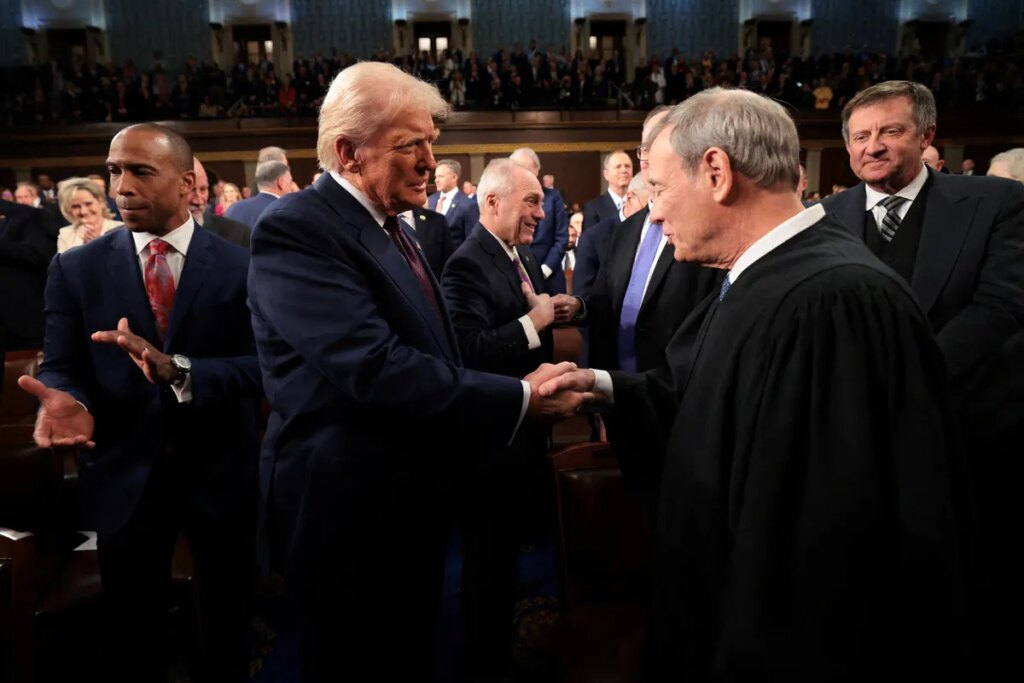
I was struck by the inspirational tone of the year-end report issued by Chief Justice John Roberts.
Roberts went back to basics with his review of the fundamentals spelled out by Thomas Paine in his Common Sense pamphlet and the principles laid out in the Declaration of Independence. Although the Declaration of Independence is not part of U.S. law, Roberts viewed the founding document as having “played a signal role in the nation’s constitutional, statutory, and common law.”
Roberts then highlighted points in U.S. history when the nation made progress in vindicating the promise of the Declaration. He pointed to the abolition of slavery in the 13th Amendment, the recognition of women’s right to vote in the 19th Amendment, the recognition of equal rights in Brown v. Board of Education, and the adoption of the landmark civil rights legislation in the 1960s. Roberts saw these events as part of the “never ending quest to fulfill the Constitution’s promise of a ‘more perfect union’.”
Roberts wrote: “These national accomplishments illustrate that the responsibilities for livings up to the promises of the Declaration rest on all three branches of government as well as well as on each successive generation of Americans.” Roberts placed particular emphasis on the critical role of federal judges in this process. Roberts wrote that the judges “must continue to decide the cases before us according to our oath, doing equal right to the poor and to the rich, and performing all our duties faithfully and impartially under the Constituion and laws of the United States.”
I consider the stirring words of this report to be truly inspirational. But what was the Chief Justice actually signaling to the nation with his words? Roberts devoted much of his leadership role as Chief Justice to undermining the “national accomplishments” he now celebrates. And in ruling on shadow docket cases, Roberts has repeatedly sided with the majority in undermining the role of lower federal court judges as bastions against abuses of executive authority.
- Roberts wrote the majority opinion in Students for Fair Admissions v. Harvard, 600 U.S. 181 (2023). Roberts in SFFA overruled decades of affirmative acton cases going back to the Bakke decision in the 1970s. The majority adopted what Roberts viewed as a “colorblind” approach to equal protection. Roberts rejected the theory that the Reconstruction era amendments, like the Thirteenth Amendment, allowed the government to give any affirmative relief to AfricanAmericans who had been subjected to the horrors of slavery. At the same time, Roberts ignored the key role Brown played in providing affirmative relief to African Americans by ordering the integration of public schools.
- Roberts took an indirect swipe atBrown when he wrote a plurality opinion in Parents Involved in Community Schools v. Seattle School District No. 1, 551 U.S. 701 (2007). In a split decision, the Court found it unconstitutional for a school district to use race as a factor in assigning students to schools to achieve racial diversity, unless the district was remedying a prior history of de jure Roberts wrote bluntly in his plurality opinion: “The way to stop discriminating on the basis of race is to stop discriminating on the basis of race.”
- Roberts wrote the majority opinion in Shelby County v. Holder, 570 U.S. 529 (2013). Roberts in Shelby County struck down the formula used for the preclearance requirement under Section 5 of the Voting Rights Act of 1965. Under this formula in Section 4(b), those states with a long history of racial discrimination had to obtain preclearance from the Justice Department to make changes that might undermine the voting rights of African Americans. Roberts considered the formula in this landmark civil rights legislation to be outdated and no longer necessary.
- In this term, the Roberts Court now has before it a case where the Court could strike down a more fundamental part of the Voting Rights Act – the Section 2 provision prohibiting racial discrimination in voting rights. See, Louisiana v. Callais, No. 24-109. The specific question presented in Louisiana is whether the Voting Rights Act still allows voters of color to challenge racially discriminatory voting maps in court.
- On many questions associated with separation of powers, Roberts has consistently sided with the majority in using the Court’s emergency docket to give the Trump administration sweeping powers under its unitary executive theory. And in so doing, Roberts rejected the power of lower court judges to issue temporary injunctions to rein in abuses of executive authority.
So now, what are we to make of the Chief Justice’s inspirational year-end report? Is Roberts having second thoughts about his prior actions because of the imminent threat to democracy posed by Trump? The recent Trump invasion of Venezuala may feed that theory. If that is Roberts’ thinking, he could be signaling a change in course on how he approaches critical questions like tariffs, birthright citizenship, racial discrimination, or separation of powers.
The other possibility is that Roberts is presenting his inspirational theme just to placate an increasing angry public. Polling suggests the public no longer holds the Supreme Court in particularly high esteem. Roberts cannot reverse this trend with empty platitudes.
We should have some idea by the end of this term if the year-end report has any lasting significance.
- Daniel R. Schramm is a retired lawyer on inactive status with the Missouri Bar who practiced law for a total of 45 years. When he was engaged in the practice of law, Schramm concentrated in appellate advocacy, estate planning and business transactions. Since his retirement, he has continued to write articles on legal topics in Substack and other publications.
The post This shameless Trump enabler just signaled he may be having second thoughts appeared first on Raw Story.