In her late 20s, Christie Tate struggled with crushing loneliness, bulimia, and suicidal thoughts. Then, she had a conversation that changed her life. Try group, a friend told her — as in group psychotherapy.
Like most people, Tate had thought of therapy as a two-person endeavor: a therapist smoking a pipe and a patient on the couch. She’d been there, done that, with little to show for it.
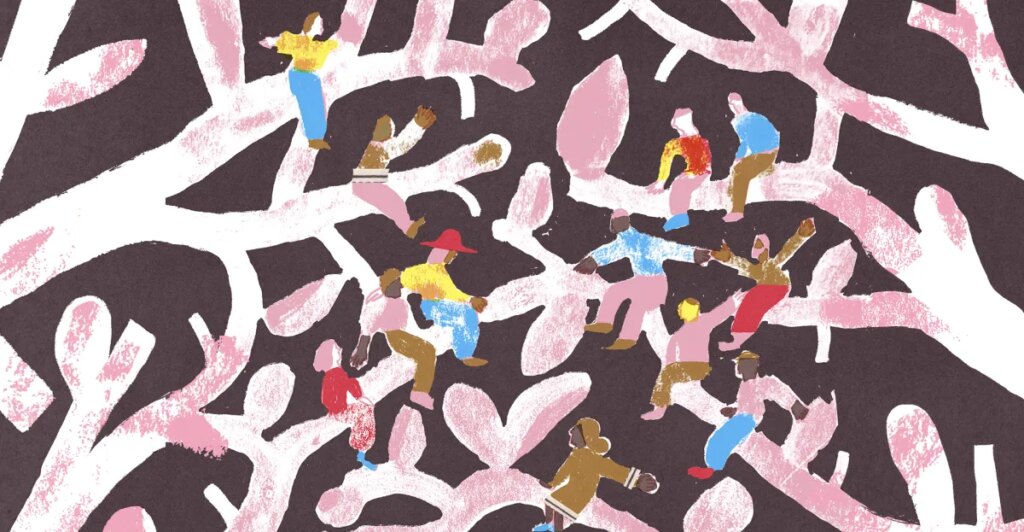
Group therapy was different. It harnessed the power of numbers. Each week, Tate, five or six other clients, and a therapist gathered together. Then, in no particular order, members talked about their lives, and analyzed their interactions with each other.
In those days, Tate’s problems were exquisitely painful, but also mysterious. She felt she couldn’t connect with people, but didn’t know why. But, the others could observe Tate’s interactions from the outside, in real time. Within a few months, fellow group members were showing Tate “all the ways I kept myself alone,” she said. “It’s all the ways I opt out or sit back or withdraw because I’m scared, or ashamed, or in pain, or can’t speak to my needs.”
Group is a social microcosm — meaning that every member eventually behaves in a group the way they behave in life.
Group cajoled and comforted Tate as she stopped dating unavailable men, changed her relationship to food, and eventually got married. For Tate, author of the memoir Group: How One Therapist and a Circle of Strangers Saved My Life, group therapy was transformative. More than 20 years later, she’s still attending. Yet, most people don’t know even group therapy is an option.
Even as psychotherapy has become something of a cultural fixation — with relentless discourse about emotionally immature parents, the rise of chatbot counselors, and TikTok therapists earning billions of views — almost all of the content is focused on individual approaches. Here, the internet reflects the real world. In 2023, the American Psychological Association estimated that less than 5 percent of American private therapy practice is dedicated to group work.
But research suggests group methods can be just as effective as individual therapy for many conditions, ranging from depression and anxiety to eating disorders and chronic pain.
In some cases, group may even have advantages. For those struggling with shame, isolation, or loneliness, group can be uniquely effective, said Bonnie Buchele, a psychoanalyst and group therapist in Kansas City, Missouri. (It’s more affordable too; group rates can be half or two-thirds that of individual therapy.) In the midst of a simultaneous mental health care shortage and loneliness epidemic — not to mention an era of incredible political division — “group,” Buchele said, “has more to offer than ever.”
Why most people don’t do group therapy
In the summer of 1905, American psychiatrist Joseph Pratt organized groups of tuberculosis patients with the goal of tracking their condition. Pratt found that the encouragement between members was just as, if not more, important to their recovery than any facts about their disease. He leaned in, encouraging more exchange between patients, in the process hosting the first group therapy sessions.
Group methods continued to gain prominence after World War II, thanks in part to English psychoanalyst Wilfred Bion, who worked with traumatized veterans. Bion was interested in flattening the hierarchy that gave psychiatrists power over patients and allowed his groups to form — and reform — their own structures. Bion’s later papers, which added theory to what he observed among patients, influenced group therapists around the world.
In the 1960s, however, the encounter group movement took center stage. Overnight, it seemed like everyone from churchgoers to New Age enthusiasts was in group, said psychologist and researcher Gary Burlingame. “The closest thing I can think of in today’s world is with social media,” he said.
Unfortunately, some encounter groups encouraged emotional disclosure without limits, or were at the mercy of leaders with authoritarian streaks. Soon, there were reports of group members experiencing breakdowns, hastily ending their marriages, and even deaths by suicide.
Therapy groups — gentler ones, with principled leaders, and practices rooted in empirical evidence — continued to meet, especially in institutional settings like hospitals and day treatment programs for various disorders. But, group therapy has never again been as zeitgeist-y as it was in the ’70s. Today, the East Coast hosts a “rigorous, healthy, big group psychotherapy community,” Buchele said. But, many other parts of the country do not.
Even if you’ve heard about group (and have access to a reputable one), there are still a million reasons not to join. Meeting times are inflexible to accommodate the greatest number of people. Group participants have to share time with others. Some weeks, some members may not speak at all.
And group can be terrifying. Members must sacrifice some of their privacy and open themselves up to uncomfortable feelings like shame. Therapists strive to be warm and compassionate, but your peers can (and sometimes will) dislike you. The opinion of a single therapist can be dismissed quite easily, but when every member of a therapy group agrees that your behavior is unacceptable, it’s hard to say they’re all wrong.
“Not everybody wants that intensity,” Tate said. “It’s a power washing, and you may just want a gentle rinse.” (Admittedly, Tate’s group is an outlier: Her therapist does not require confidentiality among members; members are allowed to fraternize outside of the group; and members can, in theory, stay for a lifetime, instead of a more typical path toward graduation.)
But, all these inconveniences are part of what gives group therapy its advantages.
How group therapy works
Wherever three or more people are gathered, you’ve got a group. But, what turns a sports team or a cappella club into therapy?
For one, a therapy group isn’t just a bunch of randoms. The therapist in charge identifies members who might relate to, or generate productive conflict for, each other. They keep in mind potential challenges, like a client who won’t speak or a client who won’t stop speaking, and try not to put too many of these folks in one room. They screen out clients who might be better suited to individual therapy, including clients who are likely to undermine the group. And they’re sensitive to diversity — in particular, of not creating a “singleton,” a person with a significant identity no one else in the group shares.
Finding acceptance can be healing in its own right. Finding acceptance in the midst of conflict is even more powerful.
The first few group meetings are some of the most important. A long-running group is, like the ship of Theseus, almost entirely reconstituted over time, as individual group members move on. But, early dynamics are likely to stick, according to psychiatrist Irivin Yalom, co-author of the 832-page textbook The Theory and Practice of Group Psychotherapy. Facilitators must model norms of openness and respect from the jump, as well as how to work in what Yalom calls the “here and now.”
Yalom argues that group is a social microcosm — meaning that every member eventually behaves in a group the way they behave in life. That’s why, instead of talking about past conflicts with people who aren’t present (the “there and then”), members are encouraged to talk about what’s happening between members in session (the “here and now”).
For author David Payne, individual therapy had been focused on pain from his past. By contrast, “group therapy forced me to see who I was now, the sometimes injurious adult I had become,” as he wrote in a 2015 essay for the New York Times. “For me, that was the bitter pill that led to change.”
At the time, Payne was an alcoholic in an unhappy marriage. “Within a month I’d run afoul of everyone,” Payne recalled in his essay. “Hardly a session passed without someone telling me I’d ‘erased’ them or someone else around the circle.” Payne would be telling a story, a group member would offer an interpretation, and he’d go on telling his story, only to repeat the group member’s interpretation as if it were his own idea. “Only when the group prevailed on me to tape record and listen to the sessions did I realize they were right,” Payne wrote, adding: “Eventually, I came to see that it was fear. Fear of needing them, of needing anyone.”
The social microcosm can also be inverted; the way you behave in group therapy can become the way you behave in life. “Group is a lab,” said psychologist Jackie Darby. “I can set the experiment with my [individual] client, but in group, you’re going to practice it, and then we’re going to analyze it.”
That’s why such gatherings are also called “process” groups. Content — the mere words exchanged — is second to the process by which interactions in the room unfold. That’s true even, and perhaps especially, when members are in conflict. While the grist can be large (anger with someone’s callous response to another member’s hardship) or small (frustration with a chronically late member), the group mills it all.
A well-handled conflict benefits everyone. An antagonist discovers their negative impact on others, while their fellow members practice sticking up for themselves. Even an observer to the conflict may undergo what Yalom calls “vicarious learning,” in which they discover how they want to handle (or not handle) the next squabble in their own lives.
A cohesive group will also be full of validation and generosity. “A lot of people anticipate groups not to be welcoming to them,” said psychiatrist Molyn Leszcz, who co-authored with Yalom the most recent editions of The Theory and Practice of Group Psychotherapy. Finding acceptance can be healing in its own right. Finding acceptance in the midst of conflict is even more powerful.
“I can be mad at you and still love you, you know,” one group member told Tate after a particularly charged session. “No, actually, I didn’t know that,” Tate recalls thinking. But, eventually, she learned.
Group in the age of loneliness
In 2023, former US Surgeon General Vivek Murthy identified isolation (physical separation from others) and loneliness (a feeling possible even in a room full of other people) as some of the biggest threats to the health of Americans today. Roughly one in three adults report experiencing loneliness on a weekly basis.
The problems posed by loneliness are legion, perhaps none more so than that it can be self-perpetuating. As I’ve written about before, research suggests that lonely brains are more likely to perceive threats in social interactions. When the lonely brain most needs other people, it’s also likely to turn away.
By this logic, group therapy is probably the last thing a lonely person wants to do. But, the path forward is not more individualism; it’s fellowship. Sharing time in group therapy may be annoying, but it’s also great practice for a life lived with others. The same is true for showing up when you’d rather be anywhere else, learning to give and receive feedback, and tolerating people who drive you nuts.
In the best-case scenario, Tate said, a group can become greater than the sum of its parts. Members may be confused or frantic or upset, she said, but “the group knows.” Such wisdom is found not within the therapist or any other individual, but in the connections in between.
The post There’s an underrated (and cheaper) type of therapy appeared first on Vox.