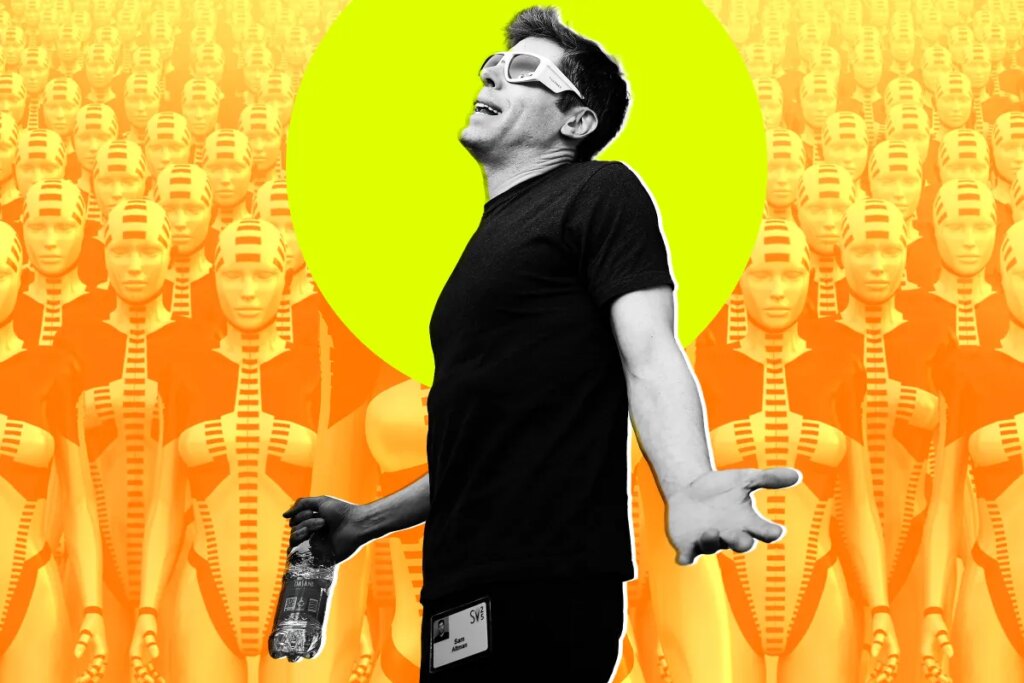
At this point, tech corporations have made it no secret that their end goal is to replace all jobs with AI — thus cementing themselves as indispensable to the world economy. But what happens if we actually get to that point?
Either they don’t have a clue, or they don’t want to say.
Speaking at a press conference last month, Geoffrey Hinton — a pioneer in the field of neural networks, the bedrock of modern AI — remarked that “it’s clear that a lot of jobs are going to disappear: it’s not clear that it’s going to create a lot of jobs to replace that.”
Often lauded as a “godfather of AI,” Hinton has gone on the record many times to warn about the social cost of AI solutionism in an economic system driven by profit. “This isn’t AI’s problem,” he continued last month. “This is our political system’s problem. If you get a massive increase in productivity, how does that wealth get shared around?”
It’s a critically important question as AI spending becomes integral to the US economy, yet one which tech corporations and the moguls heading them have been at a loss to answer.
SpaceX and Tesla CEO Elon Musk, for example, has waxed poetic about a future in which AI and robotics could make us all rich. Currently the world’s wealthiest person himself, Musk has spent some time over the last few weeks bleating about “universal high income,” a take on universal basic income where every out-of-work peon would live comfortably off the prosperity of private corporations, like his beleaguered AI venture, xAI.
Of course, as The New Yorker‘s John Cassidy observes, such material abundance for displaced workers won’t be possible unless Musk and his fellow billionaires agree to share their largesse. (As Martin Luther King Jr wrote from Birmingham Jail, “it is an historical fact that privileged groups seldom give up their privileges voluntarily.”)
OpenAI’s Sam Altman has echoed Musk’s ideas, saying he hopes AI can bring about what he calls “universal extreme wealth,” in which everyone basically has ownership stakes in every AI company.
Mustafa Suleyman, co-founder of DeepMind and CEO of Microsoft AI, has called AI a “fundamentally labor-replacing tool,” which is evidently worth the mass economic turmoil, because “in 15 or 20 years’ time, we will be producing new scientific, cultural knowledge at almost zero marginal cost.”
Overall, it’s hard to see this scenario coming to pass. Currently, Goldman Sachs only predicts a 7 percent increase in global GDP over the next ten years due to AI, while the Penn Wharton Budget Model foresees a 3.7 percent boost to GDP by 2075.
Any AI-driven bump in GDP would undoubtedly be a boost — but far from the one needed to avoid widespread poverty and anguish without major concessions from the billionaire class. But hey, if they’re serious about it, there’s never been a better time for them to put their money where their mouth is.
More on AI: Google CEO Says We’re All Going to Have to Suffer Through It as AI Puts Society Through the Woodchipper
The post Tech Billionaires Have No Answer for What’ll Happen If AI Takes All Jobs appeared first on Futurism.