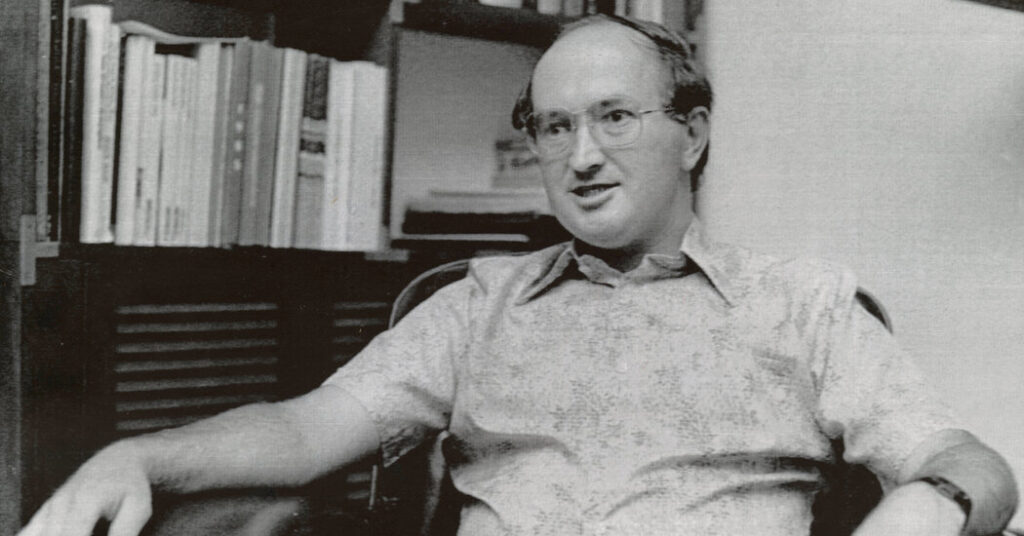
Renfrew Christie, a South African scholar whose undercover work for the African National Congress was critical in hobbling the apartheid government’s secret nuclear weapons program in the 1980s, died on Dec. 21 at his home in Cape Town. He was 76.
The cause of death was pneumonia, his daughter Camilla Christie said.
President Cyril Ramaphosa of South Africa paid tribute to Dr. Christie after his death, saying his “relentless and fearless commitment to our freedom demands our appreciation.”
The A.N.C., in a statement, called Dr. Christie’s role “in disrupting and exposing the apartheid state’s clandestine nuclear weapons program” an “act of profound revolutionary significance.”
From the doctoral dissertation he had written at the University of Oxford on the history of electricity in South Africa, Dr. Christie provided the research needed to blow up the Koeberg Nuclear Power Station; the Arnot coal-fired power station; the Sasol oil-from-coal facilities that produced the heavy water critical to producing nuclear weapons; and other critical sites.
The explosions set back South Africa’s nascent nuclear weapons program by years and cost the government more than $1 billion, Dr. Christie later estimated.
By the time the bombs began going off, planted by his colleagues in uMkhonto we Sizwe, the paramilitary wing of the A.N.C., Dr. Christie was already in prison. He was arrested by South African authorities in October 1979 on charges of “terrorism,” three months after completing his studies at Oxford, and spent the next seven years in prison, some of that time on death row and in solitary confinement.
“While I was in prison, everything I had ever researched was blown up,” he said in a speech in 2023.
Terrorism was a capital offense, and Dr. Christie narrowly escaped hanging. But as he later recounted, he was deliberately placed on the death row closest to the gallows at the Pretoria Maximum Security Prison. For two and half years, he was forced to listen to the hangings of more than 300 prisoners.
“The whole prison would sing for two or three days before the hanging, to ease the terror of the victims,” Dr. Christie recalled at a 2013 conference at the University of the Western Cape on laws regarding torture.
Then he recited the lyrics of an anti‐apartheid folk song that reverberated in the penitentiary: “‘Senzeni-na? Senzeni-na? What have we done? What have we done?’ It was the most beautiful music on earth, sung in a vile place.”
“At zero dark hundred,” he continued, “the hanging party would come through the corridors to the gallows, slamming the gates behind them on the road to death. Once they were at the gallows there was a long pause. Then — crack! — the trapdoors would open, and the neck or necks of the condemned would snap. A bit later came the hammering, presumably of nails into the coffins.”
In an interview years later with the BBC, he said the “gruesome” experience affected him for the rest of his life.
Dr. Christie acquired his fierce antipathy to apartheid at a young age, growing up in an impoverished family in Johannesburg.
Many of his family members fought with the Allied forces against the Germans in World War II, and “I learned from them very early that what one does with Nazis is kill them,” he said at a 2023 conference on antinuclear activism in Johannesburg. “I am not a pacifist.”
At 17, he was drafted into the South African Army. A stint of guard duty at the Lenz ammunition dump south of Johannesburg confirmed his suspicions that the government was building nuclear weapons. “From the age of 17, I was hunting the South African bomb,” he said at the conference.
After attending the University of the Witwatersrand, he received a scholarship to Oxford, which enabled him to further his quest. For his doctoral dissertation, he chose to study South Africa’s history of electrification, “so I could get into the electricity supply commission’s library and archives, and work out how much electricity they were using to enrich uranium,” he told the BBC.
From there, it was possible to calculate how many nuclear bombs could be produced. Six such bombs had reportedly been made by the end of apartheid in the early 1990s; the United States had initially aided the regime’s nuclear program. Thanks to the system of forced labor, South Africa “made the cheapest electricity in the world,” Dr. Christie said, which aided the process of uranium enrichment and made the country’s nuclear program a magnet for Western support. (South Africa also benefited from its status as a Cold War ally against the Soviet Union.)
Dr. Christie turned his findings over to the A.N.C. Instead of opting for the safety of England — there was the possibility of a lecturer position at Oxford — he returned home and was arrested by South Africa’s Security Police. He had been betrayed by Craig Williamson, a fellow student at Witwatersrand, who had become a spy for the security services and was later granted amnesty by South Africa’s Truth and Reconciliation Commission.
After 48 hours of torture, Dr. Christie wrote a forced confession — “the best thing I ever wrote,” he later told the BBC, noting that he had made sure the confession included “all my recommendations to the African National Congress” about the best way to sabotage Koeberg and other facilities.
“And, gloriously, the judge read it out in court,” Dr. Christie added. “So my recommendations went from the judge’s mouth” straight to the A.N.C.
Two years later, in December 1982, Koeberg was bombed by white A.N.C. operatives who had gotten jobs at the facility. They followed Dr. Christie’s instructions to the letter.
“Of all the achievements of the armed struggle, the bombing of Koeberg is there,” Dr. Christie said at the 2023 conference, emphasizing its importance. “Frankly, when I got to hearing of it, it made being in prison much, much easier to tolerate.”
Renfrew Leslie Christie was born in Johannesburg on Sept. 11, 1949, the only child of Frederick Christie, an accountant, and Lindsay (Taylor) Christie, who was soon widowed and raised her son alone while working as a secretary.
He attended King Edward VII School in Johannesburg and was conscripted into the army immediately after graduating. After his discharge, he enrolled at Witwatersrand. He was twice arrested after illegally visiting Black students at the University of the North at Turfloop, and was also arrested during a march on a police station where he said the anti-apartheid activist Winnie Mandela was being tortured.
He didn’t finish the course at Witwatersrand, instead earning bachelor’s and master’s degrees from the University of Cape Town in the mid-1970s before studying at Oxford. At Cape Town, he was a leader of the National Union of South African Students, an important anti-apartheid organization.
On June 6, 1980, he was sentenced to 10 years in prison under South Africa’s Terrorism Act, with four other sentences of five years each to run concurrently.
“I spent seven months in solitary,” Dr. Christie said in the 2023 speech. “Don’t let anybody kid you: No one comes out of solitary sane. My nightmares are awful.”
After his years in prison, he was granted amnesty in 1986 as the apartheid regime began to crumble. (It officially ended in 1994, when Nelson Mandela became the country’s first Black president.) He later had a long academic career at the University of the Western Cape, retiring in 2014 as dean of research and senior professor.
In addition to his daughter Camilla, he is survived by his wife, Dr. Menán du Plessis, a linguist and novelist he married in 1990; and another daughter, Aurora.
Asked by the BBC whether he was glad he had spied for the A.N.C., Dr. Christie didn’t hesitate.
“I was working for Nelson Mandela and uMkonto we Sizwe,” he said. “I’m very proud of that. We won. We got a democracy.”
Kirsten Noyes contributed research.
Adam Nossiter has been bureau chief in Kabul, Paris, West Africa and New Orleans and is now a writer on the Obituaries desk.
The post Renfrew Christie Dies at 76; Sabotaged Racist Regime’s Nuclear Program appeared first on New York Times.