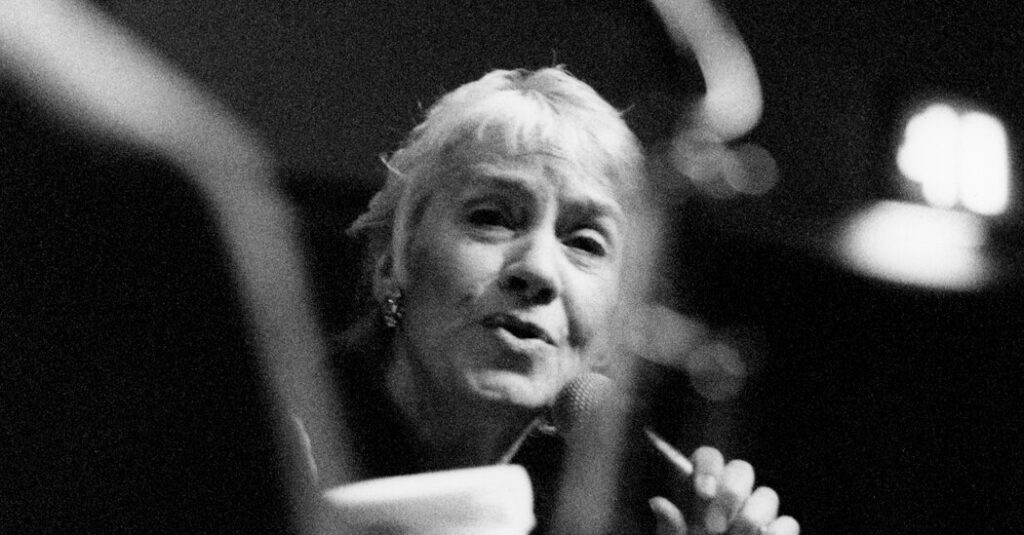
Rebecca Kilgore, a jazz singer whose pure, elegant tone, impeccable swing style and adventurous musical taste helped reinvigorate the Great American Songbook, and who was a frequent partner of the songwriter and pianist Dave Frishberg, died on Jan. 7 in Portland, Ore. She was 76.
The cause of death, at a hospice facility, was Lewy body dementia, her husband, Dick Titterington, said.
Long based in Portland, far from the jazz epicenters of New York and Los Angeles, Ms. Kilgore recorded for small labels while flying under the mainstream cultural radar. But she was extolled by musicians and musical connoisseurs for the vitality she brought to her reinterpretations of pop standards of the 1920s, ’30s and ’40s.
Michael Feinstein, a celebrated performer of American Songbook standards himself, featured Ms. Kilgore at his Manhattan club, Feinstein’s at Loews Regency, several times. In a 2014 video interview, he called her “one of the great contemporary interpreters of American popular song” and a musical “detective” who exhumed unaccountably obscure songs by well-known composers like Cole Porter and Hoagy Carmichael and made them sparkle with meaning.
Instead of retreads of vintage recordings, Mr. Feinstein said, she created “something completely fresh that makes so many songs that I’ve never heard anybody sing in the last several decades fresh and new and viable again. That’s the hallmark of a great artist.”
Almost entirely self-taught, Ms. Kilgore had a late professional start in music. She was working as a secretary at Reed College in Portland in 1981 when she was hired to replace a friend in a swing-revival quintet called Wholly Cats.
“It was a gas,” she later said, “and it convinced me that I wanted to make a career out of singing.”
Apprenticeships with jazz, folk and country-swing bands followed, culminating in a stint at the Heathman Hotel bar in Portland that lasted for most of the 1990s. There, she performed with Mr. Frishberg, who had moved to the city from Los Angeles after an acclaimed career during which he worked with stars like Judy Garland and Anita O’Day and composed “Peel Me a Grape” and other witty cabaret songs.
He served not only as her accompanist but also as her accomplice in reviving long-forgotten Tin Pan Alley standards. Describing her technique and delivery as “flawless,” he told JazzTimes in 2011 that Ms. Kilgore was his “favorite singer to play for.”
The critic Harvey Siders, writing in JazzTimes, praised the pair’s chemistry, highlighted by Mr. Frishberg’s playful and inventive piano and Ms. Kilgore’s velvety tone.
“Her vocals are pristine, uncluttered and unpretentious,” Mr. Siders noted of their work on the 1994 album “I Saw Stars.” “There are minefields for Kilgore scattered among trombonist Dan Barrett’s arrangements. How she can negotiate the lyrics for the way-up ‘Happy as the Day Is Long’ is anyone’s guess, yet she enunciates with enviable clarity. Another puzzle is how she can focus on ‘This Is No Laughing Matter’ when pianist Dave Frishberg interpolates ‘Vesti La Giubba’ from Pagliacci.”
Ms. Kilgore’s fans included the cartoonist Gary Larson, who called her voice “spellbinding” and recruited her to sing the swing-era ballad “I’ll Be Seeing You” on the soundtrack of his animated TV special “Tales From the Far Side” in 1994.
Her appearances at Manhattan nightclubs were infrequent but almost invariably drew superlatives from critics. In a review in The New York Times in 2010, Stephen Holden wrote that she “swings gracefully and seemingly without effort, drawing back from song lyrics just enough to scrutinize them and make you listen attentively to messages that in other interpretations might have flown by.”
Although her voice could be husky or sweetly supple as called for, Ms. Kilgore prided herself on being an unflashy, unfussy performer who avoided the emotive crescendos and other theatrics associated with so-called song stylists.
“My goal,” she told The Oregonian in 1995, “is that when someone hears me sing a song, they say, ‘Wow, what a beautiful song,’ rather than, ‘Wow, what a great singer.’”
Rebecca Louise Kilgore was born on Sept. 24, 1949, in Waltham, Mass., a Boston suburb, one of two daughters in an artistically inclined family. Her father, George M. Kilgore, did sales work for a rivet company and was a Unitarian Church choir director; her mother, Jean (Schaufus) Kilgore, managed the home and took on redecorating projects.
When Rebecca was young, her musical tastes aligned with the cultural moment: Joan Baez during the folk revival; the Beatles during the British Invasion. But one day, she told The Oregonian, her favorite radio station aired an unexpected segment on Ella Fitzgerald and Billie Holiday, and she was startled and captivated by the romance of the lyrics.
“The old music’s not saying, ‘I want to sleep with you, I want to have your baby.’ It’s saying, ‘Your eyes are like starlight,’” she said. “I prefer that.”
After briefly studying art at the University of Massachusetts Amherst, she went to visit her sister in Portland and quickly embraced the city’s low-key vibe and bohemian arts scene. Performing with Mr. Frishberg at the Heathman Hotel, starting in 1991, enabled her to make music a full-time career, one that included lucrative one-night appearances around the world and work on jazz cruises.
Her marriage in 1997 to Peter Schwimmer, a guitarist, banjo player and mandolinist, ended in divorce. In addition to Mr. Titterington, a trumpeter she married in 2002, she is survived by her sister, Jane Kilgore, known as Jenny. Her stepson, Miles Ian Titterington, died in 2016.
Ms. Kilgore, who occasionally played guitar, led trios and quartets beginning in the late 1980s. She recorded prolifically with Arbors and other labels, producing tribute albums to Jimmy Van Heusen, Frank Loesser and Jerome Kern.
Reviewing “Winter Days at Schloss Elmau,” the 2019 album she recorded with the Echoes of Swing band, the jazz critic Dave Gelly marveled in The Guardian that she performed Mr. Carmichael’s rarity “Winter Moon” with “impressive poise”; reimagined “Winter Wonderland” in 5/4 time; and sang the poetry of Robert Frost, Emily Brontë and Shakespeare set to music.
“I never like to do the tried and true,” Ms. Kilgore told JazzTimes in 2011. “My passion is discovering songs. When I uncover a song, it is like falling in love, and I want to impart to the audience the fun and the beauty of finding it.”
The post Rebecca Kilgore, 76, Dies; Acclaimed Interpreter of American Songbook appeared first on New York Times.