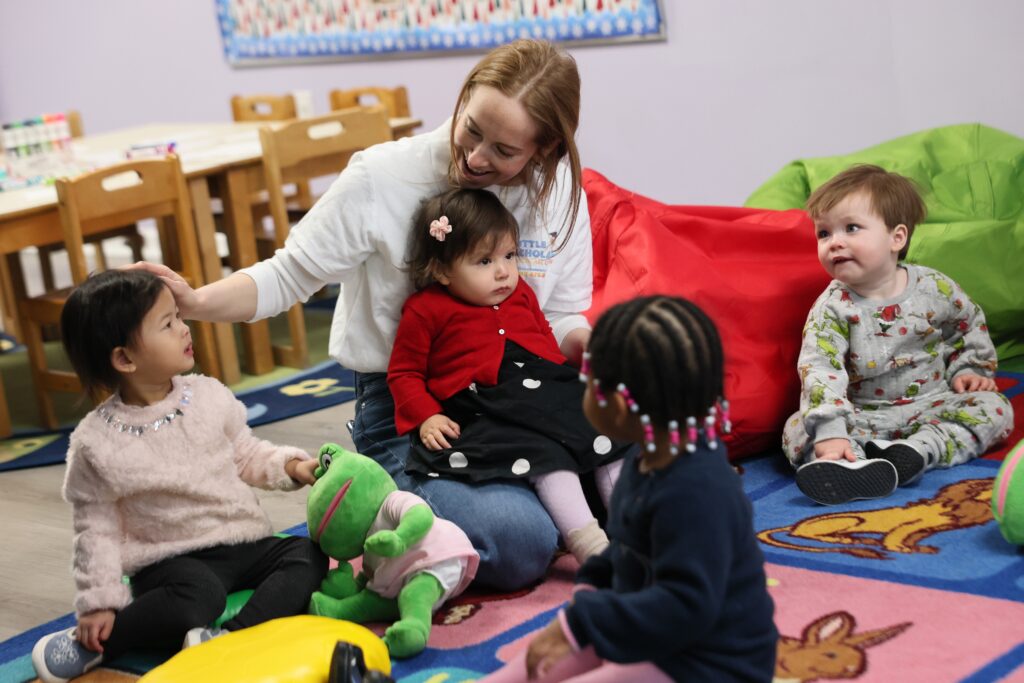
The lack of affordable child care is creating significant hardships for many families, new research finds, with 1 in 5 households reporting having to cut back on coverage or resort to less desirable alternatives.
The high price of day care is well known: In dozens of states , the cost of day care is higher than in-state college tuition and fees, according to the advocacy group Zero to Three. Little research has been done, however, to show what families do when they can’t afford to pay for it.
The new survey is part of the Columbia University Center on Poverty and Social Policy’s Poverty Tracker, which has polled the same New York City families for years to glean detailed information about poverty. More than 2,000 households participate in the survey.
Christopher Wimer, the center’s co-director, said poverty researchers frequently measure “hardships” — such as not having enough food to eat, sleeping in a homeless shelter or having utilities disconnected. But he set out to quantify the frequency of “child care hardships” in a similar way.
The results, first published Wednesday, show that about 15 percent of the households with children younger than 12 had to stop using a child care arrangement or cut back on child care hours in the past year because they could not afford it. A similar number said they resorted to an “inadequate” child care arrangement because they had no other affordable options.
The research showed that younger parents, those without a college degree and Black and Hispanic parents were more likely to say they experienced at least one form of hardship. Single mothers experienced the most hardship, with 37 percent cutting back on child care, using less desirable child care because of cost or both.
The findings come as the Trump administration has moved to freeze $10 billion in federal funding for child care in New York and four other Democratic-led states and as New York Gov. Kathy Hochul (D) is promising more public spending on child care. Federal officials cited allegations of fraud to justify the freeze, but a judge blocked the order.
According to a 2020 Economic Policy Institute analysis, parents spend about $42 billion a year on care for infants, toddlers and preschoolers, while state and federal governments covered about $34 billion.
“In the worst-case scenario, where New York is not able to access child care assistance for tens of thousands of families — those child care programs, without that federal funding, might end up shutting down,” said Julie Kashen, a child care expert at the Century Foundation, a left-leaning think tank.
Kashen said any shutdowns would hurt both families who receive vouchers and those who don’t. “When you find a child care program for your child, you want them to be able to stay there. You want them developing healthy relationships with the people who are caring for them.”
Amdiya Malik, a mother in the Bronx, has cycled through many child care options for her four children, who are now ages 3 through 16. She and her husband immigrated from Ghana to the United States when their oldest daughter was a toddler. Though Malik had a job as a nursing assistant and he worked as a correctional officer, they found child care here so expensive that they sent their daughter to live with relatives in Ghana until she was old enough for publicly funded prekindergarten. At that point, Malik worked just two hours a day while the girl was in the half-day school program.
She made a similar arrangement for their next daughter, sending her to live with Malik’s sister in Nigeria. They enrolled their son in a registered day care program. Even at a below-market rate of $30 per day, it was too expensive, and they eventually stopped. Their youngest daughter now receives low-cost care through a nonprofit; Malik calls it “lifesaving.”
Columbia researchers also conducted in-depth interviews with some of the families they surveyed. Vicki Lens, a professor supervising that qualitative research, recalled one mother describing times she left her older children to watch her baby because she couldn’t afford child care. “Mommy has to go to work; you’ve got to be good,” she would tell them.
That mother worked in security by day and as a delivery driver by night but couldn’t keep up with the $500 a week it cost for her 1-year-old’s day care. Her aunt agreed to watch the baby for $180 a week, but the mom still ended up taking the baby out with her on deliveries and asking her older kids to babysit often. Lens recalled the mom telling her that child care “has always been a nightmare.”
Lens also has heard stories from parents who cobble together care from neighbors and relatives; from a mom who had to quit her job as a police officer when she was switched to the night shift and is now considering enlisting in the military to afford child care; from a couple who got evicted trying to juggle child care, work and higher education.
The Columbia researchers may expand their survey beyond New York City and plan to gather more data over time to examine broader patterns, such as the burden for children of different ages.
New York City offers free preschool starting at age 3. Last week, Hochul and Mayor Zohran Mamdani announced plans for free child care for 2-year-olds. Publicly provided child care is becoming more common, with nearly half of American 4-year-olds now enrolled in publicly funded preschool, as well as some 3-year-olds. Free care for younger children is less prevalent: New Mexico recently became the first state to guarantee free day care to all households.
“To have a major state the size of New York assert a pathway to universal child care definitely cements that there’s real momentum toward a new vision for child care in this country,” said Elliot Haspel, a family policy expert with Capita, an independent think tank. “The speed with which the boulder is starting to roll down the mountain is exciting.”
The average cost of care for infants and toddlers in New York City soared between 2019 and 2024, according to a recent report from its comptroller, increasing 79 percent in family-based centers and 43 percent in stand-alone centers.
Pete Nabozny, policy director for the Children’s Agenda, a Rochester, N.Y.-based nonprofit, said the proposed $1.7 billion in new child care funds in New York’s upcoming budget may be the largest such increase to date by any state. But the Trump administration’s attempt to freeze subsidies adds “a lot of uncertainty” to what the state could achieve, Nabozny said.
Melissa Boteach, chief policy officer for Zero to Three, said child care providers have been beset by uncertainty because of several federal policy moves — a freeze on federal spending just after President Donald Trump’s inauguration which was quickly reversed, the closure of Head Start offices, cuts to states’ funding as part of Republicans’ July legislative package and a lengthy government shutdown. She faulted the Trump administration for “introducing new and completely preventable chaos and uncertainty.”
“Babies don’t know if they’re in a red state or a blue state,” she said. “But they know that the loving caregiver they’ve developed a relationship with is no longer at the child care center.”
The post Parents are cutting back on child care as costs stretch budgets appeared first on Washington Post.