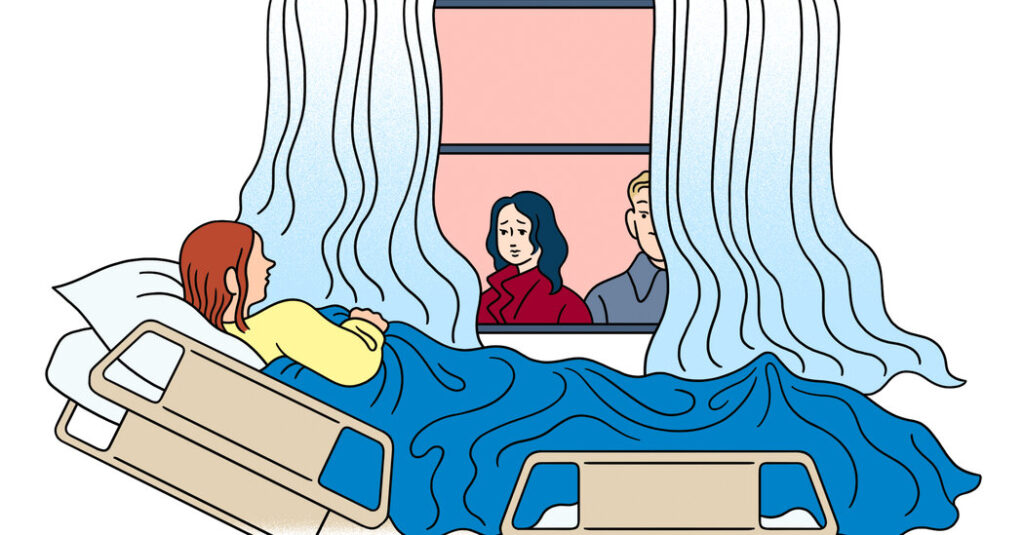
About a decade ago, a close friend and her husband separated after a long marriage. We originally met through our children and bonded as she supported me through career challenges and our shared experiences with separation.
My friend and I eventually drifted apart; despite my attempts to reach out a few years ago, I never heard back. I also knew her husband through a support group, and we developed our own friendship over time. Six months ago, I learned she was diagnosed with Stage 4 cancer. More recently, her husband and I, both divorced, unexpectedly fell for each other. We have proceeded with care, mindful of the history.
She has now reached out asking to reconnect. I’ve postponed a meeting, feeling paralyzed. I don’t want to lie, but I dread telling her that I am dating her ex-husband while she’s seriously ill. Yet it feels cruel to simply disappear.
What is the ethical thing to do here? How do I preserve honesty without causing unnecessary pain? — Name Withheld
From the Ethicist:
You didn’t betray your old friend by falling for someone she was married to, long after they separated. (The folkloric rules about avoiding a friend’s ex lose force when it’s the friend who broke off ties and the breakup was years ago.) But as you recognize, you would be letting her down by ghosting her now.
The complications here are obvious. Once you take up with her again, you’ll implicitly be offering yourself as a supportive presence in a difficult time — and you’ll be doing it while you’re in a relationship with her ex. To conceal that fact, though, means re-entering her life under false pretenses. If, once you’ve told her the truth, she doesn’t want to see more of you, it will be sad, but it will also be her choice.
A Bonus Question
I volunteer during the workweek at an organization. Another volunteer brings her 10-year-old child with her, because the child is home-schooled. Sometimes the child is given a task to work on, but most of the time the child either sits around restlessly or plays on a phone or an iPad. They spend almost the entire day at the organization once a week. Some other volunteers have asked the mother and the child about lessons and interests, and the answers have been very vague.
I know that this family’s decisions are none of my business, and I know that questioning someone’s parenting is almost never welcome. I do not wish to cause tension at the organization or upset another volunteer. And of course, I realize that I have insight into only a few hours of this child’s week. Still, I feel very sorry for this child, who appears to be lonely and sad and bored during those hours and who could instead be learning and socializing in school.
Is there anything I could do or say to help this child? Or should I just continue to mind my own business? — Name Withheld, New York
From the Ethicist:
Society grants parents broad authority over how they raise their children, but there are limits to it set by the interests of the child. Home-schooling is regulated by the states to varying degrees, and your state is particularly demanding, requiring the review of a home-instruction plan, quarterly reports and annual assessment. So there are mechanisms, however imperfect, for oversight.
You’ve seen a child in an adult workplace for one day a week. Plenty of kids would look bored, withdrawn or screen-bound under those circumstances. (And plenty of kids who go off to conventional schools are “very vague” about what happens there.) Feeling concern is one thing; deciding, on the basis of what you’ve observed, that you should involve yourself in this child’s parenting is another. I can well believe that your ideas about child-rearing may be sounder than your fellow volunteer’s. But not every suboptimal situation is yours to fix, and I suspect that intervening here would do more to create tensions than to help the child.
Thoughts? If you would like to share a response to today’s dilemma with the Ethicist and other readers in the next newsletter, fill out this form.
Readers Respond
The previous question was from a reader who discovered a secret about their father and was debating whether to conceal it from the rest of the family. They wrote:
I’m in my 60s and maintain a memorial page for my father on a well-known grave-locator site. Last week I discovered that someone linked him to a woman listed as his first wife and to a recently deceased man listed as their son. I assumed that these were errors, but a quick search on a genealogy site confirmed the marriage and the divorce in the early 1950s, with supporting documents. There was never a word about any of this in my family. … My immediate issue is whether to take down the memorial page. There are four adult grandchildren in our family, and their warm memories of their grandfather would be permanently altered if they learned about this. … I also don’t know whether my octogenarian mother is aware of any of this. If she isn’t, learning about it would devastate her — perhaps as much as learning that I know or that this information is now publicly available. I’m sure it would kill my younger sister if I told her what I found. … I’m struggling to understand what responsibilities, if any, I have with respect to what I’ve learned. — Name Withheld
In his response, the Ethicist noted:
I’m sorry that your father kept from his children the fact that he had an earlier family. And if he didn’t tell your mother, that was especially wrong. But divorce was more stigmatized and less common in the 1950s. In those circumstances, it’s not surprising that people sometimes covered it up. … We are entitled to know the truth about important facts in our family histories, as I’ve often said, and taking down the web page would just continue the concealment your father began. … I recognize that, as so often, there may be a conflict between two values: helping people face reality and avoiding unnecessary pain. But think about your mother, the person most likely to be seriously upset by the news (assuming it’s indeed news to her). Surely it would be better that the revelation come from you, rather than a stranger online. You could process it together and decide what it means, rather than leaving her to stumble on it later and wonder why you kept her in the dark.
(Reread the full question and answer here.)
⬥
My sister and I had a similar situation: Right after the death of our grandmother, we learned that our grandfather had married, had a child and divorced before meeting our grandmother. We found out because the daughter from the previous marriage called us, and through that conversation we discovered that everyone except us was in the know! My sister and I wondered if there were any other secrets we hadn’t been told and whether our family truly valued honesty. The situation demonstrated to us in a jarring way how our family dealt with shame. Discussing the situation openly with all family members now is an opportunity for the letter writer to put it to rest for everyone. — Christine
⬥
The fact that the letter writer was surprised to hear that his father had a previous family does not entitle him to hide the information again now. The other family exists. They deserve to be acknowledged. They surely put this information out because it is important to them. They’ve been denied and ignored for decades. It’s time to stop. — Julie
⬥
I can understand that your older mother might be shocked and upset to learn that her late husband had been married previously, but I am bewildered by the idea that your adult children’s memories of their grandfather would be forever altered by this news, and that it would “kill” your younger sister. This is 2026. Second families, blended families, half and stepsiblings, surrogacy and myriad other familial permutations are common. I myself discovered at 55 that I have an older half sister. You didn’t discover that your father was a murderer or a violent criminal. You found out he had a wife and child in his younger years and that he was legally divorced. I think you’re making far too big a deal of this. — Katherine
⬥
Having had a similar experience in my family, I can attest to the damage done by telling a senior citizen news like this. They may not have the skills to process it, and it could destroy their perception of their entire life. What good can come from telling your mom? I say wait and tell everyone after she passes. — Ann
⬥
I disagree with the Ethicist. First, because it’s impossible to know the context: Perhaps the letter writer’s father never even knew about this child. Second, he has no idea what conversations happened within the privacy of his parents’ marriage, and he has no right to know. Finally, he risks much greater harm to his mother by opening this discussion (about which she would surely have more unanswerable questions) than by simply taking down the post until after she dies. At that point I think he is free to tell the others, and to tell them, truthfully, that he held this disclosure until after their grandmother’s passing to protect her. — Diane
The post My Old Friend Might Be Dying. Should I Tell Her I’m Dating Her Ex? appeared first on New York Times.