Jin Shin has come across some monster potholes over the last couple of weeks, including one in Koreatown that rattled his car with a sickening thump and another near the airport where its depth was obscured by water.
“The car just tilted in way, way deep,” said the 31-year-old, who runs the TikTok account Dash Cam of L.A. Luckily, Shin was going slow enough that he didn’t sustain any damage — this time. He learned his lesson about a decade ago, when a pothole blew out one of his shocks near an entrance to the 2 Freeway, costing him about $2,500 to repair.
Born and raised in L.A., Shin said that learning to negotiate pockmarked pavement is part of every Angeleno’s driving education. “Basically, we learn a lesson after our cars break down,” he said. “We remember where the potholes are on each street. That’s our way of survival.”
With more than 14 inches of rain falling on downtown L.A. between October and last week — roughly 99% of what the city typically sees during the entire rainy season that ends in March — there have been a lot of new potholes for L.A.’s drivers to map out on their daily commutes.
Officials can’t say exactly how many potholes there are out there — just the number of those that have been reported. But the record rains have left the region’s roads awash in them, and crews are trying to keep up. The rocky conditions of roads has become a hot topic on L.A. social media, as motorists share their stories of direct hits and near misses.
“LA potholes got me looking like I hit a d— pedestrian,” one TikTok poster recently wrote over a photo of a sedan with a bent and rimless wheel.
The situation might end up costing taxpayers as motorists file claims for damages with the city.
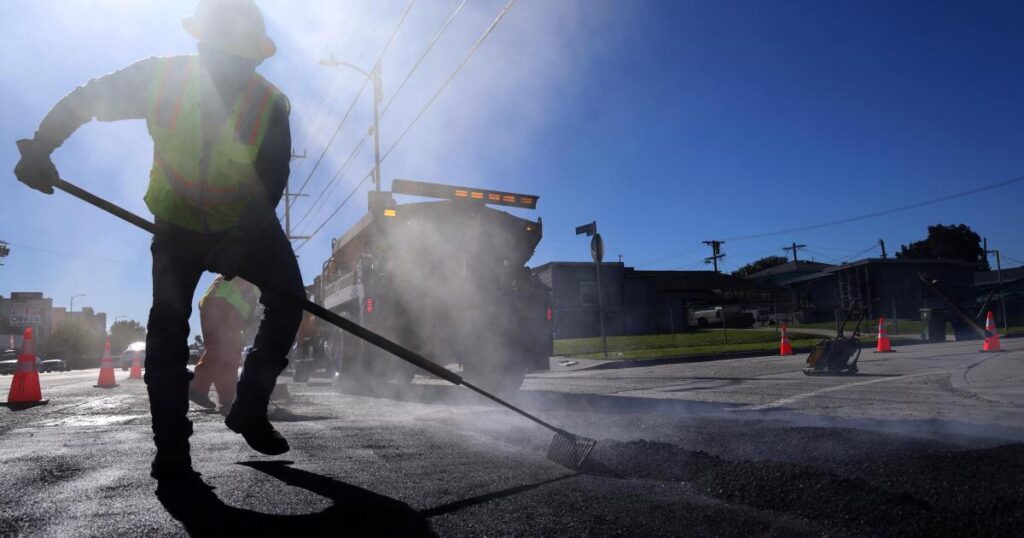
In just the last few weeks since Christmas Eve, crews have repaired more than 3,800 potholes and are working seven days a week to tackle the surge of new complaints, according to the Bureau of Street Services.
But when more potholes open up after a soaking, there’s a painful — and at times expensive — learning curve for memorizing all the new locations, Shin said.
“Potholes are a natural outcome of wear and tear from cars and vehicles driving, as well as water soaking into asphalt, and it takes time for them to form,” the bureau said in a statement. “Increased potholes are a very common occurrence during wet weather events.”
When it rains, moisture seeps into fissures in the road and weakens the asphalt, which can break apart and buckle under the weight of passing cars and trucks.
Rain that gets through cracks in the pavement softens the soil beneath, causing more deformation under traffic loading and leading to more cracking, according to Jonathan Stewart, professor of civil and environmental engineering at the UCLA Samueli School of Engineering. “It’s a cycle of progressively enhancing degradation,” he wrote in an email.
People have been complaining about the progressively enhancing degradation in the city for weeks. One pothole on South La Brea Avenue in West Adams reportedly damaged 15 vehicles in the half-hour after it formed early this month, prompting police to temporarily shut down a portion of that street until the crater could be coned off. That hole has since been filled.
“Here’s the bill for the front tire and rim that was damaged,” said a man in a video posted to X last month as he held up a receipt for $2,824.31 before panning the camera over a large pothole he said his son had hit 2 1/2 weeks before.
Generally, more potholes means more financial claims against the city because it is on the hook for compensating drivers for damage on its streets if it knew or should have known about the potholes and had sufficient time to fix them.
According to the city attorney’s office, drivers have filed 284 pothole-related vehicle damage claims against the city since the rainy season started Oct. 1.
Meanwhile, the city’s total annual costs from Bureau of Street Services-related litigation — which include payouts and staff time related to claims arising from pothole damage and other issues — have been rising steadily, from $13.9 million in 2020-21 to $58.4 million in 2024-25, according to the Department of Public Works’ most recent budget request, which attributes the costs to the deteriorated condition of city streets and sidewalks.
It is still too early to tell how this year’s winter will measure up with past ones when it comes to street damage, but the pothole problem is nothing new in Los Angeles, where the streets become a veritable minefield following any stretch of significant storms. And it’s usually followed by political bluster.
In January 2005, at least 1,200 potholes opened up after weeks of record-setting rainfall, according to an L.A. Times report. Mayor James Hahn patched one during a news conference he called to draw attention to the city’s response, saying that such fixes were “one of those ways to let people know what government is doing.” His father, former L.A. County Supervisor Kenneth Hahn, famously promised a dollar to anyone who could find a pothole in his district.
Another big year for potholes was the exceptionally wet 2023, when L.A. diverted crews from other regular duties to focus on fulfilling roughly 19,642 pothole repair requests the city had received over four months. That April, Arnold Schwarzenegger made headlines for taking matters into his own hands and filling what turned out to be a service trench for gas line repairs.
Still, some fear the current condition of L.A.’s streets may worsen despite the efforts of city crews, as Los Angeles has been prioritizing patching roads over repaving them in their entirety lately. However, the Bureau of Street Services is planning to initiate new repaving projects as soon as possible, said Dan Halden, director of external relations.
“Street resurfacing — a core component of the Bureau’s responsibilities — has always been expected to take place later this fiscal year,” he wrote in an email.
The post L.A. is awash in potholes after record rains, making commutes ever more treacherous appeared first on Los Angeles Times.