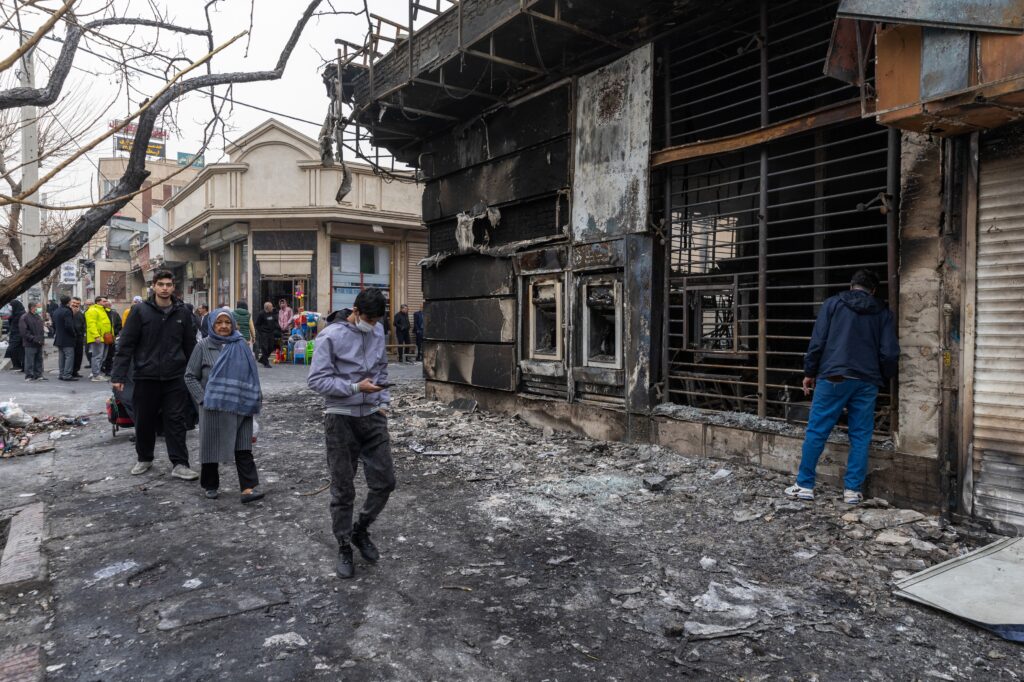
ISTANBUL — Deep divisions in the Iranian opposition dating back decades now pose a significant challenge to efforts at delivering change in Iran, where security forces have unleashed a ferocious crackdown against anti-government protests that have reached a level unseen in many years.
In the absence of any clear opposition leader inside the country, Reza Pahlavi, the son of Iran’s shah deposed in 1979, has stepped into the vacuum, calling from the United States for demonstrations and work strikes. After he summoned Iranians to the streets last week, enormous crowds turned out to vent their rage, which has quickly evolved from dissatisfaction with dire economic conditions to outright demands for overthrowing the government.
Since the demonstrations erupted, sparked initially by the collapse of the Iranian currency, more than 2,500 people have been killed, according to one human rights group, and protests have taken place across the country and among various economic sectors, classes and ethnic groups.
The country’s opposition is equally diverse, including ethnic minorities, republicans, monarchists, leftists and former supporters of the Islamic Republic. Groups hold passionate and differing views, for instance, on what form a future government should take and on the degree of regional autonomy that should be given to Iran’s minorities.
No matter the size of the protests, political experts say that a divided opposition makes it less likely that the regime would fall peacefully. And they say that without a unified, organized opposition, it could be difficult to attract the sizable portion of Iranians who may oppose the Islamic system but are reluctant to protest without greater confidence in a smooth transition.
No other opposition figure has Pahlavi’s name recognition or the nostalgia that his name evokes. Most Iranians alive today were born well after the 1979 Islamic revolution, when his father, Mohammad Reza Pahlavi, was ousted as the shah of Iran following nearly four decades in power. As economic misery and international isolation have deepened, Iranians have increasingly looked to the prerevolutionary era as a time when Iran was prosperous and respected.
But rather than try to forge a coalition with Iranians from other political traditions, as he attempted last time there was major unrest in Iran, Pahlavi has this time presented himself as the uncontested leader of the opposition, pointing to the fact that protesters inside the country have often chanted pro-monarchy slogans. Due to an internet shutdown by the government, it remains unclear whether people have heeded Pahlavi’s call to strike in key sectors of the economy.
“Many people who chant ‘Long live the Shah’ and ‘this is the final battle! Pahlavi will return’ clearly want the return of constitutional monarchy and the Pahlavi dynasty,” said Andrew Ghalili of the National Union for Democracy in Iran, a nonprofit in Washington aligned with Pahlavi. “But the Crown Prince’s support in Iran is not limited to monarchists — who are a very large section of the Iranian population. He has a strong support base among republican Iranians who reject the clerical rule and see Crown Prince Reza Pahlavi as the only leader who can guide Iran through revolution and then transition to democracy,” he wrote in an email.
Interviews with members of Iran’s opposition and their public statements show that many remain suspicious of Pahlavi’s claim to leadership, putting a ceiling on his support and potentially spelling trouble if Iran’s government were to collapse.
Riven by disagreements
The potency of these divisions became apparent in 2023, the last time Iran was convulsed by nationwide protests. The most prominent figures of the fractious Iranian diaspora opposition announced they had formed a coalition to work toward a secular, democratic Iran. Its members, including a women’s rights activist, a well-known actress and Pahlavi, agreed to set aside their deep differences to bring an end to Iran’s theocratic system, gripping each other’s hands in a show of unity. That image, and their comments, were broadcast by Persian-language satellite channels and closely followed by Iranians inside the country.
“We may not agree on every single thing,” Pahlavi said at the event. “What is important is that we do not lose momentum.”
But less than two months later, the coalition had fallen apart, riven by disagreements over membership, a lack of strategic thinking and organizing, and the harsh opposition of much of Pahlavi’s base of support, according to public and private accounts from several people involved.
“If the Crown Prince was the problem, and other members of the coalition had significant support among Iranians, then the rest of the … coalition should have been able to operate, mobilize, and lead without him,” said Saeed Ghasseminejad, a Pahlavi adviser and a senior Iran and financial economics adviser at the Foundation for Defense of Democracies, a Washington think tank, in an email.
In addition to Pahlavi’s followers, there are today several other significant political movements and figures within the opposition. Outside Iran, the opposition includes Masih Alinejad, an activist and journalist based in the U.S. who has fought against Iran’s compulsory hijab law and was a key member of the 2023 coalition. She declined to comment for this article.
Inside the country, harsh repression by the Iranian government has hobbled civil society and robbed it of its most charismatic and popular leaders, though some have continued to speak out and organize despite great risk. In the early days of the protests, for instance, 17 Iranian civic activists, journalists and former government officials issued a statement calling for a peaceful transition away from the Islamic Republic.
The signatories included Mostafa Tajzadeh, a former deputy interior minister during Iran’s reformist era who is now in prison and has been in and out of jail for much of the period since 2009. He has called for an end to clerical rule through an elected constituent assembly but also opposes the violent overthrow of the government. Narges Mohammadi, another signatory, won the Nobel Peace Prize in 2023, while she was serving a lengthy prison sentence related to her human rights work. She was released on medical leave in late 2024 but was violently arrested in December by security forces.
Divided over Pahlavi
Ammar Maleki, a political scientist at Tilburg University in the Netherlands who conducts public opinion polling in Iran, said his research has found that Pahlavi has strong support among one-third of Iranians and strong opposition from another third, with the rest being undecided and open to supporting him based on the context.
“Just with protest and even with the support of two-thirds of society, you cannot change the regime without international support,” Maleki said. “And even if the regime is changed, you cannot achieve stability without accommodating other opposition groups.”
Interviews with protesters in Iran showed that even among Pahlavi’s supporters, there are nuanced views on him and his future role.
“I fully support the return of the prince,” said Nazanin, a 35-year-old woman from Semnan, in an interview conducted before Iran’s internet blackout. “He is the best option for leading this revolution now.”
“I personally believe in the symbolic role of Reza Pahlavi as a leader of the transition period” rather than as a future ruler of Iran, said Davoud, a man in his mid-40s in Mashhad, in an interview before the blackout. Both spoke on the condition they would not be fully identified for fear of reprisals.
“I would never have supported this guy in the past,” said a woman in western Tehran in a voice message provided by an intermediary to The Washington Post in the midst of the internet blackout. “But we have no other option. There is no way back, only forward. If we don’t rally around him and unite, we will be buried here.”
Role of ethnic minorities
Pahlavi’s support varies across the country and is lower in areas heavily populated by Iran’s ethnic minorities, such as Kurds, Azeri Turks or Baluch, Maleki said.
Fariba Baloch, a civic activist based in London who advocates for the rights of Iran’s Baluch minority, said Pahlavi had failed to reach out to ethnic minorities to understand their needs or provide a plan for how mass protests would lead to the toppling of the regime. “When he accepts responsibility and says ‘I’m a leader,’ he must specify his next steps,” Baloch said.
Abdullah Mohtadi, secretary general of the Komala Party of Iranian Kurdistan and a core member of the 2023 coalition, also said that Pahlavi had, to his knowledge, not reached out to Kurdish groups to initiate a dialogue. The breadth of Iran’s ethnic and political diversity “is not reflected in his policies nor his performance nor in the plans he has put forward,” Mohtadi said.
Ghalili rejected such criticism of Pahlavi, saying he has been a unifying figure who has reached out to ethnic minorities, women’s activists and dissidents. “Crown Prince Reza Pahlavi’s approach has been deliberately inclusive and principle-based, focused on Iran’s territorial integrity, human rights, secular governance, and democratic choice,” Ghalili said.
And Ghasseminejad said that Pahlavi’s coalition included ethnic and religious minorities and people of different political beliefs, unified by their support for Pahlavi’s leadership.
While many opponents of the Iranian regime largely share a hope for a democratic, pluralistic future, some worry that Pahlavi’s emergence as the most prominent opposition figure opens the door for an opposite outcome. Mahdieh Golroo, a journalist and activist who was imprisoned in Iran and now lives in Sweden, said that she fears that the elevation of one single figure would result in another totalitarian government.
Some members of the opposition are now, in part, blaming themselves and their own allies for not offering Iranians an alternative that they could turn to.
“Over the past two years, I have been a member of countless groups of people who thought like me, but could not put aside small differences and work together (I certainly am not innocent here),” said Kaveh Shahrooz, an Iranian-Canadian lawyer and human rights activist, in an Instagram post last week.
He called for people who shared a desire for a democratic Iran to finally form a united front. “This may be the most critical moment in Iran’s history in recent decades,” he wrote. “We have a moral responsibility to act now. Tomorrow will be too late.”
The post Iran’s opposition is clamoring for leaders but hobbled by divisions appeared first on Washington Post.