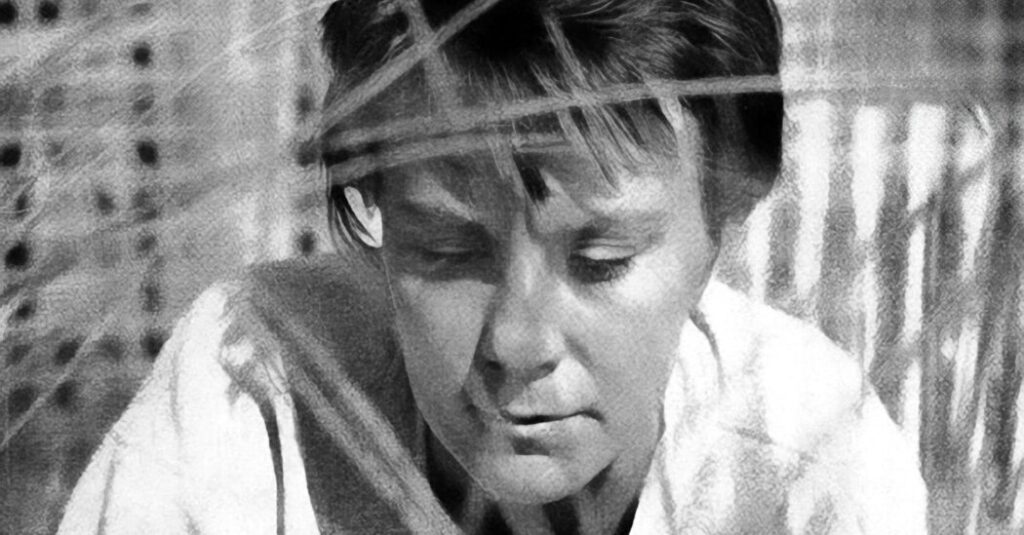
The letters cover more than two decades and in them Harper Lee discusses growing old, her aversion to public attention and her opinions of fellow writers like Truman Capote, Tennessee Williams and Eudora Welty.
But one of the most compelling parts of a previously undisclosed trove of correspondence between Lee and a writer friend are those that provide a fuller view of her take on the Deep South’s transition from Depression-era segregation to the Civil Rights movement.
In one letter from 1992, Lee provides the younger writer, JoBeth McDaniel, with a short history of the deprivations of the 1930s, the growing affluence after World War II and then the response of white Southerners as Black neighbors staked a claim to be treated as equals.
“Many Christians were challenged for the first time to be Christians,” Lee wrote, adding, “What was heart-breaking was to discover that people you loved — friends, relatives, neighbors — whom you assumed were civilized, harbored the most vicious feelings.”
Matters of race and justice are at the core of Lee’s two novels, “To Kill a Mockingbird” and “Go Set a Watchman,” which both take place in the imagined town of Maycomb, modeled after Lee’s birthplace, Monroeville, Ala.
In the dozens of letters that Lee wrote to McDaniel, who also grew up in Alabama, she also spoke about the private segregated schools that spread as an answer to government desegregation, calling them a source of “human misery,” and not just for Black students.
The schools, Lee wrote, created “a new social stigma” and “tracks dividing white from white,” separating those with money from those without. She had thought of writing about that dynamic, Lee added, but suggested that she lacked sufficient personal experience, saying: “I’d be writing as a bystander, a witness to a scene of an accident.”
Charles J. Shields, the author of a biography, “Mockingbird: A Portrait of Harper Lee,” called her letters to McDaniel significant because they broaden our understanding of Lee’s view of Southern society.
“This is a marvelous opportunity to take a more nuanced view of Harper Lee,” he said.
Though not as reclusive as J.D. Salinger or Thomas Pynchon, Lee gave her last formal interview in the 1960s. She then avoided statements or speeches, even when occasionally showing up at public events. She was mortified when people focused on her anyway.
“It was truly awful,” she wrote to McDaniel about attention from reporters when she accepted an honor at a ceremony in 2001. “Never again.”
As a result, Lee’s letters have assumed an outsized importance in providing a record of the second half of a reluctant luminary’s life. McDaniel is among some half dozen people who have come forward with letters from Lee, primarily since her death in 2016.
Others by Lee have been offered for auction or acquired by a university. A few letters have been published by news organizations. Wayne Flynt, a former history professor at Auburn University, included several letters Lee sent him in a book about their relationship.
“In a sense the letters were her autobiography,” said McDaniel, who is working on a memoir of her 30-year friendship with Lee and looking for a way to preserve her correspondence.
“To Kill a Mockingbird,” which won the 1961 Pulitzer Prize for fiction, sold more than 40 million copies and became one of the beloved books of the 20th century. It is narrated by Scout, a young white girl who learns that racial injustice is an accepted fact of life in Maycomb in the 1930s when her father, a lawyer named Atticus Finch, depicted as the moral conscience of the town, defends a Black man unjustly accused of raping a white woman. Despite evidence of innocence, the man, Tom Robinson, is convicted and then killed while trying to escape.
In “Go Set a Watchman,” which began as a draft of “Mockingbird,” but was published in 2015 as a separate book, Lee told another story about Maycomb, set in the 1950s. Scout, then living in New York, returns home and is disillusioned by the discovery that Atticus has racist beliefs and once attended a Ku Klux Klan meeting.
Lee had already retreated from fame by the mid-1980s when she met McDaniel, then 25. The two were introduced, McDaniel said, by a mutual friend who thought they might get along in part because each grew up in a small town in lower Alabama.
Though she was still widely admired, Lee, who never married, had recently hit a rough patch, McDaniel said, losing her literary agent and drinking more than was healthy. McDaniel, who went on to write for Life magazine and other publications, said she had difficulties of her own, including the death of her mother the year before.
McDaniel came to see Lee as a surrogate parent, “a strong person with a moral core” whom she depended upon for blunt counsel about writing and relationships.
“I appreciated her love for me and her guidance,” McDaniel said, adding: “She was just like a rock in my life.”
The two women took long Amtrak rides together, McDaniel said, adding that she also visited Lee regularly in Monroeville and in Manhattan, where Lee had a small book-filled apartment on the Upper East Side. Although Lee “prized anonymity,” McDaniel said, she had friends and an active social life there, where she could visit museums and dine in restaurants without the scrutiny that was inevitable in Monroeville.
“She was invisible in New York, in ways she couldn’t be in Alabama,” McDaniel wrote in an email. “And she loved that.”
After Lee’s death at the age of 89, McDaniel said friends began urging her to have the notes and letters from Lee cared for by professional archivists.
Now, McDaniel said, she is looking into the possibility of a long-term loan to a library or academic institution that would safeguard the documents and make them available to scholars.
In notes and letters to McDaniel, Lee emerges as a witty, sometimes mordant, correspondent, mixing her analysis of social ills, with thoughts and advice on writers and writing. In one letter, she emphasized the importance of narrative and plot: “You can be literary as hell BUT WHAT HAPPENS NEXT?” At another point, Lee said a historical novel required research but cautioned against too much, adding: “You’ll produce something the length of Proust and possibly just as boring.”
She described Eudora Welty as “Miss God” and said that “The Color of Water” by James McBride, a memoir of growing up Black with a white mother, “broke my heart.”
Of all Dylan Thomas’s poems, Lee wrote, “Do Not Go Gentle Into That Good Night” was not only the “most glamorous” but “the only one worth anything.”
Her descriptions of Capote, a childhood friend in Monroeville and the model for the precocious character Dill in “Mockingbird,” were unsparing — a reflection, McDaniel said, of Lee’s habitual directness. “Every lousy deed (and there were many) of his life arose from his being intensely jealous of someone or envious of his possessions,” Lee wrote in one letter. She added: “He nearly drove Carson McCullers crazy, copying her style & content” — a notable remark, given the fact that McCullers had once referred to Lee as “poaching on my literary preserves.”
The most consistent element in Lee’s letters to McDaniel is humor, sometimes barbed, at other times used to make light of worrisome subjects or to temper critical opinions.
After cataract surgery in 2003, Lee wrote: “Just made it back before the world began to look like special effects from ‘The Mummy’.”
In the letter from 1992 where she delivered her emphatic critique of Southern resistance to desegregation, Lee added a postscript that hit a softer note. “Please ignore all typos, punctuation errors, and loony grammar,” she wrote. “These old hands are as arthritic as my brain.”
ᐧ
The post In Letters to a Friend, Harper Lee Expanded on Her View of the South appeared first on New York Times.