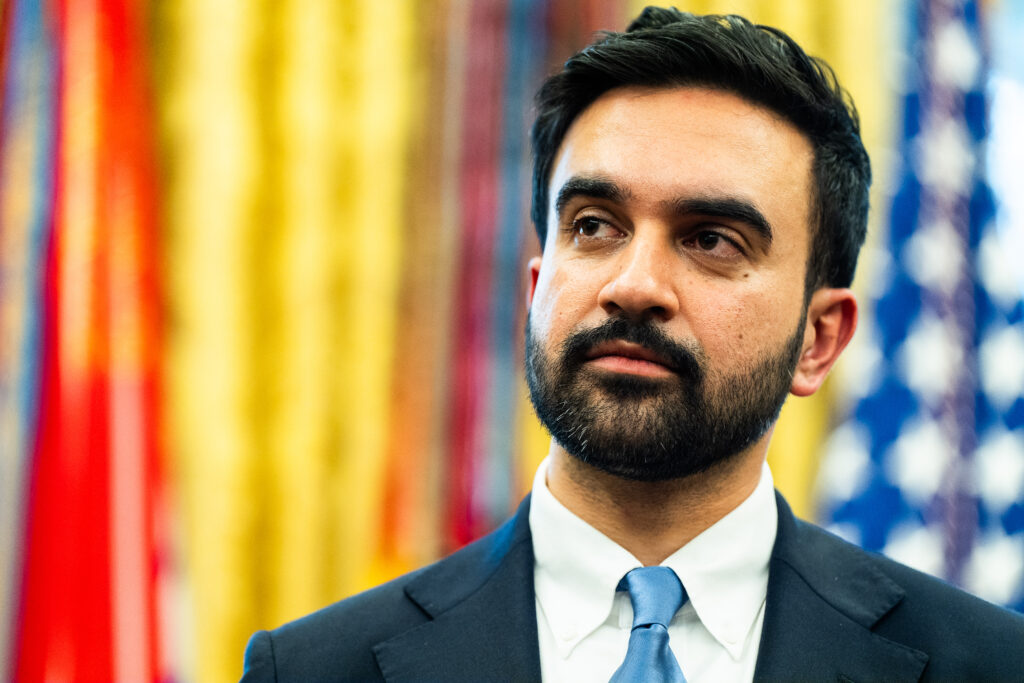
It’s somewhat remarkable to me that Zohran Mamdani is now the mayor of one of the world’s greatest cities. It’s a reminder that democracy works, that dark horses and so-called radicals can win elections if they’re able to persuade enough of their fellow Americans to come along with them. Democracy should be unpredictable — a system that produces unlikely possibilities and allows voters to hope in the seemingly improbable.
As an American Muslim millennial, I still find it hard to believe that someone who reminds me of myself could rise to the mayorship of New York. The question of how Mamdani — an unabashed socialist who unapologetically calls Israel’s actions in Gaza a “genocide” — pulled off such an upset has been the subject of numerous accounts and profiles. I’m more interested, however, in what might be called the Mamdani Model, one that insurgent Democrats can replicate, assuming they have the courage.
From 2014 to about 2023, and peaking in 2020, Democrats fell under the sway of “woke” ideas that prioritized divisive cultural issues such as transgender rights and reducing funding for police. In those years, there was widespread backlash against White men, who were increasingly denied employment opportunities in elite institutions. As Jacob Savage documented in his viral essay “The Lost Generation,” the rise of diversity, equity and inclusion meant that Hollywood, newsrooms and universities — in the name of prizing diversity over all else — made it challenging for White millennial men to gain a foothold in the creative professions.
The election of Donald Trump in 2024 and his jihad against DEI ended the “peak woke” preoccupations of the preceding years. Meanwhile, a growing number of Democrats and liberals have acknowledged that things may have gone too far, alienating too many Americans who might have otherwise been sympathetic to Democratic Party’s economic message but couldn’t get on board with an expansive and aggressive cultural agenda.
In 2020, that summer of discontent, Mamdani was where many progressives were, heralding the moment ignited by George Floyd’s murder as an unprecedented reckoning. Not only did Mamdani wish to cut funding to police, he called the New York Police Department “racist, anti-queer & a major threat to public safety.” During his campaign for mayor, Mamdani apologized for his comments. Though he still spoke out for trans rights, namely in a two-minute ad released in October, cultural issues were far from his primary focus. Instead, he relentlessly emphasized “affordability” as his signature campaign theme.
The writer Ross Barkan has been perhaps the most insightful chronicler of all things Mamdani. He hired then-obscure Mamdani as his campaign manager in his 2018 bid for a New York state Senate seat. As Barkan notes, “You look at his 2020 statements, you’d see a very woke politician. … Knowing him from 2018, though, I don’t remember him being overly woke. I can say he was someone who’s always a pragmatist in that way. [When] we were campaigning, he was thinking, how do we appeal to moderates? How do we appeal to conservatives?”
Something else changed after 2020. In defeating Kamala Harris by a clear margin in 2024 and making inroads with culturally conservative Hispanics, Black men, Arabs and Muslims, Trump effectively declared victory in America’s culture war. But even before that and perhaps more importantly, Oct. 7 happened. For the left after 2023, Gaza eclipsed “wokeness” as the defining issue of a new era. To be a progressive increasingly meant recognizing the horrors of Israel’s war on Palestinians in Gaza and the West Bank. And, on this — maybe more than anything else — Mamdani found himself on the right side of history. It’s fair to say that he wouldn’t have gained as much traction had Oct. 7 not occurred. And he probably wouldn’t have become mayor of New York.
The two issues dearest to Mamdani’s heart are Palestine and the affordability crisis. “Palestine is the through line for Zohran,” Barkan says. Mamdani is open to compromising on other issues, but he holds the line on these dual concerns. This allows him to be at times ruthlessly pragmatic — for example, in keeping the decidedly not progressive Jessica Tisch as police commissioner — while maintaining his reputation as a principled leftist who will not buckle under pressure. Because what it means to be a dyed-in-the-wool leftist has changed.
Before Oct. 7, I questioned whether it made sense to see myself as a progressive, even though I had volunteered for Bernie Sanders’s presidential campaign in 2020. Back then, I was “anti-woke,” and it bothered me that so many on the left had embraced cancel culture, indulging in mob justice to silence views not to their liking. I didn’t believe in racial preferences in hiring, seeing that as an attack on the meritocratic ideals that made America great. As a Muslim, I worried about the hard-line secularism that seemed to be animating progressives. The Democratic Party, I thought, should be a big tent for cultural liberals and cultural conservatives alike. But the tent was narrowing.
Now, the tent is expanding. As long as you’re “pro-Palestine” and economically progressive, you can probably find a place for yourself in today’s Democratic Party. That’s a good thing. Or, at least it’s a good thing if you’re a Democrat who wants to see your party compete more effectively with Republicans on the state and national level.
There are limits to Mamdani’s post-woke model. In the culturally liberal environs of New York, where most people are already sympathetic to LGBTQ+ rights, you don’t necessarily need to go out of your way to highlight your support. It’s largely a given. These days, wokeness may be a bit cringe, but it’s still in the background, especially with the young millennial and Gen Z women who make up a significant portion of Democrats’ voting base.
But being in the background means that issues such as Gaza will often seize the limelight, an unusual development in local politics where foreign policy isn’t necessarily top on voters’ minds. One can debate whether Gaza is merely a foreign policy issue, when it directly implicates billions of American tax dollars that go toward funding Israel’s assault on Palestinians. It’s also a moral marker, gesturing toward one’s own commitment to American principles such as the right to life and the pursuit of happiness.
It’s little surprise, then, that in the Democratic primary for Nancy Pelosi’s San Francisco congressional seat, Gaza has become a sort of litmus test for aspirants. At a candidate forum, California state Sen. Scott Wiener — and his two opponents Connie Chan and Saikat Chakrabarti — were asked whether they consider Gaza a genocide. Chan and Chakrabarti raised “yes” placards while Wiener did not raise either a “yes” or “no” placard, suggesting he was unsure. It would have been worse had he said no, but his equivocal stance still provoked a round of boos and heckles from the crowd. Faced with mounting criticism, Wiener, who is Jewish, subsequently released a video clarifying his position, saying “I’ve stopped short of calling it genocide, but I can’t anymore.”
In the Democratic primary for New York’s 10th Congressional District, which includes Lower Manhattan and parts of Brooklyn, the genocide question has divided the two main contenders, both of whom are Jewish and consider themselves Zionists. Rep. Dan Goldman, who holds the seat, signed on to a letter calling accusations of genocide “false” in 2024. But he has since softened his position, saying “I think there needs to be a serious investigation into what went on in Gaza during the war. What you call it is I think more of a legal matter, in my view, but what we all can agree on is that the destruction was unconscionable.” Meanwhile, his main challenger, Brad Lander — the former New York City comptroller who has received Mamdani’s coveted endorsement — recently began calling Israel’s actions a genocide.
That a growing number of Jewish elected officials, even those who have been staunch supporters of Israel’s right to exist as a Jewish state, are now more explicitly critical of Israel’s conduct in Gaza points to an important shift. Whether that shift is wholly sincere or more a product of caving to pressure from primary voters who are mostly opposed to Israel’s war in Gaza is perhaps a different question.
It may also mean that the very meaning of “wokeness” has changed, transforming itself from a question of culture to a question of whether the United States should continue supporting an Israeli government that now stands accused of the crime of crimes. Democratic contenders are increasingly recognizing — probably correctly — that it will be hard for them to win primaries if they alienate constituents on a key moral and political question. At least for some voters, it might be the key political question, a way of distinguishing the moral caliber between candidates who otherwise aren’t that different on the cultural questions that had previously bedeviled Democrats. At least so far, this is what the post-woke moment looks like.
The post How Mamdani shows Democrats the way beyond wokeness appeared first on Washington Post.