It began in Los Angeles, in Signal chats and strategy sessions on Zoom. Last year, as immigration raids proliferated throughout the city, Latino activists and neighbors began organizing a response, monitoring for Immigration and Customs Enforcement agents along sidewalks and in Home Depot parking lots and texting their networks when they spotted an arrest underway.
By late summer, activists in Chicago were trained and ready. Before the Trump administration had announced a crackdown called Operation Midway Blitz, immigrant rights organizations had handed out orange whistles for volunteers to use as a public warning system, formed “rapid-response” groups and advised people to report sightings of ICE agents and memorize their own legal rights. Chicagoans, even many without formal ties to protest groups, showed defiance against ICE with “Hands Off Chicago” signs adorned with the city’s beloved starred-and-striped flag, placed prominently in windows of restaurants and bungalows.
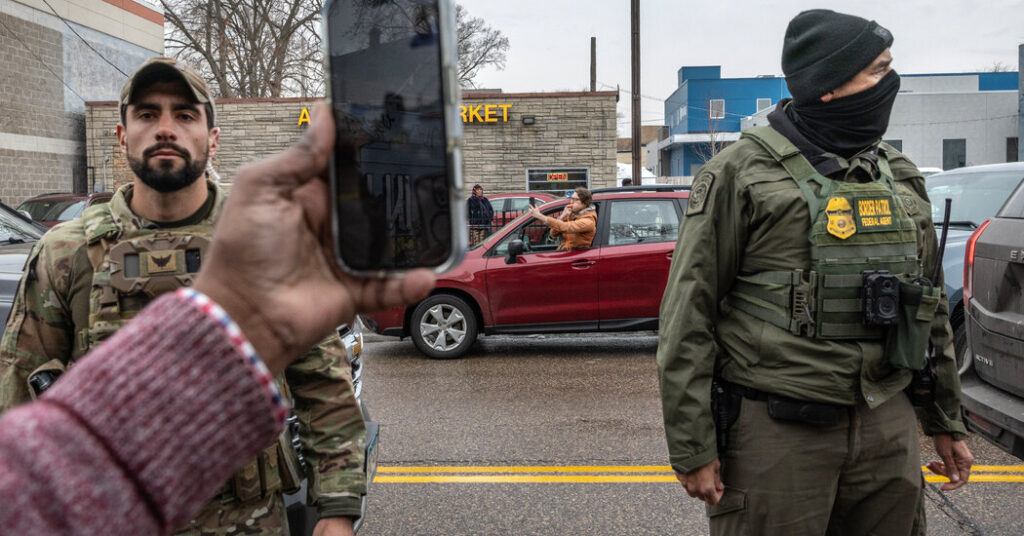
And in recent weeks in Minneapolis, the latest focus for a Trump administration surge of immigration enforcement, a loose but growing network of neighborhood volunteers has shown up near reported arrests, yelling at agents and recording them on iPhone cameras. Some gathered near hotels where agents were believed to be staying, pounding drums and making noise.
President Trump’s sweeping effort to tamp down illegal immigration, using masked federal agents who film their interactions with cellphones and often question American citizens about their legal status, has set off a surge in confrontational activism fueled by both large liberal advocacy groups and hyperlocal neighborhood networks.
In Los Angeles, Chicago and Minneapolis, established groups representing labor and immigrant rights have provided funding and organized downtown rallies against the Trump administration. But fierce opposition to ICE and the Border Patrol has also sprung up through block clubs, neighborhood group chats, school Facebook groups and Catholic parishes, stretching beyond the typical Democratic voter base.
Participants say they have been propelled into action with two goals in mind: an urge to protect their neighbors, many of whom are in the country without authorization but have no criminal backgrounds, and also to push back against what they see as a violent and overreaching federal government.
“It’s a lot of people who wouldn’t normally involve themselves in politics, but at the same time don’t like what’s happening in their community,” said Sandra Trevino, a Chicago resident who works in sales but spends her weekends patrolling the city for immigration agents and texting her networks with updates.
Kristi Noem, the Homeland Security secretary, has called the actions of such activists dangerous, part of “a coordinated campaign of violence against our law enforcement.”
In Minnesota, where an ICE agent fatally shot a 37-year-old woman, Renee Nicole Good, last week, tensions have mounted since an immigration crackdown began there in early December. Some Minnesota residents have thrown icy snowballs or other objects at agents, called them Nazis and fascists and trailed them in their cars, honking their horns, a practice frequently used in Chicago last year.
“Secretary Noem has been clear: Anyone who obstructs or assaults law enforcement will be prosecuted to the fullest extent of the law,” the department said in a statement on Tuesday.
Federal investigators are looking into Ms. Good’s possible connections to activist groups, and Mr. Trump has described Ms. Good and her wife, Becca Good, as being “professional agitators,” though he offered no evidence to support his claims.
It is not yet clear how deeply the Goods were connected to anti-ICE efforts in Minneapolis. Becca Good was wearing an orange whistle around her neck as she confronted federal agents while filming them with her cellphone, videos show, moments before Renee Good was fatally shot in her car.
In a statement issued to Minnesota Public Radio, Becca Good suggested that the two women had taken part in a protest on the day of the shooting, but their involvement beyond that day is unknown.
“On Wednesday, Jan. 7, we stopped to support our neighbors,” Becca Good said. “We had whistles. They had guns.”
Anti-ICE tactics by volunteers and so-called patrollers who track and follow immigration agents in caravans have only intensified in the Twin Cities in the last week, despite Ms. Good’s death, activists and officials said in interviews.
Some people wondered if Ms. Good’s death would lead to a broader reckoning by organizers about the risks of confronting ICE agents, and the safety of pursuing them in cars. But group chats on WhatsApp have proliferated, as neighbors watched for signs of immigration agents and rushed outside to confront them.
Ashley Lopez, who works in education and lives in the city of West St. Paul, has become active in anti-ICE neighborhood groups only in the week since Ms. Good’s death.
“Because of what happened to Renee, I felt like we had nothing to lose anymore,” said Ms. Lopez, who has joined patrols that blow whistles and set off their own car alarms if they see ICE agents. “Why should she be the only one who put herself in danger?”
Tensions between federal agents and Minnesotans are intensifying on sidewalks, in parking lots and on the streets. Some activists said they have also observed increasingly forceful responses by ICE and Border Patrol agents since Ms. Good’s death, with agents chasing patrollers through parking lots and spraying their vehicles with chemical agents.
Dieu Do, an immigrant rights activist, said that before the immigration crackdown in Minneapolis, her organization received dozens of emails a day from people asking how they could get involved. That has now grown to hundreds daily.
“People are still showing up and defending their community despite seeing such a violent act,” she said. “They’re calling for justice, even though there is a chance they could be hurt in the process.”
Patrollers in Chicago said this week that they were still roaming around the city looking for ICE agents. But many of their Signal chats and Facebook groups have gone quiet, a sign that the Trump administration’s focus has shifted squarely to Minneapolis — at least for now.
That feels far different from how it did in Chicago last fall, when masked federal agents walked down the Magnificent Mile downtown, startling residents and tourists. As residents began protesting their presence in neighborhoods, agents used aggressive methods to disperse crowds, releasing tear gas and pepper spray along blocks around the city.
“In a way, it really galvanized local support against them everywhere they went,” said Brandon Lee, a coordinator for the Illinois Coalition for Immigrant and Refugee Rights. “When they release tear gas in a neighborhood, it doesn’t matter if you support ICE or not. You’re going to get tear-gassed.”
Organizers in Chicago said that during Operation Midway Blitz, they had been able to hone practices borrowed from Los Angeles activists as hundreds of Border Patrol and ICE agents made arrests around the Chicago region.
“The Border Patrol and the Trump administration used Chicago as a testing ground, and we in turn used them as a testing ground right back for certain organizing tactics,” said Joanna Klonsky, a media strategist in Chicago.
That included rapid response networks, the tactic of following ICE and C.B.P. vehicles with whistles and being as loud as possible to warn people nearby.
“We’re now at a point where there is a playbook for peaceful, legal opposition,” Ms. Klonsky said.
Organizers in Los Angeles and Chicago said they were watching Minneapolis closely and anticipating where Mr. Trump would plan his next surge of immigration agents. Groups in New York City have passed out thousands of whistles so far, bracing for a high-profile surge of immigration enforcement.
“Folks are realizing that the only way to respond is quickly, and in person,” said Alida Garcia, a political consultant who has been organizing in Los Angeles. “What is interesting about this moment is, if it’s your employee you’re protecting, or your kid’s teacher that you’re protecting, or the street vendor you buy tacos from once a month, that feels very personal.”
Julie Bosman is the Chicago bureau chief for The Times, writing and reporting stories from around the Midwest.
The post How ICE Crackdowns Set Off a Resistance in American Cities appeared first on New York Times.


