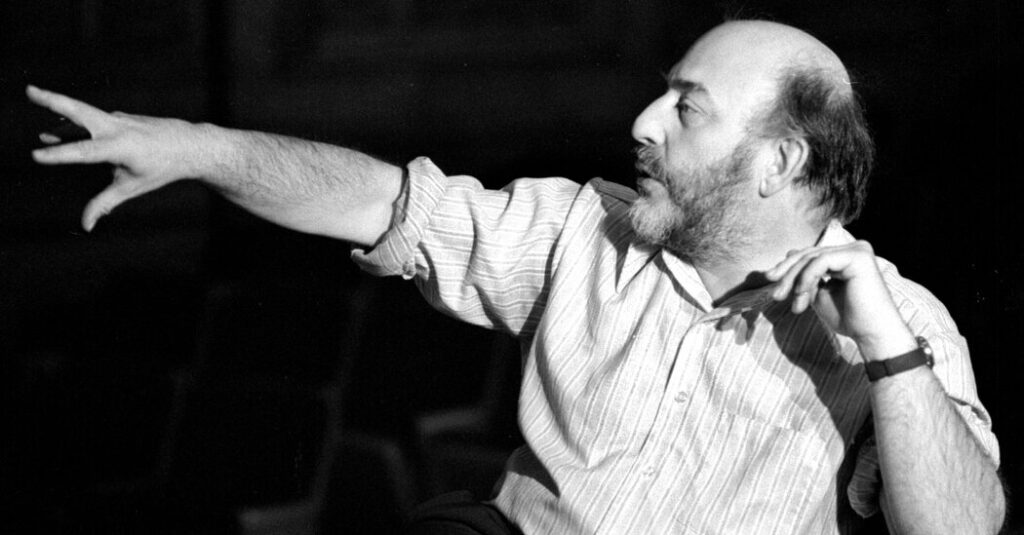
Frank Dunlop, a boundary-pushing British director who infused the London theater scene with an Age of Aquarius spirit by founding the iconoclastic Young Vic theater company, and who later brought his maverick sensibility to the Brooklyn Academy of Music, died on Jan. 4 in Manhattan. He was 98.
His death, in a hospital, was from complications of a stroke, his friend Julie Nives said.
Mr. Dunlop established the Young Vic in 1970 under the aegis of the acting titan Laurence Olivier, the director of the National Theater, which was founded in 1962 and housed at London’s venerable Old Vic.
The Young Vic, which Olivier called “Frank’s baby,” built a home on the South Bank of the Thames just down the road from the Old Vic, which had once been called the Royal Victoria Theater. As the name implied, the Young Vic initially served as the National’s youth-oriented offshoot: a “paperback theater,” as Mr. Dunlop called it, shorn of traditional class distinctions and pomp and centered on daring, unorthodox productions.
Aiming to lure swinging London’s young adults away from rock concerts and discothèques, the Young Vic, with fewer than 500 seats, offered tickets at teen-friendly prices. It presented itself as “a kind of open university of the arts and a firework display to provoke the imagination,” as Mr. Dunlop put it in an interview with The New York Times in 1969, when plans for the theater were announced.
“We want young people to feel that this center is theirs in every way,” he said. “We want them to feel free to drop in for a film, listen to music — classical or rock — or just sit and argue.”
Underscoring the theater’s reputation for cool, the rock group the Who tested new material for what would become the band’s landmark “Who’s Next” album in a performance at the Young Vic in the spring of 1971.
The Times theater critic Clive Barnes described the Young Vic as “Britain’s people’s theater, a pop group devoted to classic ideals.”
By all accounts, Mr. Dunlop was the right man for the job. Already established as a rising-star director and leader of groundbreaking theater companies, he came off in person as “a merrily bubbling volcano,” as the critic Michael Billington wrote in The Times of London in 1967.
“Ideas, plans, suggestions issue from him like lava,” he added.
The Young Vic made its mark in 1970 with “Scapino,” an irreverent Dunlop-directed take on a 17th-century farce by Molière. Its characters, in offbeat costumes, included a proper British toff and a hippie; one fight scene involved an oversize foam rubber sausage in place of a sword.
It was “as lively as an explosion of electric eels,” the critic Milton Shulman wrote of the show in The Evening Standard.
Mr. Dunlop’s other productions there included Samuel Beckett’s “Waiting for Godot,” Terence Rattigan’s comedy “French Without Tears” and an early version of “Joseph and the Amazing Technicolor Dreamcoat,” the musical that helped launch Andrew Lloyd Webber and Tim Rice toward stardom.
Along the way, Mr. Dunlop continued to direct for other companies. He guided a 1974 Royal Shakespeare Company production of “Sherlock Holmes” — the American actor William Gillette’s adaptation from 1899 — from London’s West End to Broadway, consummating what he once called a “15-year love affair” with American theater.
“This is not a very good play,” Mr. Barnes of The Times wrote in a review. Yet under Mr. Dunlop’s direction, he added, the production was “magic, you live with it, laugh with it and, strangest of all, even feel with it.”
Dividing his time between New York and London, Mr. Dunlop continued to oversee the Young Vic (which eventually split from the National to become its own company) while serving as the director of the Brooklyn Academy of Music Theater Company from 1976 to 1978.
While Downtown Brooklyn “might as well be Outer Mongolia” to some Broadway fans, The Guardian wrote in 1977, Mr. Dunlop helped establish a beachhead there, importing his exuberant “Scapino,” “Dreamcoat” and other productions.
Among his idiosyncrasies as a director, he loved to cast actors against type. His 1978 BAM production of Shakespeare’s “Julius Caesar” included the “lean and hungry Cassius,” as the critic Mel Gussow observed in The Times, played by the “short, chunky Richard Dreyfuss.” (Mr. Dunlop, a stocky 5-foot-4, had played Hamlet as a youth).
In stagings of “Caesar,” Mark Antony was typically played by “the glamour puss of the company, with a silver voice,” Mr. Dunlop said in an interview with Mr. Gussow. Instead, he cast the toothy character actor and playwright Austin Pendleton.
“In the theater, there is a convention that the man of action is a big man,” Mr. Dunlop said. “In the world, it is quite different. Great statesmen tend to be small men: Napoleon, Churchill. They work hard at trying to be tall men.”
Frank Dunlop was born on Feb. 15, 1927, in Leeds, England, one of two children of Charles and Mary (Aarons) Dunlop. His father was a mechanical engineer. Frank got his early education at Kibworth Beauchamp Grammar School (now known as Beauchamp College) in Leicester.
Drawn to theater from an early age, he played the lead in more than a dozen Shakespeare plays as a teenager. After a stint in the Royal Air Force, he enrolled at University College London, where he studied English literature.
He gained early experience starting a young people’s company, the Piccolo Theater, in Manchester. In 1956, he moved on to the Bristol Old Vic, founded as an offshoot of London’s, where he served as a resident director. Four years later, he made his London debut with “Les Frères Jacques,” a play he wrote and directed.
Mr. Dunlop held a variety of posts during the 1960s; in one, he founded the Pop Theater Company at the Edinburgh International Festival before going to work at the National under Olivier. He took a much-publicized turn running the Edinburgh festival from 1984 to 1991, and was credited with broadening its appeal while bringing in cutting-edge work from companies like New York’s avant-garde Wooster Group, featuring Willem Dafoe.
He continued to direct in the United States and abroad into the 2000s, spending his final decades living on the Upper West Side of Manhattan.
He leaves no immediate survivors.
As The Times of London recently noted, Mr. Dunlop once said that it would be “impossible for me to live with anybody — man, woman or dog, for any length of time.” For him, he added, enchanting audiences was “the best sort of lovemaking.”
Alex Williams is a Times reporter on the Obituaries desk.
The post Frank Dunlop, 98, Dies; Gave British Theater a Free-Spirited Spin appeared first on New York Times.