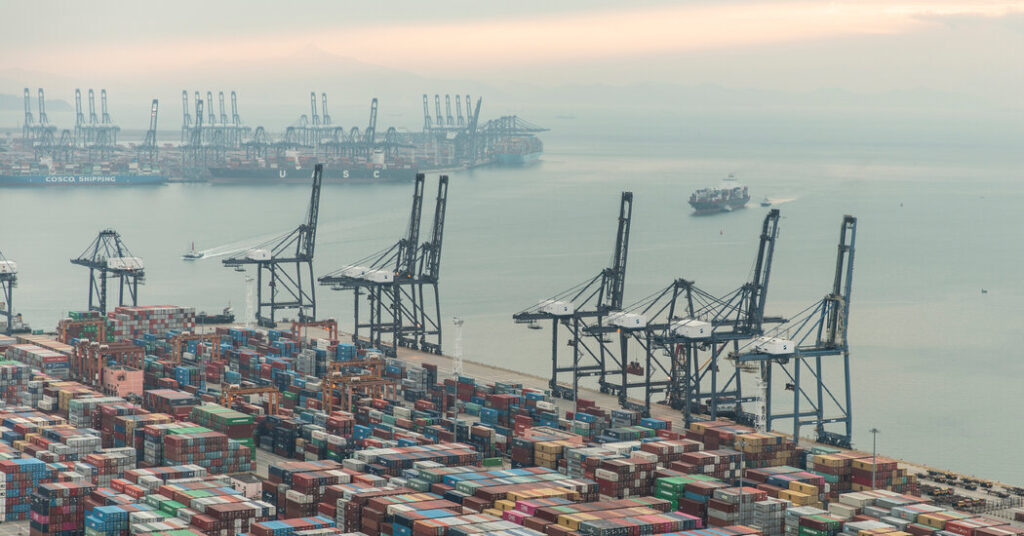
China’s trade surplus — the amount by which its exports exceed its imports — hit a staggering $1.19 trillion in 2025, according to official numbers released on Wednesday. The figure shows just how much China is an exporting powerhouse but is also a sign of its economic weakness and of how its practices pose a greater danger to free trade than even President Trump’s tariffs.
The tariffs undoubtedly took a hammer to free trade. With the United States retreating from its leadership role, China has tried to assume the mantle of being the promoter of globalization and the defender of the multilateral rules-based system that underpins global trade (which, incidentally, the United States played a major role in setting up).
China’s economic model has certainly delivered growth but in an unbalanced way. Investment in buildings, machinery and equipment became its main driver in recent years. That investment is, of course, good in that it raises productive potential. But with real estate investment declining because of falling housing prices, a lot of this investment has been undertaken by state-owned enterprises and is neither efficient nor profitable.
Still, all of this investment has meant the production of lots of goods. That sounds like a blessing but has instead spawned a problem. Domestic consumption has not kept pace with rising output because Chinese households are reluctant to spend freely. Facing uncertain employment prospects and the plunging value of their real estate, they have been stashing a lot of their earnings in savings. And household confidence seems to have taken a hit from concerns about the government’s economic management skills, further crimping demand.
When an economy produces more than it consumes, something has to give. One possibility is that prices fall, which tends to encourage consumers to buy more. But when households anticipate continually dropping prices, they might postpone consumption rather than increase it. China has been facing such deflationary pressures.
The only option left is to send surplus goods abroad. This is exactly what China has been doing, with its exports growing by leaps and bounds. The United States is the exception. Mr. Trump’s high tariffs on Chinese goods have resulted in exports to the United States falling sharply. This has meant that China has been increasing exports to its other trading partners, counting ever more on them to absorb its surplus output and keep its own growth on track.
Surely recipient countries should be grateful for inexpensive Chinese goods landing on their shores. The reality is that, unlike the U.S. economy, which has been powering along with relatively robust gross domestic product and employment growth, most other rich economies — such as the European Union’s, Japan’s and Britain’s — are in dire straits. Chinese exports are swamping their manufacturers, which are unable to compete. Even low- and middle-income countries have a difficult time countering Chinese exporters, strangling some of their companies.
This situation is unsustainable, and countries on the receiving end are fighting back. President Emmanuel Macron of France recently raised the trade issue with his hosts in Beijing. The European Commission’s president, Ursula von der Leyen, warned that Europe risked becoming a dumping ground for Chinese goods. Mexico has raised tariffs on imports from China, and other countries are likely to follow suit.
Beijing has countered with pleas for keeping trade free and open. But China cannot claim to be a fervent supporter of the global trading system when it is using those rules to its advantage and to the detriment of everyone else. For the second-largest economy in the world to rely on other countries to prop up its growth will only accelerate the breakdown of the rules-based system. In combination with Mr. Trump’s tariffs, the onslaught of Chinese exports will wreck what remains.
This is not to say that world trade will collapse. The benefits from trade and cross-border supply chains are so large that they will continue to grow. But trade is fragmenting in ways that reduce the benefits, especially if countries begin emphasizing trade with their geopolitical allies and try to shut out rivals. The fragmentation will leave poorer economies, which are only now integrating into global trade, worse off.
What could China do? It could get serious about fixing its growth imbalance and make changes, such as strengthening its social safety net, that would encourage its citizens to spend. The government has acknowledged this is a priority but shows no urgency to act, given that growth has stayed around its 5 percent target. Now that growth is at risk of weakening, the government might yet again resort to its old playbook of credit-financed investment to stimulate the economy, which would worsen the problem.
China’s central bank could allow the Chinese currency to appreciate, something it has been resisting recently. A stronger currency would make Chinese exports more expensive and imports less costly and thus would help tamp down the trade surplus. Its currency would gain prominence in global finance, something Beijing has long desired, if its value was seen as determined by the market instead of the central bank.
Doing what’s best for the long run would allow China to help the world economy. If not, China would not only damage global growth but also cede any claim to a leadership role in the evolving new world order.
Eswar Prasad is a professor of trade policy in the Dyson School at Cornell University and a senior fellow at the Brookings Institution. His latest book is “The Doom Loop: Why the World Economic Order Is Spiraling Into Disorder.”
The Times is committed to publishing a diversity of letters to the editor. We’d like to hear what you think about this or any of our articles. Here are some tips. And here’s our email: [email protected].
Follow the New York Times Opinion section on Facebook, Instagram, TikTok, Bluesky, WhatsApp and Threads.
The post Forget Trump’s Tariffs. The Real Danger Lies in China’s Trade Surplus. appeared first on New York Times.