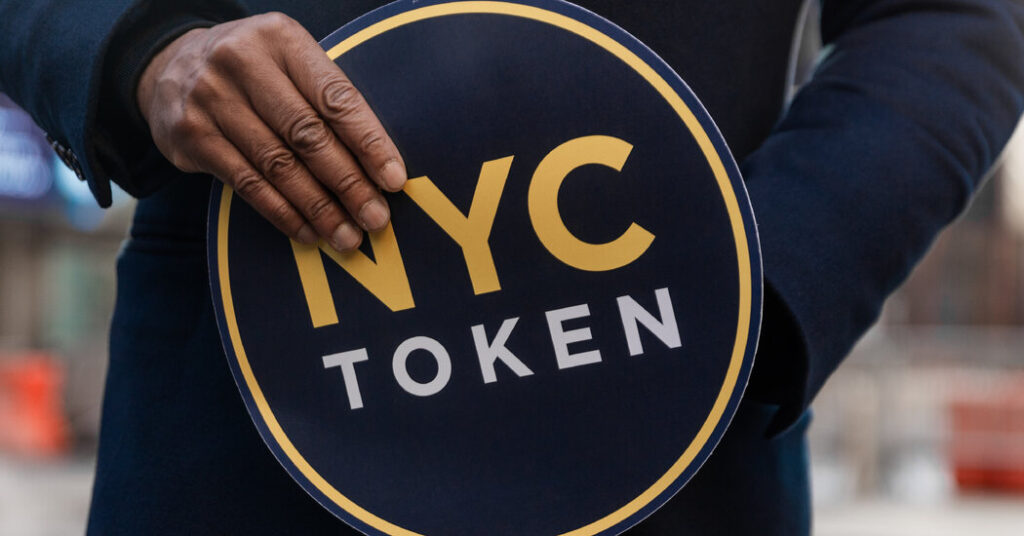
Eric Adams was crowing as he stood in Times Square on Monday to launch his first post-mayoral venture, a New York City-themed crypto coin that he said would fund the fight against antisemitism.
“This thing is about to take off like crazy,” he boasted in an accompanying hype video.
That, somehow, turned out to be an understatement.
In the minutes after trading opened, the coin, NYC Token, rocketed to a market capitalization of nearly $600 million, then crashed almost as quickly after an account linked to the coin’s launch withdrew about $2.5 million in early proceeds without notice, unnerving investors.
By Tuesday morning, the account had returned some of the funds, but Mr. Adams was battling accusations from crypto enthusiasts that his NYC Token might be a so-called rug pull — a common crypto scheme in which someone markets a coin to the public, and then quickly siphons off significant profits.
The project’s leaders insisted no money had been stolen. Still, Mr. Adams called in Brock Pierce, a crypto investor and friend, to try to help salvage matters, according to Mr. Pierce.
This was not how Mr. Adams had hoped to begin his business career, especially after ethics scandals and his own federal criminal indictment cut his mayoralty off after a single term.
Mr. Adams did not comment on the whipsaw events. An X account associated with the coin tried to calm potential investors, insisting in a cryptic statement that the withdrawal was merely undertaken to “rebalance the liquidity” of the coin to adjust for demand and that the coin was “in it for the long haul.”
In an interview, Mr. Pierce offered a harsh assessment of the rollout. The people Mr. Adams was working with “did not have any of the necessary experience,” he said, and the launch had “gone sideways,” justifiably alarming a community of crypto enthusiasts who have frequently been bilked before.
He said it would be clear within 72 hours or so if the coin would survive. But he added that it might take Mr. Adams longer to regain the esteem of the crypto community, even as he argued that the former mayor was innocent.
“He’s going to have to do some work to restore that credibility,” he said.
In the crypto world, anyone can launch a new coin and market it to the public for purchase, at low cost and without much technological expertise.
Cryptocurrencies like NYC Token occupy a legal gray area in the United States. Under the Biden administration, federal prosecutors and securities regulators aggressively pursued crypto-related crime.
But President Trump has largely unwound that enforcement effort. Early last year, the Securities and Exchange Commission declared that memecoins, a type of cryptocurrency based on an online joke or tied to a celebrity mascot, would not be subject to regulatory oversight.
When politicians and celebrities start selling digital coins, though, it rarely ends well.
By starting his own coin, Mr. Adams was following in the footsteps of Mr. Trump, who launched a digital currency called $TRUMP shortly before his inauguration last year. The price of $TRUMP briefly surged before dipping, leading to losses for hundreds of thousands of investors. Still, it was a profitable play for the Trump family and its business partners, who accumulated nearly $100 million in transaction fees within weeks of the coin’s launch.
Last year, Javier Milei, the president of Argentina, announced the creation of a cryptocurrency called $Libra designed to somehow boost the country’s economy. The coin’s price surged, then swiftly collapsed, leaving investors with $250 million in losses. The crash led to accusations that insiders had fled with the profits and sparked a political scandal in Argentina.
The launch of NYC Token has begun to follow a similar pattern.
A longtime crypto enthusiast, Mr. Adams unveiled the coin on Monday, describing it as a way to raise funds to combat antisemitism and what he called “anti-Americanism,” as well as to teach young people about blockchain technology.
“This is going to be how we are addressing many of the issues facing not only this city but many cities in America,” he said.
Mr. Adams, who left office on Jan. 1, told reporters that he did not plan to take payment from the venture — at least at first.
Other details were harder to pin down, including whom the former mayor was working with and what nonprofit groups he planned to support. Todd Shapiro, a longtime friend, helped arrange news coverage, and Frank Carone, his former chief of staff, has been involved in helping Mr. Adams set up several lines of business.
But neither Mr. Adams nor Mr. Shapiro would say who was working directly on the cryptocurrency project with the former mayor.
The coin’s launch was sloppy from the start. It was available to trade about 20 minutes before instructions for buying it were unveiled on X, according to Nicolas Vaiman, the chief executive of Bubblemaps, a crypto analytics firm.
A gap that long can open the door to insider trading, Mr. Vaiman said, because it gives anyone with advance knowledge an opportunity to buy the coin before the public announcement pushes up its price.
More suspicious activity soon emerged. Every crypto transaction is recorded publicly, allowing analysts to track the funds that were abruptly withdrawn.
Some $1.5 million of the funds were later returned, but by Tuesday afternoon, about $1 million in investors’ money was still not accounted for, according to Mr. Vaiman.
“This is definitely a red flag,” he said.
Exactly why the withdrawal happened wasn’t clear, even as some crypto enthusiasts accused the former mayor of fleecing the coin’s investors. “Maybe it’s lack of coordination,” Mr. Vaiman said. “Maybe it’s incompetence.”
Mr. Shapiro’s office shared an unsigned statement from “NYC Token” saying that its “market maker made adjustments in an attempt to keep trading running smoothly, and as part of this process, moved liquidity.”
“THE TEAM HAS NOT WITHDRAWN ANY MONEY FROM THE ACCOUNT,” the group said in the statement, but it did not elaborate.
Mr. Pierce said that he had conducted his own after-action review and believed that Mr. Adams had good intentions. He asserted that “no one has stolen or run off with any money.”
Some former aides and allies to Mr. Adams, though, were not waiting around to draw conclusions.
“Like most other stories about adams, it’ll be metabolized by the public as a big joke,” Jonah Allon, who worked as Mr. Adams’s press secretary when he was Brooklyn borough president and mayor, wrote in a pair of posts on X.
“But,” he added, “for the people who served under him, still desperately trying to line up new jobs — most of them dedicated civil servants, not cronies or apparatchiks — there’s nothing funny about it.”
Hours later, another social media post involving Mr. Adams began to circulate, capturing an exchange he had with an airline passenger. The video post shows the former mayor warning the passenger, as they disembarked from a flight, that he was no longer mayor and seemed to issue a threat.
“You’re going to see the Brooklyn in me,” he said.
Dana Rubinstein contributed reporting.
Nicholas Fandos is a Times reporter covering New York politics and government.
The post Eric Adams Hawked a Crypto Coin. A Day Later, $1 Million Was Missing. appeared first on New York Times.