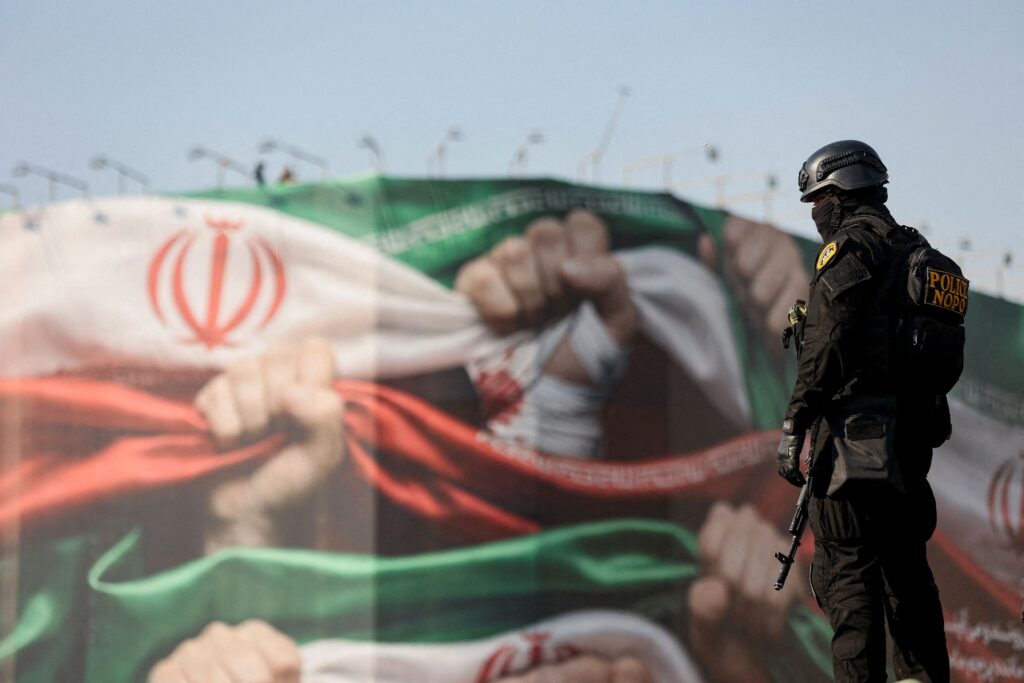
Such is the dizzying speed of recent developments that an event from only a week ago could offer a precedent to newer upheavals. As protests against the Iranian regime continue in the face of hideous violence, with potentially thousands of demonstrators killed, a host of Iran analysts are eyeing President Donald Trump’s gambit in Venezuela this month for clues to what might come in the days ahead.
Trump ordered the U.S.’s brazen Jan. 3 raid, which saw U.S. Special Forces capture Venezuelan President Nicolás Maduro and whisk him away to detention in New York, effectively ending his 13-years in power. The move was a geopolitical bombshell, the most concrete expression of Trump’s desire for hemispheric domination, and it sent ripple effects as far as Greenland and Iran.
Trump reiterated his support Tuesday for the uprising, urging anti-government protests to “take over” state institutions while insisting “help is on its way.” The specter of U.S. military action looms.
There are obvious differences between the political circumstances in both countries, as well as the U.S.’s room to maneuver in both contexts, but Trump’s eagerness to impose his will abroad — even in defiance of international law and legislative checks at home — is clear. Still, the apparent endgame in Caracas, which has seen Trump working with the remnants of Maduro’s regime and sidelining Venezuela’s prodemocratic opposition, may be a cautionary tale for Iran’s protesters.
“The Maduro case is strategically relevant less as a template than as a signal,” noted Kirsten Fontenrose, a nonresident senior fellow at the Atlantic Council who helped coordinate Middle East policy at the White House during Trump’s first term. “It suggests a U.S. willingness to act decisively against leaders already criminalized and sanctioned, rather than allowing standoffs to persist on the assumption that the risk of escalation alone will deter action.”
It’s far from clear whether Trump will opt for some form of “kinetic” action against Iran. Regional Arab allies are reportedly skittish about U.S. intervention. Analysts see a regime that has lost its legitimacy and a popular revolt that’s demanding its overthrow, but the theocratic establishment and its military apparatus remains too entrenched to easily dislodge. Trump appears to enjoy brief, decisive military strikes — his decapitation of Maduro’s regime, for example, or the blitz the United States carried out on Iranian nuclear facilities last summer — but is less keen on complicated, protracted engagements. The full defeat of the Iranian regime cannot come from airstrikes alone, analysts contend.
Iran’s supreme leader Ali Khamenei is preaching defiance in public, but his government has engaged in diplomatic backchannels with the U.S. “What you’re hearing publicly from the Iranian regime is quite differently from the messages the administration is receiving privately,” White House spokeswoman Karoline Leavitt said this week. “I think the president has an interest in exploring those messages.”
Speculation around a potential diplomatic deal is rife. “It is likely that quite a few actors within Iran understand well how narrow the revolutionary regime’s room for maneuver has become,” Danny “Dennis” Citrinowicz, a former Israeli intelligence official with expertise on Iran, wrote in a social media post.
“Even if the protests are successfully suppressed, Iran’s underlying structural problems will remain unresolved,” he added. “Against this backdrop, a window of opportunity may be emerging — and perhaps even a degree of internal legitimacy to push the leader toward a comprehensive agreement that would include giving up enrichment.”
That’s where a Venezuela-style scenario has resonance. The Trump administration appears to have reached accommodation with Maduro’s interim successor, former vice president Delcy Rodriguez, in exchange for U.S. control over Venezuelan oil exports. He might be eyeing a similar arrangement with oil-rich Iran — and the country’s isolated regime, chafing under sanctions and reckoning with economic disaster at home, might feel compelled to oblige.
“To stabilize the system, it must address the sanctions regime, which in turn requires engagement with Washington,” wrote Ali Alfoneh, a senior fellow at the Arab Gulf States Institute, a think tank. “A Venezuelan-style arrangement remains conceivable: Iran’s collective leadership could marginalize or remove Khamenei, open negotiations with Trump, invite U.S. oil companies back into Iran, and secure sanctions relief sufficient to stabilize the economy.”
There are plenty of reasons this could also be unlikely. Khamenei “is aging and eminently expendable, but the vast power structure he presides over is trapped by its complicity and its foundational reliance on anti-Americanism,” wrote Suzanne Maloney, director of the foreign policy program at the Brookings Institution. “All of the ayatollah’s apparatchiks understand that they, too, will go down with the ship, which is why Iran’s once vaunted reformists have remained silent throughout the latest bloody crackdown.”
Alan Eyre, a fellow at the Middle East Institute and a former U.S. diplomat focused on Iran, said he didn’t think a Venezuela-style scenario was “plausible” in the short term. “Trump seems more interested now in increasing pressure on the regime, which grows weaker every day the protests continue,” he told me. “I don’t think this regime is currently willing to make the changes necessary in its power structure necessary to induce President Trump to seek accommodation. But the situation is very fluid and realities are changing by the day.”
Trump’s boosters, meanwhile, have different targets for the precedent set by Venezuela.
“Cuba may be next,” Matthew Kroenig, who worked in the Pentagon during Trump’s first term, told Foreign Policy. “The Cuban government is already under a lot of pressure because of economic mismanagement, but there is additional pressure now that Venezuelan oil is being cut off. … I do think there’s a focus on bringing the Venezuela model to Havana.”
Sign up to receive WorldView, a free, thrice-weekly email newsletter from the international desk of The Washington Post.
The post Could Iran go the way of Venezuela? appeared first on Washington Post.