Before the pungent, earthy smell of wheat grass wafted across America or the words “fresh-pressed juice” squeezed their way on seemingly every menu, the Otto family built a burgeoning wellness community at a white-tiled juicery in Beverly Grove.
Now 51 years old, the pint-size Beverly Hills Juice still draws generations of fans and offers punchy, sweet and herbal concoctions made from local persimmons, blood oranges, greens and ginger, the custom hydraulic press cranking through the best of the season at nearly the same prices for half a century.
It’s credited with proliferating pressed juice in L.A., but the shop’s founding family says it was built on the shoulders of health-minded giants.
“We didn’t really start anything,” said co-founder Jennifer Otto. “We were just kind of on the coattails of so many people that had already developed, quite extensively, really cool stuff.”
In 1975 Los Angeles was already an epicenter of the health-food movement.
The city’s first Erewhon debuted six years prior. The Source Family’s restaurant — early vegetarian evangelists — also touched down in 1969 and served fresh juice alongside salads and cottage cheese. Mexican markets and stands sold fresh jugos and aguas frescas throughout the city. La Hood was serving fresh juice from a stall in Grand Central Market. And Jennifer and her husband David Otto would regularly trek to Bruce’s Juices in Hermosa Beach for a fix before launching their own store.
Theirs started humbly, and a bit unexpectedly.
David Otto’s family owned a steakhouse, and the would-be music agent grew up on a diet of red meat. But as the health-food movement gathered steam, and when he lost his parents at relatively young ages, he became a vegetarian. Otto dived into fasting and began juicing for his friends and family, pushing out produce from his home Champion Juicer.
Nearly all of them told him to open his own business, and eventually he listened. Otto left the music industry and launched the shop with Jennifer, a self-described “health nut” herself.
It originally stood between Beverly Hills Health Club for Men and the Beverly Hills Health Club for Women (despite the names, they were located on the same street in West Hollywood). The founding Ottos named their juice shop accordingly, and began with carrot juice. Four years later they relocated to Beverly Grove, taking over a deluxe but short-lived butcher shop that featured a tile interior, floor drains and walk-in refrigerators: dream amenities for a juicery that regularly splattered the walls and floors with produce.
At first business was slow going — and confusing. Before “cold-pressed juicing” became widespread, customers needed decades of explanation. Beverly Hills Juice’s product is pressed meticulously in advance, cold, and bottled ahead of ordering, but customers expected made-to-order juices from the more pervasive centrifugal juicers; those generally reduce nutrients due to heat, serve a less-smooth final product, and separate quickly.
In the shop’s earlier days, David Otto would wake up at 2 or 3 a.m. to arrive at downtown’s historic produce market in time to scoop up the best fruits and vegetables. In the 1970s small, organic farms were harder to find; now the possibilities feel endless, and they make use of access to Cuyama Orchards, Wong Farms, JJ’s Lone Daughter Ranch, Frecker Farms, Tutti Frutti Farms and others.
The production team arrives around 5 a.m. each day to begin juicing in small batches. It’s that care, customers say, that makes all the difference.
“There’s nowhere better than this: nowhere that offers the same type of juice, or even close to the same quality and freshness,” said customer Arya Afgham. “It doesn’t come close.”
Afgham walks to the shop at least five times a week with his friend Cobe Yerushalmi. They look for their seasonal favorites, such as persimmon juice in winter. Sometimes they’ll watch as other customers leave the stand carrying 20 or 30 bottles at a time.
Actor Leland Orser, a customer since 1991, has seen juicing grow throughout the city but believes Beverly Hills Juice is still at the top of its game.
“There’s no comparison,” he said. “It’s literally a hole in the wall. It’s real. It’s never changed. I mean, you can’t do better.”
Now he drops in once or twice a week, mostly for the fan-favorite Banana Manna shakes: a blend of frozen bananas with nuts or seeds. “Once you’ve had a shake,” he said, “it’s like it becomes an addiction.”
Of course, Orser noticed, the prices have risen since 1991 — but barely. Back then the shakes cost $2 apiece, plus the cost of added juice; today, they start at $4. For decades wheat grass cost $1; only last year did the Ottos raise the price to $1.50. Inflation, rent and other increases in operating costs nearly caused the juicery to close multiple times, but they’ve always tried to keep their product affordable. It’s a practice Philip Otto tries to maintain.
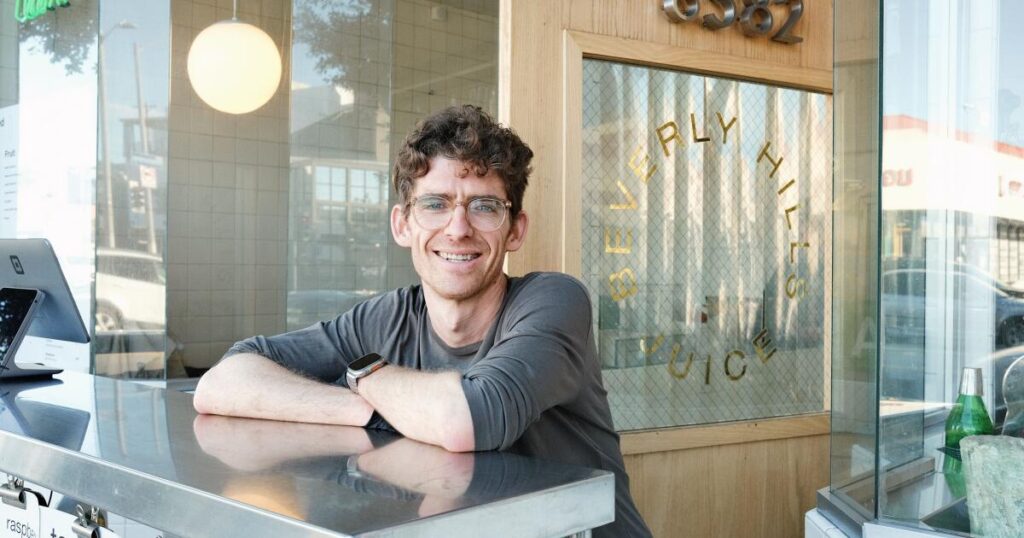
After David Otto’s death in 2022, the youngest of his three children is now the primary overseer of the store alongside Jennifer. He, like his siblings, grew up in the shop. Their house, Philip Otto said, didn’t even have a refrigerator. Why would it? They spent all their time at the juicery.
“I remember working here before I could see over the counter,” he said.
At 5, he was peeling strawberries. At 6, he was helping customers. Sometimes he’d be sent out to deal with the more ornery guests in an effort to calm them. As he has helped take over, he has brought his sustainability passions to the fore: Bottles have been replaced by 100% recycled materials. He’s made their composting program even more local.
Though some of the business practices have changed — including the pandemic-spurred switch to ordering at an outside counter — the consistency has not. Longtime friends Sarah Gingrich and Albert Pranoto have been driving from West L.A. for a taste for more than 15 years, and they say they do it because the quality never drops.
“There was a trend where juice was really big, and everyone was going everywhere, but we just kept coming to this one,” said Gingrich. “Places get popular and the flavor changes, but this place has always been the same. And we’re so picky. If something changes, we’ll know immediately.”
Philip Otto credits this to his family’s dedication: David Otto was adamant about never growing into a chain.
“It’s definitely an anomaly, because I think in business generally, if you’re not growing, you’re dying,” Philip Otto said. “It is hard to stay small. … No one is getting rich here, but my goal is to sustain this business. It’s amazing that we’ve made it 50 years. In a city like L.A. that can feel so vast and big and disparate, it’s really nice that this exists.”
Beverly Hills Juice is located at 8382 Beverly Blvd., Los Angeles, and is open Monday to Friday from 7 a.m. to 5 p.m., and Saturday and Sunday from 9 a.m. to 5 p.m.
The post At 51 years, Beverly Hills Juice is the sentimental epicenter of L.A. juicing appeared first on Los Angeles Times.