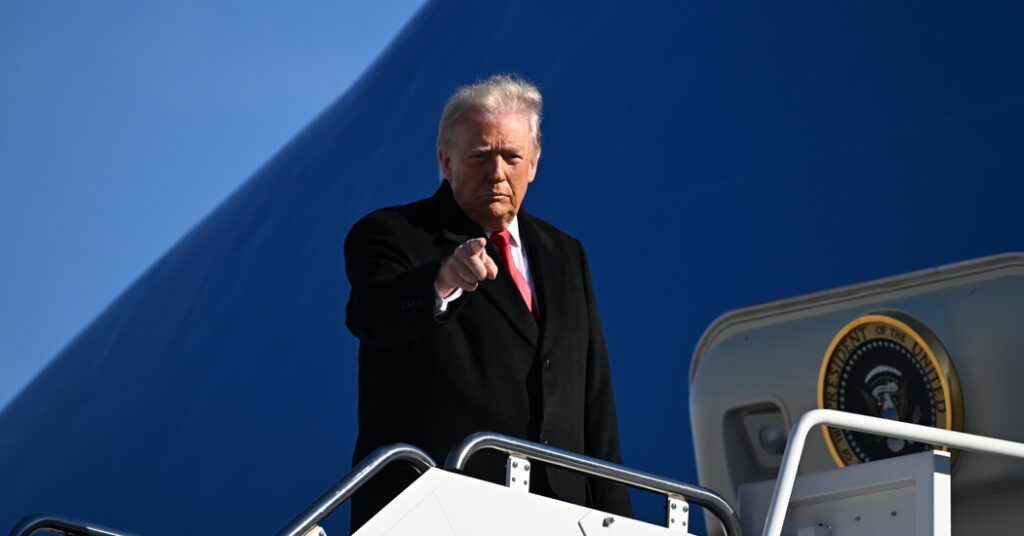
President Trump has put some big bets on the table, all at once.
He is gambling that he can exploit his control of Venezuela’s oil resources even if the chief executive of Exxon Mobil believes — from bitter experience — the oil industry there remains “uninvestable.” At the same moment, he thinks he may be able to crush Cuba, cutting off the fuel and funding it got from Venezuela.
He is actively urging protesters on the streets in Iran to overthrow the government. In a social media post on Tuesday, he told Iranians to “take over your institutions,” embracing their calls for freedom despite the fact that his national security strategy says little about supporting pro-democracy movements and urges a focus on the Western Hemisphere, not the Middle East.
Mr. Trump appears newly emboldened, buoyed by the seeming success of striking Iran’s nuclear sites and sending an Army Delta Force team in to seize Nicolás Maduro from his bed. If Mr. Trump is successful — and if his luck holds — the world may look back at these remarkable few months as a burst of American interventionism and say that Mr. Trump managed to bury Iran’s nuclear program in rubble and oversaw the fall of repressive regimes in Venezuela, Iran and Cuba.
Of course, wiping out repressive regimes and ushering in a new era of freedom for people in different parts of the world are not part of Mr. Trump’s national security strategy. In the first year of his administration, Mr. Trump dismantled the instruments of soft power — such as Voice of America and the State Department unit that dropped internet capability into Iran — that were key to democracy promotion.
Nonetheless, there is a new argument brewing among some Republicans in Washington. They say that despite the MAGA credo that Washington should avoid foreign entanglements, an exception can be carved out for getting rid of repressive leaders who once shouted, “Death to America.”
It would be less than a 1989 moment, when the Berlin Wall fell; two years later, the Soviet Union dissolved. But it could mark a collapse of America’s second-tier adversaries.
Mr. Trump has certainly left himself plenty of room for maximal intervention, in Tehran, Caracas and beyond — even to seize Greenland. In his New York Times interview last week, he declared that the only limits to his powers as commander in chief were “my own morality” and “my own mind.”
Since the interview, Mr. Trump has indicated he is all in to encourage an uprising in Iran. He wrote on social media on Tuesday that “help is on its way” to the anti-regime protesters, seeming to dismiss words of caution from those who warn that the United States risks playing into the hands of the mullahs, who want to portray the uprising as American-inspired.
“Iranian Patriots, KEEP PROTESTING – TAKE OVER YOUR INSTITUTIONS,” Mr. Trump wrote.
“The question is how many of these interventions have to come off for this to be a success?” asked James Arroyo, the director of the Ditchley Foundation, which convenes discussions among foreign policy experts on a variety of global challenges. “Not all,” he concluded, “but some.”
But events could also roll the other way. It is possible, a year from now, that Venezuela is still a mess with relatively little new oil production capability. Or, that Mr. Maduro’s authoritarian appointees are still repressing dissent, that the play to choke off Cuba’s lifeline and bring down its government fails, and that Iran’s mullahs manage to slip away, again, remaining in charge in Tehran, even if just barely.
Mr. Trump is clearly betting otherwise, and so are some of America’s European allies. “If a regime can only stay in power through violence, then it is effectively finished,” Germany’s chancellor, Friedrich Merz, said on Tuesday during a visit to India. “I assume we are now witnessing the final days and weeks of this regime.”
Of course, there are a host of other potential wild cards, each with risks for the president.
Russia’s war on Ukraine could still be grinding on, despite Mr. Trump’s confident-sounding declarations over the past few months that President Vladimir V. Putin of Russia “wants to make a deal.” (Even some of his close advisers, including Secretary of State Marco Rubio, have publicly said otherwise, and after a flurry of activity over sending a new proposal for a peace deal to Moscow several weeks ago, Mr. Trump has gone quiet on the topic.)
If Mr. Trump is widely perceived to have sold out Ukraine, essentially paving the way for Russia to take part of the country and threaten a re-invasion of the West, it would hardly play to his new interest in fighting for the freedom of the oppressed in adversarial countries.
Similarly, if he failed to protect Taiwan, he would run the same risk.
And whatever gains Mr. Trump makes as a late-in-life convert to fighting for the freedom of the oppressed could be overshadowed by his burning desire to take over Greenland.
Speaking to The Times last week, he seemed more determined than ever to take the giant island, which would be the largest single territorial gain for the United States in history. Mr. Trump appears to know this: Walking around the Oval Office and the Cabinet Room, he pointed out a painting of James K. Polk, who he noted presided over the expansion of the United States to California, in the era of “manifest destiny.”
To other NATO nations, Mr. Trump’s demand to own Greenland sounds more like imperialism than interventionism.
Mr. Trump isn’t making an argument that Greenlanders have been oppressed by Denmark. While there are tensions between the 57,000 or so residents of the frozen isle and the Danish government nation that protects their territory and has an outsized influence on their budget and politics, the current relationship is largely amicable. Yet Mr. Trump made clear that if he had to choose between expanding America’s footprint and preserving the Atlantic alliance, he would probably choose the former.
“One way or the other, we’re going to have Greenland,” he told reporters on Air Force One on Sunday evening, one of several statements the Chinese government has leaped upon to accuse Mr. Trump of grabbing territory, exactly what Washington used to say about China’s moves in the South China Sea.
Then there is the other risk to Mr. Trump: that long-range, remote-control efforts to control other nations turn out to be a lot harder than bombing the Fordo nuclear enrichment site, or shooting through the layers of Cuban and Venezuelan guards protecting Mr. Maduro. Some who have had top U.S. military roles worry Mr. Trump may not appreciate the lessons of past efforts at control and occupation of foreign societies.
“The road to disappointment for presidents who become enamored with ‘low-cost, risk-free, covert, surgical,’ or other enticing ways to use force, is well documented,” said Gen. Stanley A. McChrystal, who ran the Joint Special Operations Command from the 2003 Iraq invasion until 2008.
“Rarely has a covert operation, air power, or a ‘coup de main’ ended a conflict,” he said.
General McChrystal added: “At some point, I believe the reality is that security comes from military capability, but even more from relationships, alliances, mature diplomacy, and credibility on the world stage.”
Perhaps so, but when pressed during his interview about lessons from past occupations — Japan in 1945 or Iraq in 2003 — Mr. Trump quickly turned the conversation back to discrete, tactical military operations. On his desk, he keeps a model of the B-2 bomber that was used in the strikes on Iranian nuclear sites, a remarkable tactical success that buried much of Iran’s nuclear fuel and diminished its nuclear program. And he marveled that the United States seized Mr. Maduro without a single American combat death, and few severe American casualties.
But now comes the long, hard haul. If he is truly “in charge” of Venezuela, as Mr. Trump has repeatedly declared, he will ultimately be held responsible for how long it takes to boost the country’s oil-production capacity, and how the resulting revenues are distributed. (He hinted the other day that he was “inclined” to cut Exxon Mobil out of the U.S. program there because “I didn’t like Exxon’s response” on whether it was a worthwhile investment. “They’re playing too cute,” he told reporters.)
If he is successful in backing the protesters in Iran, he will then have to decide how deeply to involve the United States in the emergence of a new government. That would most likely bring comparisons to the 1950s, when the C.I.A. staged a coup, under the direction of Kermit Roosevelt Jr., an American intelligence officer and a grandson of another famous interventionist, Theodore Roosevelt, whose portrait hangs near Mr. Trump’s desk.
Eric Schmitt contributed reporting.
David E. Sanger covers the Trump administration and a range of national security issues. He has been a Times journalist for more than four decades and has written four books on foreign policy and national security challenges.
The post An Emboldened Trump Places His Bets From Caracas to Tehran appeared first on New York Times.