President Trump basks in media attention but is also known to use journalists as foils, lashing out at questions he does not like and even referring to the press as “the enemy of the people.”
So when four New York Times reporters and a photographer walked into the Oval Office around 5 p.m. last Wednesday to interview the president, they could not be sure which version of Mr. Trump they were going to get. They were tense, but prepared.
One of them, David E. Sanger, had decades of experience in situations like this. He has covered five presidents and interviewed almost all of them in the Oval Office and on trips around the world. The other three — Tyler Pager, Zolan Kanno-Youngs and Katie Rogers — are experienced White House reporters, but it would be their first major formal interview with a sitting president.
They had prepared meticulously, rehearsing and refining their questions for days with our White House team.
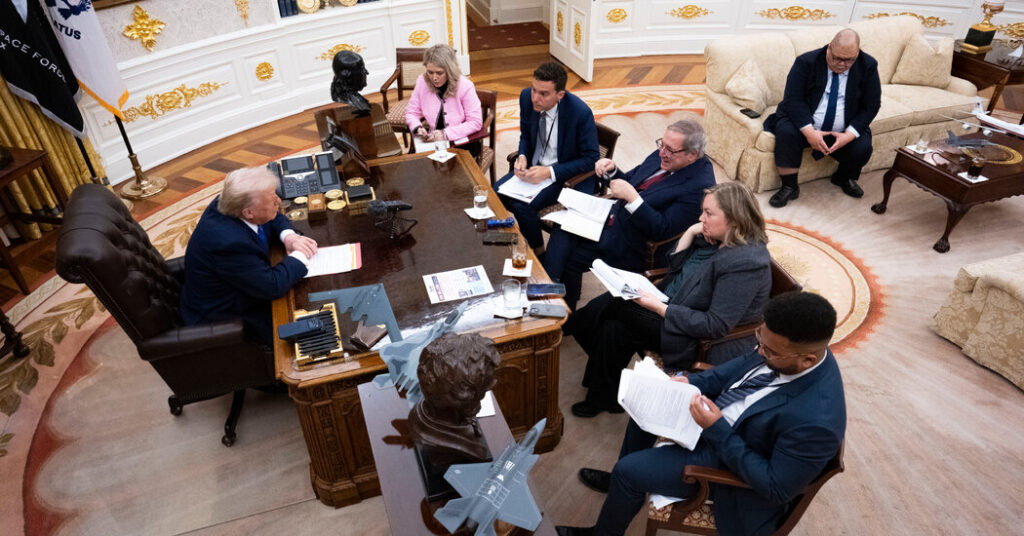
This is a behind-the-scenes look at how the interview came about and what it was like to be in the room, as described by the reporters and their editor, Elizabeth Kennedy. Pictures from the interview, by the photographer Doug Mills, accompany this piece.
“Trump takes questions from reporters a lot, but usually on his own terms — in ‘gaggles,’ or press conferences, where he sets the pace and can change the subject easily if he wants to,” Ms. Kennedy said. “Here, we wanted to make sure we gave Times readers and listeners something different — a deeper and more nuanced exploration of his policies and beliefs.”
Preparations
An on-the-record, extended interview with the president of the United States is rare. President Biden did not grant one to The Times in four years. Our White House reporters had been trying to get one with Mr. Trump since his return to office.
About two weeks ago, when the president agreed to the interview, members of the White House team knew they had to prepare carefully. Mr. Trump is a tough interview, skilled at parrying questions, and the reporters knew he could be unpredictable and end the interview at any point.
“You’re on his turf,” Ms. Rogers told us. “You’re going in the cage with the lion.”
The team gathered with Ms. Kennedy and some colleagues on the White House beat — the reporters Erica Green, Shawn McCreesh and Luke Broadwater. Leaders of the Washington bureau, Richard Stevenson and Matea Gold, also weighed in. They first agreed on big subjects and translated those themes to specific questions, refining and stress-testing them in multiple brainstorming sessions.
The president’s aides did not ask in advance about the topics, and the reporters did not offer them. No questions were off limits.
Mr. Sanger said one strategy for going deeper was knowing how Mr. Trump generally responds.
“We wanted to anticipate his answers from those things that he repeats frequently and try to steer him back to topic areas where we could actually get him to reveal his thinking, his logic and whether he has considered the secondary effects of his actions,” he said.
He added: “The stakes are high here because you know that your every word is going to be scrutinized, and on the other hand you’re human beings and you have to get the president into a conversational mode.”
No planning decision was too small, including what to wear.
“He is so detail-oriented that you know he is scanning everyone in the room,” said Ms. Rogers. “You don’t let it dictate how you’re going to operate.”
Mr. Sanger wore something sentimental: a gold tie clip that belonged to his grandfather, the longtime chief of the classical music radio station WQXR, which was once part of The Times. Mr. Sanger always wears something of his when he interviews a president.
Mr. Kanno-Youngs stopped in for a haircut that week at Edges Barbershop in Washington. “Some of the barbers there also love talking about politics,” he said. “It was fun and helpful to hear what was on their mind.”
By the time the reporters were walking over to the White House, Ms. Kennedy said she was confident.
“It felt like waiting for a baby to be born,” she said. “There was nothing to do but wait.”
The Interview
As the reporters settled in, the president started off with some pointed small talk — a complaint about The Times. “You know, maybe somebody can explain it to me. Maybe Katie can explain it to me why I don’t get good coverage,” Ms. Rogers recalled him saying.
Mr. Trump had been incensed over an article she wrote in November about signs of his aging, complaining about it in a Truth Social post that insulted Ms. Rogers by name.
Soon an aide appeared with a note: President Gustavo Petro of Colombia was on the phone. President Trump motioned for the reporters to stay in the Oval Office while he took the call, which he said was off the record.
Nearly an hour later, the mood in the room had shifted.
“He was feeling good after that call,” Ms. Rogers said. “Good enough to entertain questions about his foreign policy and a host of other questions.”
The challenge now was to draw the president out. Following their plan, Mr. Sanger opened with questions about how the leaders of Russia and China might exploit the precedent of invading a neighboring country that they regard as a threat.
Mr. Trump engaged, though at moments he drifted into familiar talking points.
“Interrupting the president of the United States is no small task,” Mr. Pager said.
He added: “It felt at times intense. We were correcting him. We were pressing him. And there are moments of it that are absolutely surreal: Sitting in the Oval Office, the symbol of American power, with the most powerful man in the world, and the ability to ask him anything that you want — it weighs on you.”
Mr. Kanno-Youngs said the questions he had prepped changed just hours before the interview. An ICE agent had just shot and killed a woman, Renee Nicole Good, in Minneapolis.
“My editors were a soundboard as I brainstormed different ways to ask about that shooting and other aggressive tactics by ICE agents,” Mr. Kanno-Youngs said. “That proved to be crucial and helped me push back when the president immediately put the blame on the victim.”
The interview was scheduled to last a little under an hour. Instead, the president answered their questions for nearly two hours; took the lengthy phone call in front of them; and toured them around the White House. They were there for about four hours.
Details of what the president said have been published in The Times, including an extended report on “The Daily”; a 23,000-word transcript; and articles on the fatal ICE shooting in Minneapolis, immigration, antisemitism, civil rights, U.S. strategy toward Venezuela, the Russia-Ukraine war, the president’s health and his plans for further White House renovations.
For Ms. Rogers, one of the most significant revelations came when she pressed the president on foreign policy. She asked him if there were any limits on his global powers.
“Yeah, there is one thing,” Mr. Trump replied. “My own morality. My own mind. It’s the only thing that can stop me.”
Ms. Rogers has covered Mr. Trump since his first term and travels around the world in his press pool. But there had been extra tension given the president’s earlier insults.
Was she up for it? Yes. She thought (correctly) the president would be more gracious in person, and she had a job to do. She said she thought of her daughters.
“I talk to them a lot about being able to take space and speak their minds and be who they are,” she said. “And that is important to me as a mother, as a human being, as a journalist to do.”
Seth Carlson is an editor on the Trust team, which works to help readers understand The Times and its journalistic values.
The post ‘Your Every Word Is Going to be Scrutinized’: How Our Reporters Prepared to Interview Trump appeared first on New York Times.