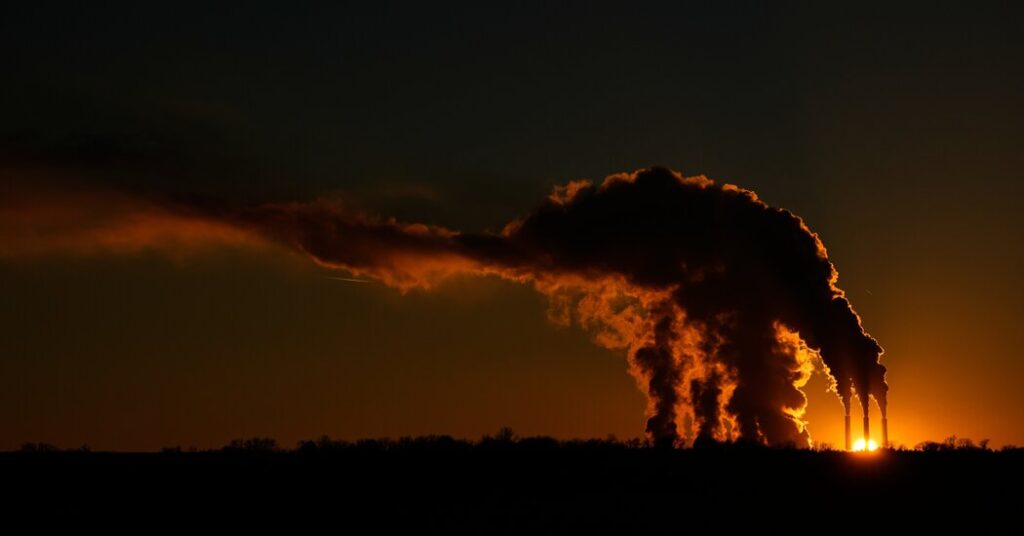
America’s greenhouse gas emissions increased by 2.4 percent in 2025 after two years of decline amid a resurgence of coal power, according to estimates published Tuesday by the Rhodium Group, a research firm.
The researchers identified two main reasons for the uptick. U.S. electricity demand grew at an unusually fast pace, driven in part by an expansion of power-hungry data centers for artificial intelligence. To meet that demand, electric utilities burned about 13 percent more coal last year than they did in 2024.
At the same time, colder winter temperatures led many buildings and homes to burn more natural gas and fuel oil for heating last year.
The jump in emissions came as President Trump returned to office and moved to dismantle policies to tackle climate change while promoting fossil fuels. But the researchers said Mr. Trump’s policies would take time to have an effect and they mostly weren’t responsible for last year’s rise in emissions.
“We don’t see a large emissions impact in 2025 from the Trump administration’s actions, although we obviously expect those to have an increasing impact as we go forward,” said Michael Gaffney, a research analyst at the Rhodium Group. “The main story here was partly weather and partly a growing power sector that’s burning more coal.”
That growing demand for electricity is itself a new shift. For much of 2000s and 2010s, America’s overall electricity use stayed roughly flat. But in recent years, demand for power has started surging amid a boom in data centers, an upswing of domestic manufacturing and the spread of electric vehicles.
Last year, electricity demand grew by 2.4 percent nationwide, with the biggest increases in Texas, the Mid-Atlantic and the Ohio Valley.
To keep up with demand, electric utilities turned to a fuel that had fallen out of favor: coal. For two decades, America’s electric utilities have been switching away from coal, the most polluting of fossil fuels, in favor of cleaner and often cheaper gas, wind and solar power.
Yet natural gas prices bounced back from record lows last year as producers exported more of the fuel overseas and demand for home heating spiked. That, in turn, made it economic for utilities to burn more coal at existing power plants. Some utilities also postponed planned retirements of coal plants. And, in a contentious series of moves last year, the Energy Department ordered eight coal-burning units to stay open beyond their planned closure dates.
Solar power generation grew by 34 percent last year, while wind power increased modestly.
“If it weren’t for the growth of solar, we’d probably be in an even worse spot this year than we already are, emissions-wise,” said Ben King, a director at the Rhodium Group.
The Trump administration, for its part, is trying to push the power sector away from renewable energy. Mr. Trump’s domestic policy bill, passed in July, repealed most federal subsidies for wind and solar power, while the Interior Department has stalled federal approvals for wind and solar projects around the country. The administration is also rolling back pollution regulations on coal and gas plants, giving fossil fuels a larger boost.
Other sectors could also see major changes in the years ahead.
Transportation, the nation’s largest source of greenhouse gases, saw little increase in emissions in 2025 despite record travel activity. The researchers attributed that to growing sales of hybrid and electric vehicles, which emit far less than gasoline-burning cars.
Yet this year the Trump administration repealed federal subsidies for electric cars while loosening federal fuel-efficiency standards.
Emissions from oil and gas drilling stayed nearly flat last year, increasing only 0.5 percent even as production increased significantly. That’s in large part because many producers have managed to curb leaks of methane, a potent greenhouse gas.
Between 2015 and 2026, U.S. companies appear to have reduced the amount of methane that escaped, per barrel of oil they produced, by 62 percent, according to the Rhodium Group.
Yet it is unclear whether this trend will continue, as the Environmental Protection Agency has delayed rules requiring producers to curtail methane leaks.
The full effects on emissions of the Trump administration’s policies remain to be seen. America’s greenhouse gas emissions have fallen roughly 18 percent since 2005 and the nation is far off-track from meeting the Biden administration’s goal of halving emissions by 2030. Mr. Trump has dropped that goal entirely.
Over the next decade, the Rhodium Group has separately estimated, U.S. emissions are projected to decline more slowly than previously thought as a result of Mr. Trump’s policies.
Researchers are also likely to have a tougher time making precise emissions estimates. The E.P.A. has stopped publishing its official inventory on greenhouse gas emissions, which the Rhodium Group and others rely on to make projections. While that did not affect this year’s report, it could make future estimates harder.
“It will be something we deal with next year,” said Mr. Gaffney. “We’re going to have to figure out how to fill that gap.”
Brad Plumer is a Times reporter who covers technology and policy efforts to address global warming.
The post U.S. Emissions Jumped in 2025 as Coal Power Rebounded appeared first on New York Times.