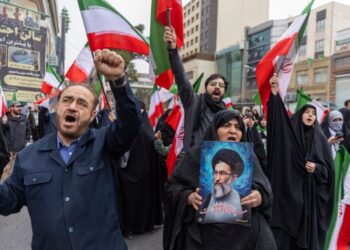
President Trump called on Iranians on Tuesday to keep protesting against their government and warned that those responsible for killing demonstrators would “pay a big price.”
His remark, on Truth Social, came just hours after Iranians were able to make international calls for the first time in days despite an ongoing internet blackout that has slowed the flow of information out of the country and obscured the severity of a crackdown on antigovernment protests. Mr. Trump also declared that he had canceled meetings with Iranian officials.
“Iranian Patriots, KEEP PROTESTING — TAKE OVER YOUR INSTITUTIONS!!!,” Mr. Trump wrote. “Save the names of the killers and abusers. They will pay a big price. I have cancelled all meetings with Iranian Officials until the senseless killing of protesters STOPS. HELP IS ON ITS WAY. MIGA!!!”
Mr. Trump has threatened to intervene militarily in Iran on behalf of the protesters if the authorities use lethal force against them.
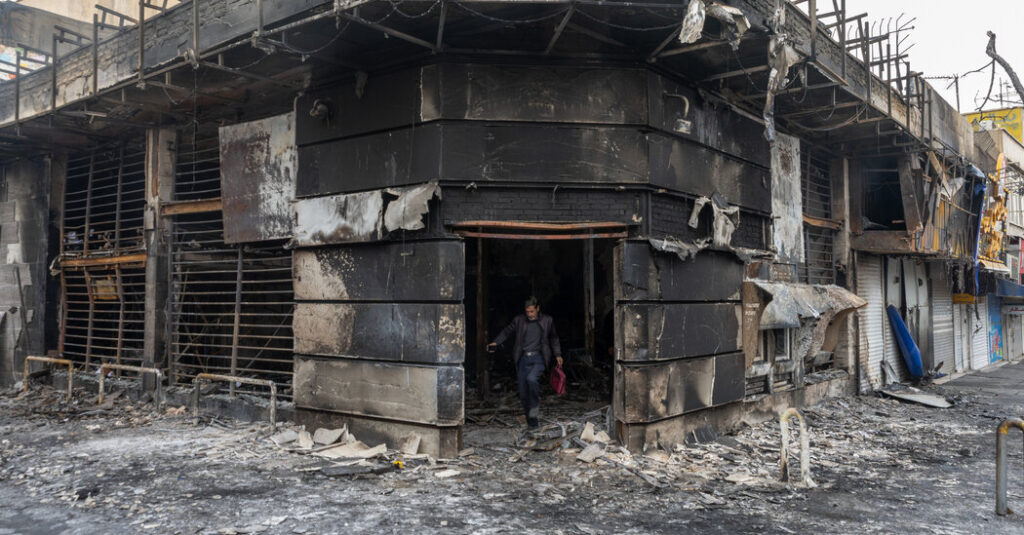
On Tuesday morning, several Iranians living abroad said they had received calls from family members inside Iran who were using landlines. They told The New York Times that their relatives had described chaotic and bloody protests, with demonstrators coming under fire from security forces and, in some cases, from snipers on rooftops. They also said the police had checked security footage in some stores and ordered owners to delete anything that might have documented the government crackdown.
Iran is witnessing the most expansive protests in years against the country’s authoritarian clerical rulers after economic grievances snowballed over the past two weeks into a broader challenge to the regime.
An internet block imposed last week sharply curtailed communications out of the country as the protests spread and security forces moved to suppress them. Digital experts said it was not immediately clear what had enabled the calls on Tuesday, which appeared to be mostly by landline.
Hundreds of people, and perhaps thousands, have been killed in the unrest, according to rights groups and at least one senior Iranian health ministry official.
According to one account of a phone call on Tuesday, a person inside Iran said that protesters in the capital, Tehran, became hesitant to go out starting on Friday, when the government began sending text messages warning that they were at risk of being killed if they did.
The callers described how the crackdown kept many confined to their homes, with some venturing out only to run errands or shop for groceries during the day. Several callers said they knew people who had been killed in the protests, according to the relatives abroad who spoke to them.
Once the calls were over, the relatives said, they were unable to call back.
“I just shed tears after the call,” said Soudabeh, in Britain. “My sister’s voice was strong and resolute. My mother sounded anguished.” All those who spoke to The Times requested that only their first names be used or that they remain anonymous for fear of retaliation.
The latest internet cutoff in Iran has been one of the most severe national disruptions in the world, said Alp Toker, the founder of the British internet watchdog NetBlocks. Iran has shut down the internet during antigovernment protests before, including during a widespread uprising for women’s freedom in 2022.
But while those shutdowns were gradual, the latest one was imposed nationwide, and swiftly.
“We saw that the process has been fully automated into an actual kill switch that enables the authority to cut off the entire nation, which is extraordinary,” Mr. Toker said.
Digital rights experts cautioned on Tuesday that while the restoration could help family members reconnect, it might create new risks by enabling the authorities to monitor citizens and track their activities.
“There is now a much bigger risk associated with using those landlines, because they aren’t secured and they aren’t encrypted,” Mr. Toker said, “and indeed, that’s quite possibly why that service has been selectively enabled.”
The authorities have also been jamming satellite services, he said, particularly Starlink terminals. But the jamming isn’t total, he said, and some communication is still possible.
Starlink is operated by SpaceX, which Elon Musk owns. Mr. Trump said on Sunday that he planned to enlist Mr. Musk’s help to bypass Iran’s internet shutdown and restore connectivity.
Iranian officials including Ayatollah Ali Khamenei, the supreme leader, have continued to post updates on social media throughout the shutdown, including on X and Telegram.
The authorities said they had shut down the internet after concluding that protesters were being guided from abroad to create chaos within the country.
On Tuesday, Fatemeh Mohajerani, a spokeswoman for the government, said the authorities had not decided when they would restore internet access.
The internet and communication blackout has limited the flow of news from Iran and hampered efforts by rights groups to track casualties.
The Iran Human Rights group, in Oslo, has said that nearly 700 protesters have been killed, while HRANA, a rights organization in Washington, said it had confirmed the deaths of more than 500 protesters and more than 130 members of the security forces.
Multiple American officials say that U.S. intelligence agencies have conservatively estimated that more than 600 protesters have been killed so far. The agencies have noted that both the current protests and the crackdown are far more violent than those in 2022 or other recent uprisings against the government.
A senior Iranian health ministry official, who spoke on the condition of anonymity, said that roughly 3,000 people had died across the country, attributing the violence to “terrorists” stirring unrest. The total, he said, included hundreds of security personnel.
Another government official said he had seen an internal report citing at least 3,000 deaths and cautioned that the number could rise further.
The crackdown could have global repercussions. While exploring diplomatic options with Tehran, the Trump administration is simultaneously considering a range of measures, including possible military strikes, to try to prevent further killings of protesters.
European leaders have called for more economic sanctions on Iran, and Ursula von der Leyen, the president of the E.U. executive arm, posted on social media on Tuesday that the European Union would work toward them.
“Further sanctions on those responsible for the repression will be swiftly proposed,” she wrote. “We stand with the people of Iran who are bravely marching for their liberty.”
Sanam Mahoozi, Kiana Hayeri, Koba Ryckewaert, Jeanna Smialekand Julian E. Barnes contributed reporting.
Abdi Latif Dahir is a Middle East correspondent for The Times, covering Lebanon and Syria. He is based in Beirut.
The post Trump Urges Antigovernment Protesters in Iran to ‘Take Over’ appeared first on New York Times.