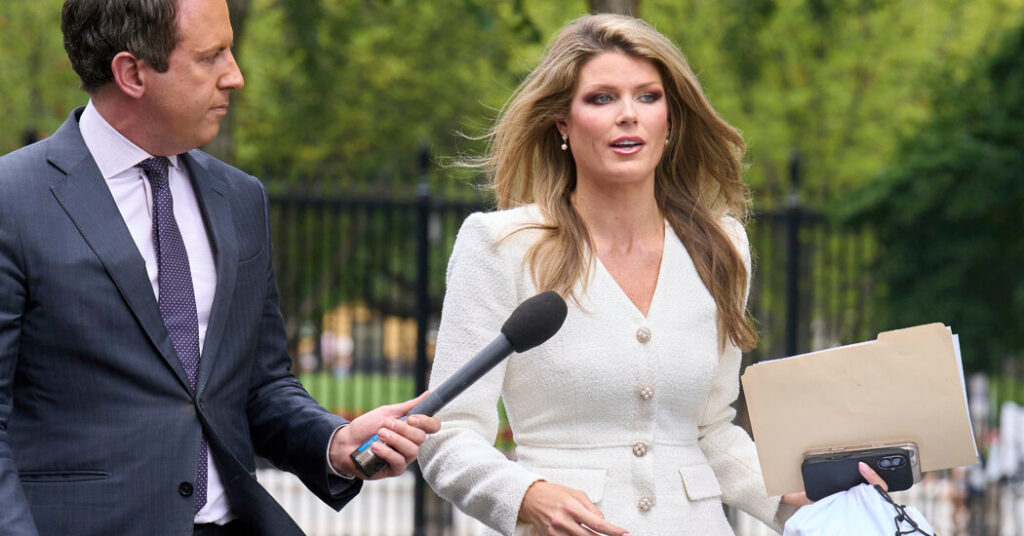
Lindsey Halligan, the Trump loyalist chosen as the U.S. attorney for the Eastern District of Virginia, told a federal judge on Tuesday that she was within her rights to continue using that title, even though a different judge has determined that she was appointed to the post unlawfully.
Ms. Halligan’s assertion came in an aggressively worded filing to Judge David J. Novak, a Trump appointee who sits in Federal District Court in Richmond. Last week, after several of his colleagues on the bench had complained about Ms. Halligan laying claim to her title despite the ruling disqualifying her from the job, Judge Novak ordered her to explain in writing why her decision to continue signing court papers as the district’s top prosecutor was not “a false or misleading statement.”
In her response, Ms. Halligan pushed back hard at Judge Novak, accusing him of having “a fundamental misunderstanding” of the original order that found she had obtained her position improperly. In late November, Judge Cameron McGowan Currie determined that the Justice Department had violated both the Constitution and laws governing the appointment of U.S. attorneys when it installed Ms. Halligan in the post, after President Trump fired her predecessor.
Judge Currie’s finding had serious consequences, leading her to dismiss a pair of criminal cases Ms. Halligan had brought against two of Mr. Trump’s most prominent political adversaries: James B. Comey, the former F.B.I. director, and Letitia James, the New York attorney general.
In her filing to Judge Novak, Ms. Halligan said that even though Judge Currie’s order had concluded that she had been illegally installed as the office’s top prosecutor, nothing in it explicitly barred her from “performing the functions of or holding herself out as the United States attorney.”
Moreover, Ms. Halligan argued that the only remedy Judge Currie had sought for the improper appointment was to dismiss the indictments against Mr. Comey and Ms. James — a decision, she asserted, that affected only those two cases.
“This court appears to be under the misimpression that because Judge Currie’s rationale for dismissing the indictments was her conclusion that Ms. Halligan was unlawfully appointed,” she told Judge Novak, “the United States must acquiesce to that rationale in all other cases.”
It remains unclear whether Judge Novak would go along with all of this. After all, he made clear in his initial instructions to Ms. Halligan that he believed Judge Currie’s ruling was “binding” on her. He even took the unusual step of ordering her to explain her actions on his own and without the defendant in the case asking him to do so.
Judge Novak indicated that if Ms. Halligan had in fact made a false statement by clinging to her title as U.S. attorney, it could result in disciplinary measures.
Ms. Halligan reacted angrily to that suggestion, accusing Judge Novak of overstepping his authority.
“The court’s thinly veiled threat to use attorney discipline to cudgel the executive branch into conforming its legal position in all criminal prosecutions to the views of a single district judge is a gross abuse of power and an affront to the separation of powers,” she wrote.
The dispute over Ms. Halligan’s position came amid persistent turmoil in the Eastern District of Virginia, a critical prosecutorial outpost known for its handling of terrorism and national security cases.
On Monday, the No. 2 official in the office, Robert K. McBride, was fired after a disagreement about whether he would take charge of the Trump administration’s efforts to reindict Mr. Comey.
Alan Feuer covers extremism and political violence for The Times, focusing on the criminal cases involving the Jan. 6 attack on the Capitol and against former President Donald J. Trump.
The post Trump Loyalist Asserts She Can Keep U.S. Attorney Title appeared first on New York Times.