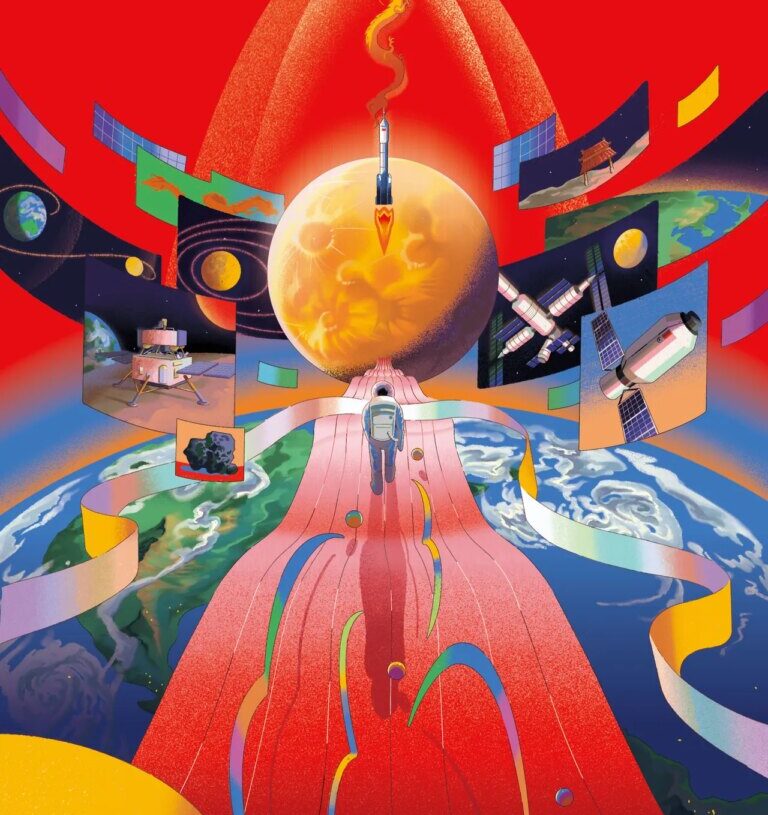
The senator wanted a promise. A solemn vow. For the last six years—or maybe the last decade or quarter century, depending on how you count it—the United States and China had been locked in a space race, a contest to see which nation could put its people on the moon. Senator Ted Cruz wanted President Donald Trump’s nominee to run NASA, Jared Isaacman, to pledge that the US would not lose.
Cruz brought a little surprise to Isaacman’s confirmation hearing last April. It was a poster of the moon. On one side stood three astronauts and a giant Chinese flag. On the other were two more figures in space suits, with the tiniest Stars and Stripes planted in the lunar soil. Cruz apologized for the imbalance. “My team used ChatGPT,” explained the senator, who chairs the committee that oversees NASA.
Then Cruz, with a bit more seriousness, asked Isaacman, “Do we have your commitment that you will not allow the scenario on the right of this poster to happen? That China will not beat us to the moon?”
Isaacman, a billionaire entrepreneur who had paid for his own missions to space, replied, “Senator, I only see the left-hand portion of that poster.”
It was a red-meat, fuck-yeah, pitch-perfect response. And Isaacman may have meant it. But by the time of his testimony, the Trump administration had started a process that would lay waste to NASA, pushing nearly 4,000 agency employees to quit. Then the White House proposed a massive, 24 percent cut to NASA’s budget. Then Trump yanked Isaacman’s nomination and named a new part-time acting chief, a fellow who boasted in his official NASA biography that he is one-half of “America’s first and longest-married reality TV couple.” Then that guy picked a fight with Elon Musk, who’s building NASA’s moon lander. And Isaacman was back in the running. In December, Trump capped off the year with an executive order pushing Americans to get back to the moon by 2028.
If all of this sounds suboptimal to you, welcome to the club, space ranger. That dysfunction is one of many reasons why the vast majority of the two dozen sources I interviewed for this story believe that China will put people on the moon first. I spoke with nine former NASA officials who served at the highest rungs of the space agency under presidents Trump and Biden; none of them were optimistic about America’s chances. “We did the worst of all worlds,” one of the nine tells me. “We positioned it as a race without planning to win.”
The original space program was the ultimate symbol of America at its screaming-eagle apex. Rocket scientist was shorthand for brilliant, and many of them were working in Huntsville, Alabama, aka Rocket City. The word astronaut was synonymous with grit, and you could find the gutsiest of them in Houston. Moonshot was (and is) code for something borderline impossible. Space races have helped spur the development of everything from the integrated circuit to the solar panel to 5G. But that was before America decided to stab itself in the brain.
Today, much of the world drives Chinese electric cars, powers their homes with Chinese solar panels, and stays in touch with made-in-China phones. Chinese scientists have eclipsed their American counterparts in the production of high-quality research, and the White House has responded by gutting American science funding and charging $100,000 to let in highly skilled immigrants. So if Chinese astronauts step down from their lander and livestream the results in 4K—and to be clear, it’s still an “if” at this point—it’ll be more than a point of national pride for Beijing. It’ll be a declaration that the American Century is officially over.
About 18 months ago and some 3,000 miles above the Earth, the Chinese robotic spacecraft Chang’e-6 released its reentry capsule, which skipped in and out of the atmosphere before parachuting into the grasslands of China’s Inner Mongolia. Inside were about 4 pounds of moon rocks and soil. It was the first sample return from the far side in human history.
Putting people on the moon might seem like a so-what sequel, coming 50-plus years after Apollo. But there’s a reason no one’s been back to the moon in half a century. It is maddeningly difficult to put anything down there, even little unmanned landers. A handful of soft-landing missions have succeeded, most of them Chinese. More numerous are the flops of the Japanese, Russian, Israeli, American, and Indian space programs.
The reasons for failure are many—light gravity and uneven terrain make it easy for a lander to tip over; no atmosphere means firing rockets to brake; that firing kicks up clouds of dust that can limit visibility. “Once you start slowing down, within a matter of single-digit seconds, you are on an intercept course with the moon, and you don’t have enough propellant to go back to lunar orbit and try again,” says Will Coogan, a chief engineer at Firefly Aerospace, the only company to pull off a fully successful robotic moon landing, ever.
Operations around the lunar poles are an “order of magnitude” tougher, a person who oversaw NASA’s lunar program tells me. Getting into the proper orbital plane requires more maneuvering. For consistent communication with ground control, you need to position a relay satellite around the moon. (As China did, about six weeks before landing Chang’e-6.) Once you’re there, be careful. Miles-deep craters are shadowed in near-eternal night, which means no solar power and temperatures that can drop below –200 degrees Celsius.
Yet that’s exactly where China’s heading. Scientists believe the poles have enormous pockets of ice—and potentially helium-3, an isotope that’s extremely scarce on Earth. Helium-3 could unlock quantum computing and possibly nuclear fusion, many experts believe. “Let’s say on the lunar surface, helium-3 becomes a new source of fusion power,” as Isaacman told Cruz at that April confirmation hearing. “It could shift the balance of power here on Earth. I don’t think we can afford to find that out the hard way.”
Both the US and China have dreamed of building a base at the south pole, and both would like to claim the prime landing sites. The upcoming Chang’e-7 mission aims to be the first to extract water from the moon. One desirable landing site is a spot high on the ridge of the Shackleton Crater, near the lunar south pole, at a location that’s almost always light. Chang’e-7 will carry instruments from Russia and several American allies—Italy, Switzerland, Thailand, Egypt, and Bahrain.
The Chinese National Space Administration says the launch should happen in August. “When they say they’re going to do something by x, they tend to do it,” says Dean Cheng, a senior fellow at the Potomac Institute for Policy Studies who’s been tracking the progress.
China’s space efforts aren’t as sophisticated as America’s; Beijing is only now testing reusable rockets. And every space program faces mishaps. In November, three Chinese astronauts were stranded aboard their space station for nine days after a piece of orbiting junk damaged their return capsule. But China’s crewed lunar effort, for now, seems to be more or less on target. The idea is that a pair of rockets—one carrying the crew and service capsules, the other a lander—will head to the moon. They’ll rendezvous in lunar orbit, and a pair of astronauts will set foot on the surface. Exactly where they’ll land hasn’t been confirmed. But testing for all of the components is well under way. A spokesperson for the China Manned Space Agency has said the mission will launch “before 2030.”
When will American astronauts get there? That’s a bit more complicated.
Warning: the recent history of the US program to return astronauts to the moon is so contradictory, so politicized, so frustrating, it’s going to make your head hurt. As Jim Bridenstine, who served as Trump’s first NASA administrator, recently told Congress, “This is an architecture that no NASA administrator that I’m aware of would have selected.”
“No way to run a program, in my opinion,” says the NASA official who helped oversee the lunar initiative. “You can’t make this shit up. Really can’t. It’s really crazy.”
The original Apollo program was insanely ambitious, but there was a clarity to the mission. One giant rocket, carrying one tiny crew capsule and one even tinier landing module. The capsule would orbit the moon, and the lander would ferry astronauts to and from the surface. That was all. The new US moon program—Artemis, named after Apollo’s twin sister—isn’t nearly so neat.
For starters: The main rocket and capsule are made up of leftovers. Back in 2010, the Senate ordered NASA to build a rocket with old engines from the space shuttle program and repurpose a capsule from a Bush-era deep-space project. The rocket, known as the Space Launch System, would lift off carrying astronauts in a capsule named Orion. The combination of SLS and Orion has cost taxpayers tens of billions of dollars. It has flown exactly once. A second flight is slotted for February.
The Orion capsule was built on the heavy side, to give astronauts extra protection against radiation and other risks. But the capsule’s propulsion was under-powered to reach a tight lunar orbit. (The European Space Agency, which provided the thing, said it couldn’t afford to supply more.)
NASA engineers figured out, however, that the capsule could reach a farther-out, super-elliptical orbit, and that orbit would still allow for landings on the lunar poles. The drawback: At that orbit, completing a circuit of the moon takes nearly a week. Once you drop astronauts off, they’re stuck on the surface for days and days. A tear in a spacesuit or a malfunction in the lander’s life support system might turn into a nightmare.
NASA also concluded that it needed to put a miniature space station in orbit around the moon. I must’ve heard a half-dozen rationales for this space station. It wouldn’t necessarily help with rescue efforts, but it could communicate with astronauts on the ground. And during later, longer-duration missions, it would give astronauts a more hospitable place to work and rest. Maybe.
Some at NASA view the so-called lunar “Gateway” as a kind of insurance policy. As one former official told me, “There’s the belief that if you have these pieces pre-positioned in space, we’ll have a long-term program that Congress is less willing to walk away from.” All of this was meant to take a decade or so to come together—like, 2028 or 2029. Until Mike Pence stepped up to the mic.
The American flag behind the vice president was large, almost comically so. Also behind him was an original space capsule from the Apollo days. Pence was exuding confidence that day in the spring of 2019. He proclaimed to the crowd at the Marshall Space Flight Center in Huntsville that “the first woman and the next man on the moon will both be American astronauts, launched by American rockets, from American soil.” He also announced out of nowhere that the schedule was cut in half. It would all be done in five years, by 2024. The end of what the administration hoped would be a second Trump term.
People in the room—and around the space agency—were stunned. As a former top NASA official recalls, “Everyone knew from the moment Pence said that, that it was pretty much bullshit.”
Reporters quizzed NASA’s leaders on the new deadline. “I do not like being—I will not lie,” a second former NASA official tells me. “So I said, ‘I think it’s a great goal, but like, this is going to be hard.’ And Jim [Bridenstine] told me later, he goes, ‘The one thing you need to start learning to say is: We will be on the moon in 2024.’”
It was a ridiculous commitment. Much of the gear to get back to the moon was still on the literal drawing board: NASA hadn’t even handed out contracts for the lunar landers yet. The space agency’s bureaucracy had a well-earned reputation for taking the maximum number of people and the maximum amount of time to get things done. “You know, 20 layers of boards and councils to get to a decision, or 480 people on a call. Do we really need that?” wonders a third former senior official.
The space program, once the avatar of American success, was becoming emblematic of American drift. Contractors complained about NASA’s endless requirements and safety checks; NASA officials complained about contractors’ empty factory floors and bankers’ hours; they both complained about the White House’s budget office micromanaging their launch dates; and absolutely everyone complained about the Senate force-feeding them tech they didn’t want.
Still, there were folks at NASA who were glad to have the 2024 deadline. After years of being lost in space, it was at least some sort of direction. Eight missions were sketched out for the Artemis program over the next decade. The pieces were already in place for the first two, an unmanned test of SLS and Orion that would orbit the moon and a manned lunar flyby. By the end of the first Trump administration, one last major component remained for Artemis III, the big one, the return of astronauts to the lunar surface. NASA had to award a contract to a company to design, build, and test the lander to bring astronauts down to the moon.
Jeff Bezos’ Blue Origin tried positioning itself as a major contender. But, as journalist Christian Davenport recounts in his book Rocket Dreams, Pence’s top aide told a Blue Origin exec he had a “Washington Post problem”—as in, the paper dared to criticize his boss’s big space speech. Joe Biden’s win in 2020 made that problem go away temporarily. But there was another issue: The bid Blue Origin submitted for the lander cost twice as much as Musk’s. (NASA and Blue Origin declined to comment on this story; SpaceX did not respond.)
SpaceX’s bid was in a class of its own. Its proposed lander was actually the second stage of its giganto, still-in-development rocket. The lander’s interior volume would be 150 times that of the Apollo lunar module, according to one SpaceX veteran, and more than that of the International Space Station. It was ludicrously big. “Like rowing across the Atlantic Ocean in a row boat and then taking a luxury cruise liner into the harbor,” is how a second SpaceX veteran put it. A “planet-colonizer,” is what Musk called it—his ride to his preferred destination, Mars. That’s why his bid was so much lower than Blue Origin’s; he wanted to build it anyway.
In between agency administrators, in 2021, NASA’s leaders gave Musk $3 billion for the lander. In some ways, they didn’t have a choice. The agency’s budget was impossibly tight. And if his design worked, it would supercharge human spaceflight for decades to come. But competitors grumbled; Blue Origin sued. The criticism grew louder when, years later, one of the NASA officials behind the decision took a job with Musk.
By then, Musk’s reputation for overpromising had been cemented. It was clear the space agency hadn’t fully understood the risks involved in Musk’s bid. That information gap would set the US lunar program back years.
You might ask yourself at this point why we should care about getting people on the moon or who gets there first. Truth be told, NASA and its contractors have had a hard time producing a consistent answer themselves.
Some will tell you there’s a whole lunar economy waiting to be unleashed. Some will say that cislunar orbit is a great place to spy on (and even attack) your rival’s satellites. Some will tell you that exploration is a goal in and of itself. Some will ask you if you’ve seen one (1) science fiction movie in your life. Because then you’ve had the feeling, however fleeting, that absolutely nothing could be cooler than setting foot on an alien moon.
The mix of rationales helps explain why the Artemis program looks the way it does, a mismatched collection of leftovers and imports from the future, a blend of realpolitik and revolutionary. It’s a forced marriage between government contractor graybeards and billionaires with stars in their eyes. On the one hand, you’ve got a rocket and a capsule that can feel like unwieldy remakes of the Apollo program; on the other, an interplanetary “colonizer” and a freakin’ lunar space station. The collection is meant to support what an extremely understated former NASA official calls a “portfolio” approach to mission success. If Artemis hits any one of these many goals (jazzy lunar businesses, the next GPS-scale invention), the logic goes, the whole thing will have been worth it.
Maybe this makes sense to you, maybe it doesn’t. But here’s what everyone agrees on: The US and China are in a multifront contest for global influence. Beijing clearly has the momentum; now imagine its velocity after a moon landing. “If you’re trying to choose, who do I want to partner with? Whose team do I want to be on?” asks the American Enterprise Institute’s Todd Harrison, one of Washington’s sharper analysts of defense and space policy. “Do you want to be on the team that’s a bunch of has-beens? Or do you want to be on the team that is rapidly developing and has leapfrogged ahead of the United States?”
In September, Bridenstine testified before Cruz’s Senate committee, warning that the US plan was in real danger. He focused his remarks on Starship, the massive SpaceX craft that’s supposed to bring astronauts to the lunar surface. It’s “important for the country, and it’s transformational,” Bridenstine said. If and when it starts to work, that is. In the short term, it makes Artemis way more complicated. Starship is behind schedule, with a number of rather public explosions. But even if it were working perfectly, Starship offers a profoundly complicated ride to the moon. NASA officials didn’t realize how complicated until after they gave SpaceX billions to build their lander.
A fully loaded, moon-bound Starship expends almost all of its fuel to get to low Earth orbit. So that Starship needs to refill its tank before it heads to the moon, requiring the launch of more and more refueling Starships.
Starship runs on liquid oxygen and methane. They have to be kept ultracool, at –161 degrees Celsius or below. But direct exposure to the sun heats Starship up, evaporating some of that fuel. That could mean even more refueling missions to make up the difference. If things go really badly, the fuel might evaporate more quickly than SpaceX can get refueling rockets into space. “That whole in-space refueling thing has never been tested,” Bridenstine added. “We’re talking about cryogenic liquid oxygen, cryogenic liquid methane being transferred in space—never been done before, and we’re going to do it dozens of times.”
Engineers at NASA’s Johnson Space Center recently calculated that one lunar mission could require more than 40 Starship launches. Refueling tests that were originally supposed to begin in 2023 are now “targeted to take place in 2026,” SpaceX says. As a reminder, China’s lunar mission will require two rockets.
This could’ve been a moment when the US changed course and declared that it doesn’t matter who repeats the Apollo landing first. Sean Duffy—the former reality star and secretary of transportation serving as acting NASA chief—took the opposite approach. He doubled down on beating China, and he blamed Starship for imperiling the lunar race. In October, Duffy said he’d formally ask other companies if they could build a lander faster than Musk. “We’re not going to wait for one company,” Duffy told CNBC. “We’re going to push this forward and win the second space race against the Chinese. Get back to the moon, set up a camp, a base.” He also gave SpaceX 10 days to submit a proposal for speeding up its lander effort.
Musk responded with his usual maturity. He called the NASA chief “Sean Dummy” in a post on X. In another, Musk tweeted a meme at Duffy, saying, “Why are you gae?”
SpaceX wasn’t used to this kind of treatment. (“Here’s the way NASA works with SpaceX: They’ve learned to say, ‘You just keep blowing things up until you’ve got something that works a few times in a row. Then we’ll swoop in,’” one of the former NASA officials tells me.) But it was clear SpaceX was listening. A week after Musk’s mean tweets, the company said it was working on “a simplified mission architecture and concept of operations.”
Bezos’ company reacted quickly, too. During the Biden years, NASA had also given Blue Origin a contract for lunar landers. Blue Moon Mark 1 was a robotic model, meant for cargo missions. Blue Moon Mark 2 was bigger (though nowhere near Starship’s size) and meant to eventually carry astronauts. Team Bezos reportedly pitched Frankensteining them together into a sort of Mark 1.5, creating a human-ready version of Mark 1 with elements gleaned from Mark 2. Then the company announced a bigger version of its rocket that could carry more weight to lunar orbit.
A bunch of other aerospace companies are looking to join the race, as NASA evaluates SpaceX’s and Blue Origin’s accelerated proposals. Isaacman hasn’t said definitively whether he’ll continue Duffy’s push for a new lander contract. Actually building the thing would still take years.
Maybe a whole new lander will be able to beat China. The word is that it won’t—that SpaceX or Blue Origin present the only realistic, if unlikely, shots. Even if a new lander does somehow work, there’s fear in and around NASA that such a dash will sap the political will for long-term moon missions with potentially bigger payoffs. And this will be another case of planting flags in the lunar dust.
It certainly won’t paper over Artemis’ many uncertainties. By some estimates, each launch of the SLS rocket could cost as much as $4 billion, and then there are all the accompanying Starship launches. The rationale for the Gateway space station continues to get harder to parse. One space policy official tried to justify it to me by saying Gateway could be flown out to Mars if the moon thing doesn’t work out.
And while NASA rushes to figure all of this out, the space agency is in turmoil.
In November, with drama mounting around Artemis, Isaacman was suddenly renominated for the space job.
No explanation was provided. Isaacman’s return was almost universally heralded in the space community; this is a guy famous for commanding the first all-civilian spaceflight, not for starring in The Real World: Boston. But it’s not clear how much of NASA will be left for him given the nearly 4,000 employees who accepted the Trump administration’s buyouts. Many top performers are gone. Hundreds more employees and contractors have been laid off. Project 2025 guru Russ Vought, who serves as the head of the White House’s Office of Management and Budget, has very specific ideas about space. His initial budget proposal to Congress slashed NASA’s funding by a quarter. One Trump administration official compared him to a vicious Civil War general: “He’s General Sherman on his march to the sea, burning down the government as he goes.”
Cruz swooped in to insert into a budget bill a combined $7 billion for SLS, Orion, and Gateway. The logic, at least for Orion and SLS, is that they’re already built, proven, and rated for human flight. But if you want a microcosm of the political psychosis gripping Washington, you could do worse. The Senate is foisting rockets that neither Duffy nor Isaacman wants long-term, all while planning to cut the agency to the bone. Is NASA a bloated bureaucracy? For sure. Is carpet-bombing it the best option? Unlikely.
But it is of a piece. Under Trump, the US has declared China a geopolitical competitor—and tried to sabotage what competitive edges remain. Meanwhile, China is presenting itself as a logical inheritor of the Apollo program. Those early astronauts wanted us to think of Earth as our one, shared home. Today, that kind of language is considered too “woke” for Washington; the US’s space billionaires talk more about escaping this hellhole. It’s China that’s touting technologies to make Earth sustainable and positioning itself as the world’s stable trading partner. It’s luring scientists and engineers that the US is actively turning away with its immigration policies—a darkly ironic turn, given how much the original space race was run by immigrants.
It’ll take a shock to turn that around. But there are some who think that maybe it’d be OK for Beijing to have its Sputnik (or Apollo 11) moment. Maybe America needs to be surprised and shamed before it’ll get its act together. “There are definitely people in the space industry,” says one industry executive, “that see the Chinese landing on the moon before us as probably a net positive.” Maybe then Musk would really focus on building rockets, instead of spending so much of his time being a racist agitator online. Maybe Bezos’ rocket company will become a more serious competitor. Maybe then the United States will care about slipping to second-rate.
What Say You? Let us know what you think about this article in the comments below. Alternatively, you can submit a letter to the editor at [email protected].
The post Trump Declared a Space Race With China. The US Is Losing appeared first on Wired.