President Donald Trump said Monday that he was imposing “effective immediately” a 25 percent tariff on goods from any nation doing business with Iran, meaning higher prices for American importers of products from dozens of countries, including China, India, Russia, Turkey and Iraq.
The president made the announcement in a three-sentence social media post that described the trade measure as “final and conclusive,” but lacked key details. It was unclear, for example, if the new tariff will be imposed in addition to existing import taxes. If it is, the U.S. economy will suffer a “meaningful shock,” according to economist Brad Setser of the Council on Foreign Relations.
The president also did not cite any legal authority for his action. But several trade analysts said Trump was probably relying on the 1977 International Emergency Economic Powers Act, which he used to implement most of his sweeping tariff actions last year. Legal challenges to those measures are now before the Supreme Court, with a ruling on their validity possible as soon as Wednesday.
Tariffs typically are imposed with a lag that provides importers time to alter their plans to avoid stiff new fees. Immediate tariffs would be enormously disruptive to international trade, as goods from many of the affected countries are already at sea bound for the United States.
Maurice Obstfeld, former chief economist for the International Monetary Fund, said the new policy was “profoundly self-harming for the U.S., and [it] will not change the Iranians’ behavior one iota.”
The White House did not immediately respond to a request for comment on the tariff announcement.
China — Iran’s biggest trading partner by far — decried the new tariffs.
“Tariff wars and trade wars have no winners, and coercion and pressure cannot solve problems,” Liu Pengyu, spokesperson for the Chinese Embassy in the U.S, wrote on X. “China firmly opposes any illicit unilateral sanctions and long-arm jurisdiction, and will take all necessary measures to safeguard its legitimate rights and interests,” he wrote.
Earlier Monday, Iran’s foreign minister said Tehran is keeping lines of communication with the U.S. open and is ready for either “war” or dialogue, as Trump weighed potential responses — including military options — and human rights groups said that hundreds of people have been killed across the country amid mass protests against the regime.
“We are not warmongers, but we are prepared for war. … We are also prepared for negotiations, but fair negotiations, with equal rights and mutual respect,” Iranian Foreign Minister Abbas Araghchi told a gathering of ambassadors in Iran on Monday.
Trump is expected to meet with national security advisers early this week to discuss how to respond to Iran’s treatment of protesters, including possible military options.
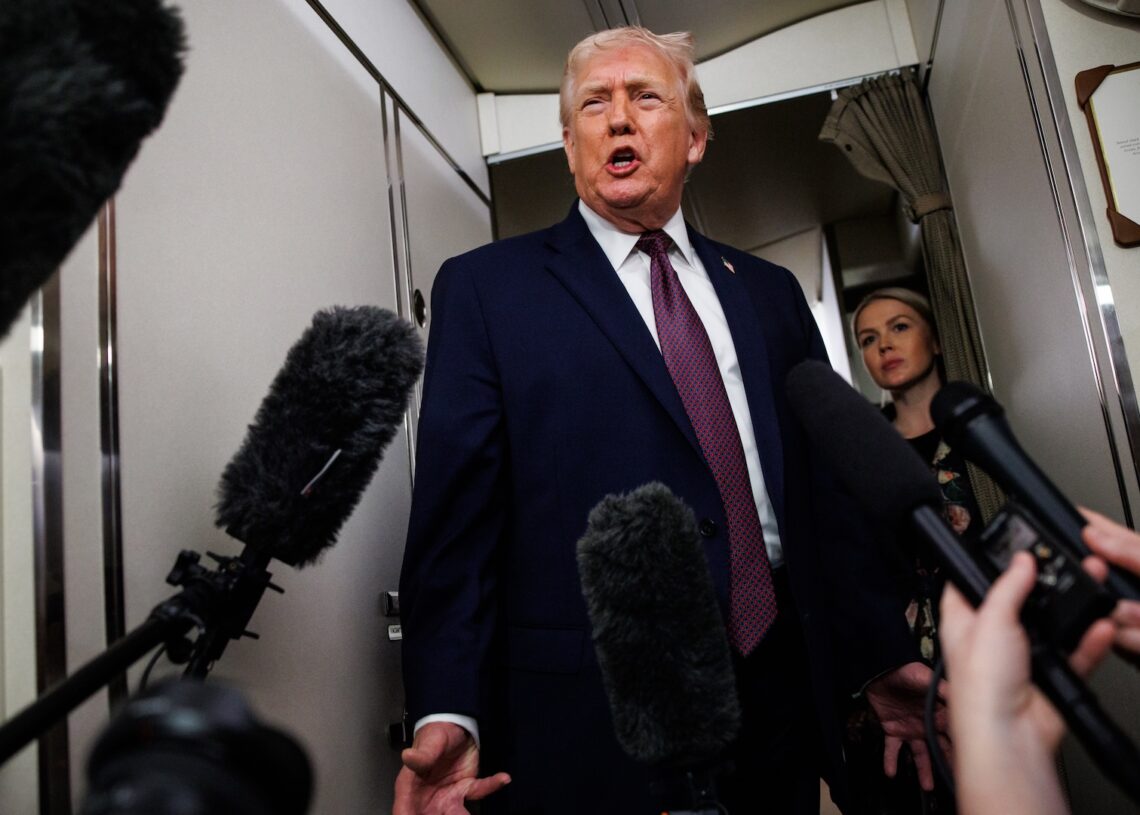
Trump said aboard Air Force One on Sunday night that Iran had contacted the U.S. to propose talks, but added: “We may have to act before a meeting. … A meeting is being set up.” He declined to elaborate on the options the U.S. was considering.
Trump said he believed Iran was taking U.S. threats seriously. “They’ve been going through it for years with me,” he said in response to a question, noting the U.S. strike that killed Iranian Quds Force commander Qasem Soleimani in Trump’s first term and the recent U.S. operation to remove Venezuelan leader Nicolás Maduro.
The New York-based Center for Human Rights in Iran said it received eyewitness accounts and credible reports that hundreds of protesters have been killed since Thursday night, while another U.S.-based group, the Human Rights Activists News Agency, estimates 490 protesters have been killed since demonstrations began on Dec. 28.
Alhough Iranian officials had expressed, after the 12-day war with Israel in June, that they would be open to returning to talks, they had also rejected what they called “maximalist demands” by the Trump administration, and so negotiations remained frozen.
“The communication channel between our Foreign Minister Abbas Araghchi and the U.S. special envoy [Steve Witkoff] is open and messages are exchanged whenever necessary,” Foreign Ministry spokesperson Esmaeil Baqaei said during a news conference Monday, Reuters reported. The traditional U.S.-Iran diplomatic channel through Switzerland also remains open, he said.
Araghchi also met Saturday with his Omani counterpart, Badr Albusaidi, who traveled to Tehran for talks and who has acted as a go-between for Tehran and Washington in the past.
Iranian authorities, who have shut down internet access, are struggling to contain some of the largest protests since the Islamic republic was founded in 1979. Protests that erupted over economic grievances have evolved into calls for regime change, and demonstrations have grown increasingly violent.
According to a senior Western official, who spoke on the condition of anonymity to discuss sensitive issues, Iranian authorities initially appeared reluctant to use lethal force but changed course once the protests threatened the regime.
Trump told reporters Sunday night that he was getting hourly reports on the crackdown on protests. “We’re looking at it very seriously. The military’s looking at it. And we’re looking at some very strong options,” he added.
On Monday, Araghchi reiterated the government’s favored narrative about the protest violence — that it was being committed by “terrorists” and not security forces. “A large number of the people who have unfortunately died in these incidents have been shot in the back by these people,” he said.
“State narratives portraying protesters as terrorists and agents of civil war are clearly directed at ideologically committed segments of society, encouraging participation in repression,” Hamidreza Azizi, an expert on Iranian security policy, wrote on Substack.
Iranians have endured years of soaring inflation, weak economic growth and international isolation, driven by mismanagement, corruption, and sanctions imposed by the U.S. and other countries over Tehran’s nuclear program.
The situation worsened late last year as the Iranian currency fell to record lows, sparking initial protests by shop owners in Tehran in late December and later were joined by students, workers and others across the country.
Susannah George, Michael Birnbaum and Huiyee Chiew contributed to this report.
The post Trump announces 25 percent tariff on countries that trade with Iran appeared first on Washington Post.