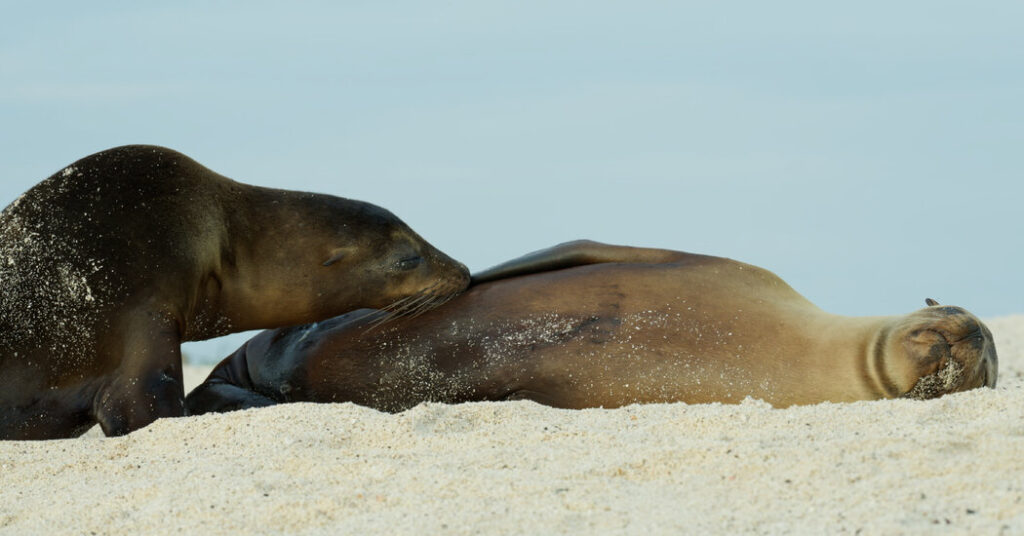
For most mammals, growing up means giving up their mother’s milk. Then there are the sea lions of the Galápagos Islands.
A long-running study has documented a significant number of sea lions in the Galápagos, an archipelago in the Pacific Ocean, that kept suckling from their mothers for years after reaching sexual maturity. Some have reached ages comparable to those of human teenagers, with a few nursing into the equivalent of middle age and beyond.
One animal was spotted nursing at age 16, which, given the life expectancy of sea lions, would be akin to people in their early 60s still breastfeeding from their mothers.
No other animal has been shown to nurse offspring so deep into its reproductive life. “It’s utterly extraordinary,” said Patrick Pomeroy, a marine mammal expert at the University of St. Andrews in Scotland who was not involved in the research. “It goes against all the accepted wisdom.”
And “the fact that this is happening in a species producing such costly, lipid-rich milk as sea lions produce makes it all the more remarkable,” said Sarah Blaffer Hrdy, a retired anthropologist from the University of California, Davis.
Darwinian logic holds that mothers should cease costly milk production for their young once those offspring can feed themselves and reproduce. Yet among Zalophus wollebaeki, the scientific name for the Galápagos sea lion, many mothers continue nursing older young even as they raise new pups.
So why has natural selection allowed these animals to keep returning to the milk bar? “It’s very hard, at the moment, for us to grasp,” said Oliver Krüger, a behavioral ecologist at Bielefeld University in Germany and a leader of the study.
In rare cases, researchers have even observed multigenerational suckling trains, with a pup latched to her mother, who is herself still nursing from her own mother. At other times, males have been seen pivoting from suckling to courtship, shifting from quiet feeding at the mother’s teat to aggressive posturing before a potential mate.
“It is an enigma for us to explain,” Dr. Krüger said. He and his colleagues published their discovery last month in The American Naturalist.
Dr. Krüger leads the Galápagos Sea Lion Project, which, since 2003, has closely monitored a single population of the endangered pinnipeds, a close relative of Californian sea lions. This colony lives on the tiny Caamaño Islet, alongside marine iguanas, blue-footed boobies and other wildlife that made the islands famous.
Over the years, the team occasionally glimpsed adult sea lions continuing to nurse. But it took a graduate student, Alexandra Childs, to join Dr. Krüger’s lab and begin examining the practice in earnest. She combed through two decades of field records and began tallying every instance of prolonged nursing she could find.
Most sea lions had weaned by their third birthday, around the age of puberty, and were feeding independently, mainly on fish and squid. But 11 percent of these newly pubescent animals kept returning to their mothers for nourishment. And among these late-nursing sea lions, about one in five continued well past the point of sexual maturity and reproductive activity.
The researchers called these unusually mom-dependent animals “supersucklers.”
The behavior showed no clear bias toward sons or daughters, the researchers found, defying expectations that mothers might preferentially feed larger males over their smaller female offspring.
The only consistent pattern to emerge was environmental. Supersuckling was more common in years when food was abundant, suggesting mothers nurse older offspring only when doing so does not jeopardize their own survival or future reproduction. In leaner years, such generosity may be too costly. Preliminary analyses by the same team suggest that having a supersuckler in the family can increase the odds that younger siblings, still fully dependent on their mother’s milk, may succumb to an early death.
Even so, scientists don’t yet know how much milk older offspring are actually getting, or how caloric it is. It’s possible that lingering visits to the teat provide only modest nourishment and that supersuckling mainly reinforces bonds that persist into adulthood.
That social explanation fits with other quirks that set Galápagos sea lions apart, said Paolo Piedrahita, an ecologist at the Higher Polytechnic School of the Coast in Guayaquil, Ecuador, and a study co-author. That includes their unusual habit, rare among marine mammals, of hunting cooperatively by herding schools of fish into shallow water.
“In the Galápagos, everything is upside down,” Dr. Piedrahita said. “What you learn in textbooks is not the rule.”
The post The Sea Lions of the Galápagos Are Not Ready to Stop Nursing appeared first on New York Times.