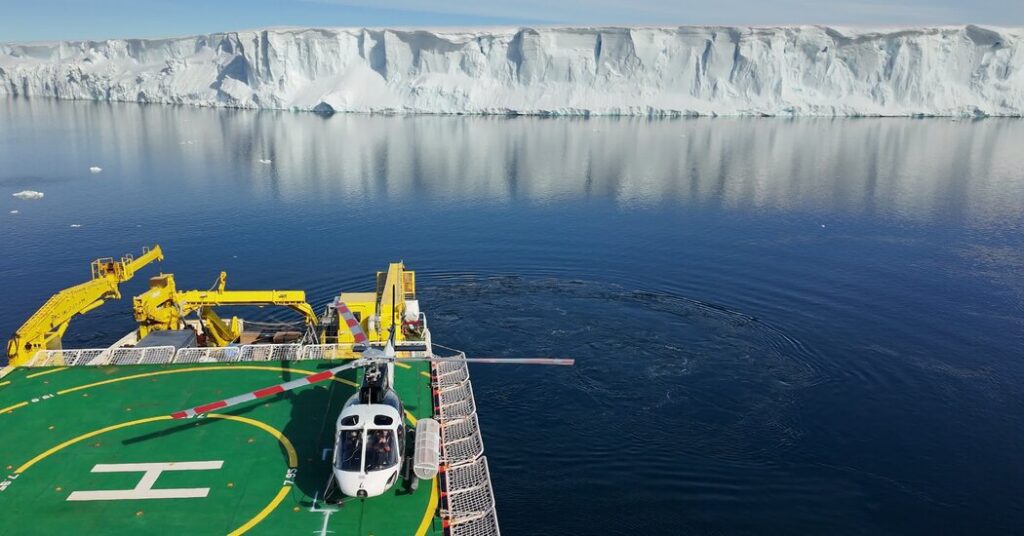
After sailing to one of the world’s most remote glaciers, members of our Antarctic expedition have finally set foot on its hostile, deeply fractured surface.
Then they almost got stuck there overnight.
One of the trickiest operations on this voyage has begun, sort of. A 10-person team aboard the icebreaker Araon is hoping to drill deep into the immense Thwaites Glacier to better understand why it is melting at such an alarming rate.
The helicopter flight from the ship’s deck to the drilling site takes less than 20 minutes. But the Antarctic weather, which can change by the hour, just hasn’t cooperated.
When Dominic O’Rourke, one of the expedition’s two helicopter pilots, took to the skies with the first members of the drilling party Saturday morning, poor visibility quickly made him return to the ship.
Later that morning, Mr. O’Rourke took Chang W. Lee, my photographer colleague, and me up in his helicopter to see whether the weather was improving. Within seconds, we were soaring above the remnants of Thwaites’s western tongue, a 30-mile-long jumble of flat-topped icebergs that are moving out to sea at more than 20 feet a day. These blocks of ice are thousands of feet across and separated by canyons that glow an otherworldly blue, like a rugged landscape of mesas recast in ice and snow.
We were still miles from the desired drilling site when the glacier and the sky started blurring into a zone of pure white. When clouds swallow up the horizon this way, helicopter pilots sometimes can’t tell which way is up, forcing them to turn around, Mr. O’Rourke said.
“We do what we can based on what Antarctica allows us to do,” he said as he flew us back to the ship.
Mr. O’Rourke tried again on Sunday morning, under slate-gray skies. His passengers were Choon-Ki Lee, a principal research scientist at the Korea Polar Research Institute, and two field guides, Jinsuk Kim and Taff Raymond.
They were scouting the glacier, looking for a spot that would be safe for the other scientists to set up camp. Using a radar device towed behind a remote-controlled car, they would determine if the ice beneath the proposed drilling site was stable enough.
If they deemed it safe, the team could start ferrying gear from the ship and doing the work they had come to the bottom of the planet to do: bore a hole through Thwaites, then install data-gathering instruments in the warming seawater below. That will help them estimate how much time remains before the glacier potentially collapses, driving up sea levels worldwide.
Within minutes, Mr. O’Rourke had turned the helicopter around. Too many clouds, too much risk.
After lunch, the skies started to clear, and Mr. O’Rourke at last managed to land the survey team on the glacier. It was sunny on the ice, he reported in a text message on his satellite communicator. Still, he was watching some low clouds nearby.
In the days since our ship arrived near Thwaites, the weather around the Araon has already cycled through a few different moods, and each one changes the environment completely. Ice, like sand, is a blank canvas on which the sun and the clouds can paint some of their most glorious tableaus.
In the afternoon, the survey team texted the ship with good and bad news. Their radar scan confirmed that a strip of the glacier’s surface, 650 feet long and ranging in width from 80 to 160 feet, was safe for the scientists to work and camp on. But low clouds had crept in, and visibility was looking too poor for a helicopter to pick up the survey team.
It seemed like Dr. Lee, Mr. Kim and Mr. Raymond might have to camp on the ice overnight, if not longer. That evening, though, on Mr. O’Rourke’s second attempt to fly out and land on the glacier, he succeeded. He brought the three men back aboard the ship after 9 p.m.
Monday wasn’t much more productive. Mr. O’Rourke tried and failed to fly some cargo to the site. The problem, again, was clouds. The scientists started getting anxious about the delays. The drilling needs to start soon if it is to finish before the Araon must head back to New Zealand on Feb. 10.
After dinner, the scientists huddled in the ship’s conference room and came to a decision: They weren’t giving up hope for drilling at Thwaites just yet.
“We got really lucky to get here,” said Won Sang Lee, the expedition’s chief scientist, nodding to the fact that sea ice has prevented the Araon from sailing this close to Thwaites before. The scientists decided to keep trying for another week.
“We only need two days out of the next eight days, and suddenly the picture could change rapidly,” said Peter Davis, an oceanographer and member of the drilling team. “With all the best field work, you just sneak through, and then you get it done,” he said.
Keith Makinson, another team member, put it this way: “It’s an absolute roller coaster.”
Raymond Zhong reports on climate and environmental issues for The Times.
The post Tantalizingly Close to an Antarctic Glacier, but Weather Blocks the Way appeared first on New York Times.