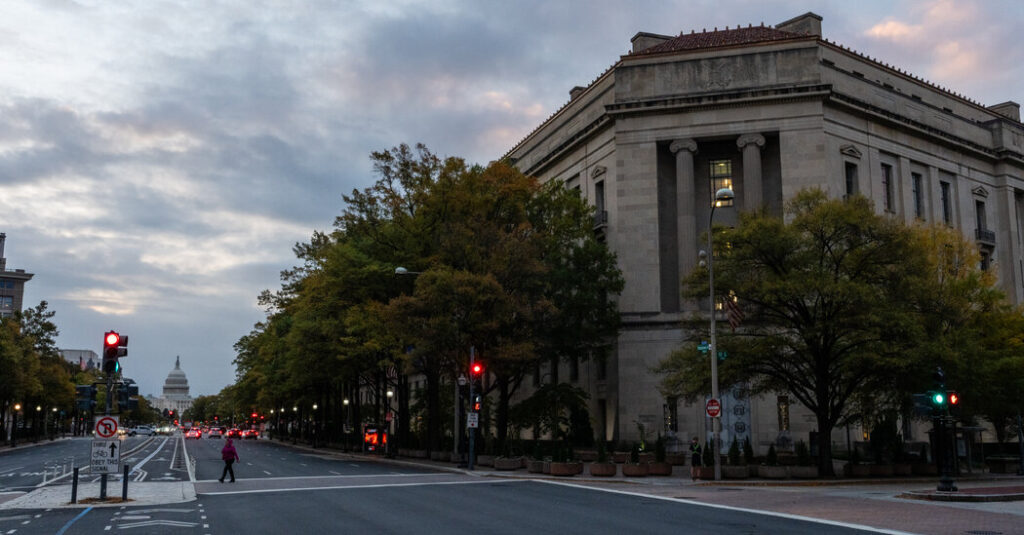
A secret Justice Department memo concluded that President Trump had constitutional authority to send military forces into Venezuela to help carry out the arrest of its president, Nicolás Maduro, without congressional authorization, according to people familiar with it.
The broad contours of the memo offer an early glimpse into the administration’s legal justification for its incursion into Venezuelan territory in early January. The memo, issued by the department’s Office of Legal Counsel, is about 22 pages and was signed by the head of the office, T. Elliot Gaiser, according to the people familiar with it, who spoke on the condition of anonymity to describe a document intended to remain confidential.
The Trump administration has started showing the document to members of Congress. It is said to broadly cover three areas: issues of international law, whether and when the U.S. military can be used to assist in a law enforcement matter, and whether Mr. Trump needed congressional authorization to direct the operation.
At least 80 people were killed during the incursion to capture Mr. Maduro, including Venezuelan military personnel and civilians and Mr. Maduro’s Cuban bodyguards. Several Americans were injured, but none fatally.
The operation raised a host of legal issues about international law and presidential power. In particular, legal scholars say, it appears to have violated international law. Under the United Nations Charter, a treaty ratified by the U.S. Senate, a nation cannot use force inside the sovereign territory of another country without its consent, a self-defense rationale or the permission of the U.N. Security Council.
The Justice Department and White House press offices did not respond to requests for comment.
Mr. Gaiser’s memo is said to open by discussing international law over several pages, including quoting from the U.N. Charter. The people familiar with the document said that even though the memo suggested that such an operation would raise international law concerns, it did not clearly state any conclusion.
But it is also said to cite as a precedent a 1989 Office of Legal Counsel memo that asserted that President George H.W. Bush had inherent constitutional power to violate or override international law by sending the F.B.I. to carry out arrests abroad. That memo made a disputed claim that presidents are not constitutionally bound to obey ratified treaties like the U.N. Charter.
Later that year, Bush relied on that claimed authority to arrest Gen. Manuel Noriega, then the strongman leader of Panama. General Noriega, like Mr. Maduro, had been indicted on drug trafficking conspiracy charges in the United States.
The 1989 memo did not address the issue of using American forces to help the F.B.I. carry out an arrest in foreign territory, even though the military invaded Panama to carry it out. The second part of Mr. Gaiser’s memo is said to discuss that issue at length in the context of the Venezuela operation.
The third part of the memo, according to the people who have read it, addresses the question of whether, as a matter of domestic and constitutional law, Mr. Trump would need authorization from Congress to send U.S. ground forces into Venezuela for the operation.
Executive branch lawyers under administrations of both parties have argued that as commander in chief, a president has constitutional power to order a military operation without congressional authorization if a deployment is in the national interest and its anticipated nature, scope and duration will fall short of “war’ in the constitutional sense.
In endorsing the idea that capturing Mr. Maduro would serve national interests, the memo is said to invoke not only his indictment on drug-trafficking charges, but also a September memo by the Office of Legal Counsel that blessed the administration’s lethal strikes on people aboard boats in international waters suspected of smuggling drugs.
That September memo, which has not been made public but has also been described by people who read it, is said to rely heavily on the White House’s own claims. Those include Mr. Trump’s assertion that the United States is in a formal “noninternational armed conflict” — meaning a legal state of war with a nonstate actor — with a secret list of 24 drug cartels and criminal gangs he has deemed to be terrorists.
A member of that purported list is Venezuela’s so-called Cartel de los Soles, which the Treasury and State Departments last year designated as a foreign terrorist organization with Mr. Maduro as its leader. In its section about the national interest, the Office of Legal Counsel memo on the operation to capture Mr. Maduro is said to specifically invoke Cartel de los Soles.
But the Trump administration’s treatment of it as an actual organization, which dates back to the 2020 indictment of Mr. Maduro, is contested. Experts in Latin American crime and narcotics issues say it is a slang term, invented by the Venezuelan media in the 1990s, to refer to officials corrupted by drug money — not a literal cartel.
Shortly after Mr. Maduro was captured to be taken to New York for arraignment, a court unsealed a superseding indictment by Justice Department prosecutors in New York that dropped that claim. It instead calls Cartel de los Soles a term used to refer to a “patronage system” and a “culture of corruption” fueled by drug money in Venezuela.
The new Office of Legal Counsel memo is said to question whether there was compelling evidence that Mr. Maduro was the leader of Cartel de los Soles, but continues to portray it as an actual group, according to the people familiar with the document.
Past precedents of military operations launched unilaterally by presidents have most often involved one-off strikes or air wars that did not involve risk to American ground troops, or peacekeeping missions to maintain order. The new memo is said to wrestle with the use of ground troops inside Venezuela on an operation for which resistance could be anticipated and risked escalation.
But Mr. Gaiser ultimately concluded that Mr. Trump could do what he wanted.
Charlie Savage writes about national security and legal policy for The Times.
The post Justice Dept. Memo Said Trump Could Send Troops Into Venezuela on His Own appeared first on New York Times.