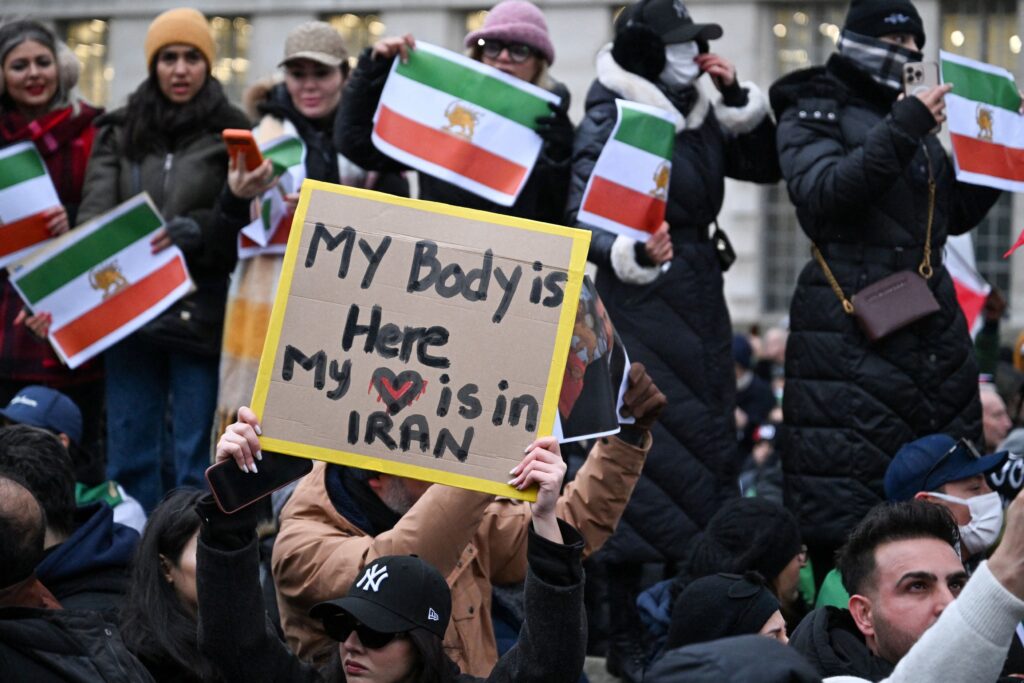
For the first time since leaving Iran in 2016, I’m allowing myself to feel hope that I might one day return.
Ten years ago this week, I was taken from my cell for the last time and, blindfolded, driven out of Tehran’s Evin prison. I had been held hostage there for nearly a year and a half. I was released in a prisoner swap that was coordinated with the implementation of the nuclear deal between world powers and Iran.
But all of that is ancient history. Today, as Iran is electrified by massive nationwide protests, I find myself wishing I was back in Tehran, the city where I chose to live and work. The one where I was married and intended to reside for years to come.
Our life plans were upended, but nothing could ever undo the affection and wonder I feel toward that place and its people. Watching Iranians’ brave fight against a well-armed authoritarian state that has shown it will stop at nothing to silence and suppress them is at once inspiring and heartbreaking. Already, a large number of protesters have been killed, and that carnage will likely mount in the coming days.
It’s a storyline I know well. I started reporting on Iran in 2001. Over the years, I covered three Iranian presidential elections, domestic political infighting and multiple protest movements. I wrote about the destructive effects of environmental degradation and economic sanctions, but also stories about art, cinema, sports and food. I interviewed politicians, artists, clerics, drug addicts and ordinary members of society.
Ingenuity, resilience and good humor stand out as traits shared by many Iranians.
And in my final months as The Post’s Tehran correspondent in 2014, I covered the nuclear negotiations that ultimately resulted in my being taken hostage and used as leverage in those very talks.
I was well acquainted with Iranians’ discontent over their nation’s economic woes and its isolation from the world, but it was my imprisonment that taught me the most about the Tehran regime and its dysfunctional, toxic relationship with Iranian society.
What role can and should the United States play in supporting the aspirations of Iranians to rid themselves of the theocratic regime that has ruled their lives for nearly half a century? Even more critically, when the time comes, how can the U.S. help ensure a smooth transition to whatever comes next?
Though I have never supported President Donald Trump’s “maximum pressure” policy on Iran, as its sanctions disproportionately hurt ordinary people without offering clear, credible goals, to delay planning for a post-Islamic Republic era would be equally misguided.
It’s a fiction that the U.S. never exerted pressure on Iran before Trump. He inherited an architecture that he extended and enforced more strictly. Arguably, though, what has been his most effective tool against Iran is the element of surprise that has left Iran unable to predict what he will do next, from approving the 2020 killing of Maj. Gen. Qasem Soleimani the commander of the Revolutionary Guard’s elite Quds Force, or the bombing campaign Trump ordered on Iranian nuclear sites in June.
It was American consistency, not weakness, that Tehran long exploited. In Trump, the Islamic Republic has met its match: a much stronger adversary who, like their leadership, believes that rules don’t apply to him.
The obvious and most pressing need right now is to help Iranians get back online. Shutting off communications has been the most effective way for authorities to suppress protests. Despite numerous protest movements since 2009 and promises to keep Iranians connected, the outside world has failed to solve this challenge.
I learned long ago not to make predictions when it comes to Iran. But two things seem very clear. First, no matter how sophisticated and educated many Iranians are, there is and will be an understandable desire for retribution against the old guard for decades of harsh injustices. A law-based approached to accountability within Iran and at international tribunals would pay many more dividends than wrecking existing institutions that ordinary citizens rely on. Continuity will be essential for an orderly transition.
And second, when the regime finally falls, whoever will lead Iran next is almost certainly living there now. It’s unrealistic and frankly unfair to expect Crown Prince Reza Pahlavi — the long exiled son of the shah overthrown in 1979 — who has a strong presence on social media but no record of actual leadership, to be able to manage a country of Iran’s size and complexity. The same is true for others in the diaspora currently jockeying for relevance.
Whether that person, whomever it turns out to be, would be better able to provide for the needs of Iranians and ensure a brighter future than the country’s current authoritarian rulers is still anyone’s guess. But the end of economic sanctions, with the advent of a new government, along with support in solving other pressing issues, including massive water shortages, would be an immediate boost.
The Trump administration should do what its predecessors failed to do for decades. Stop taking its cues from experts and charlatans in Washington and build bridges to changemakers within Iran.
The post I’ve waited for this electrifying moment in Iran for 10 years appeared first on Washington Post.