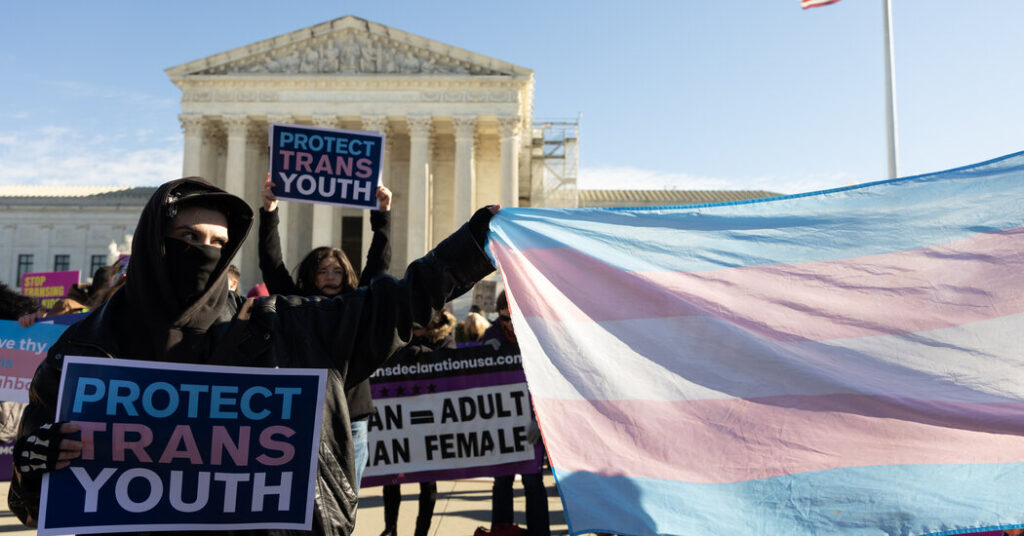
Five years ago, the Supreme Court delivered a major victory to the L.G.B.T.Q. community when it ruled that a federal civil rights law that prohibits employment discrimination on the basis of sex protected gay and transgender people from workplace discrimination.
The decision in that case, Bostock v. Clayton County, was written by a conservative justice, Neil M. Gorsuch. He said that it was “impossible to discriminate against a person for being homosexual or transgender without discriminating against that individual based on sex.”
At the time, Justice Gorsuch made clear that his ruling was limited.
“We do not purport to address bathrooms, locker rooms or anything else of the kind,” he wrote.
Last year, advocates for transgender adolescents and their families cited that 2020 decision in a challenge to a Tennessee law that prohibits certain gender transition medical treatments for minors. But in a major setback for transgender rights, the court’s conservative majority upheld the law in June and rejected arguments that it violated the Constitution.
Chief Justice John G. Roberts Jr. wrote that the Tennessee law drew distinctions based only on age and types of medical treatments — not sex.
In response to emergency requests last year from lawyers for President Trump, the court’s conservative majority has allowed the administration to roll back transgender rights while litigation continues in the lower courts. The justices cleared the way for the administration to stop issuing passports that include gender identity markings selected by applicants and allowed the administration to begin enforcing a ban on transgender troops serving in the military.
In contrast, the court said in September in a South Carolina case that a transgender boy may use the boys’ bathroom at a public high school while he pursues a challenge to a state law requiring students to use the bathrooms for their sex as “determined by anatomy and genetics existing at the time of birth.”
The court’s brief order was unsigned and gave no reasons. It applied to a single student and stressed that it was “not a ruling on the merits of the legal issues presented in the litigation.”
In October, the justices heard oral arguments in the case of a Christian therapist who said her free speech rights had been violated by a Colorado law barring mental health professionals from seeking to change a minor’s gender identity through so-called conversion therapy. Based on their questions, the justices seemed likely to rule for the therapist.
Ann Marimow covers the Supreme Court for The Times from Washington.
The post Here’s How the Supreme Court Ruled in Cases Involving Transgender Rights appeared first on New York Times.