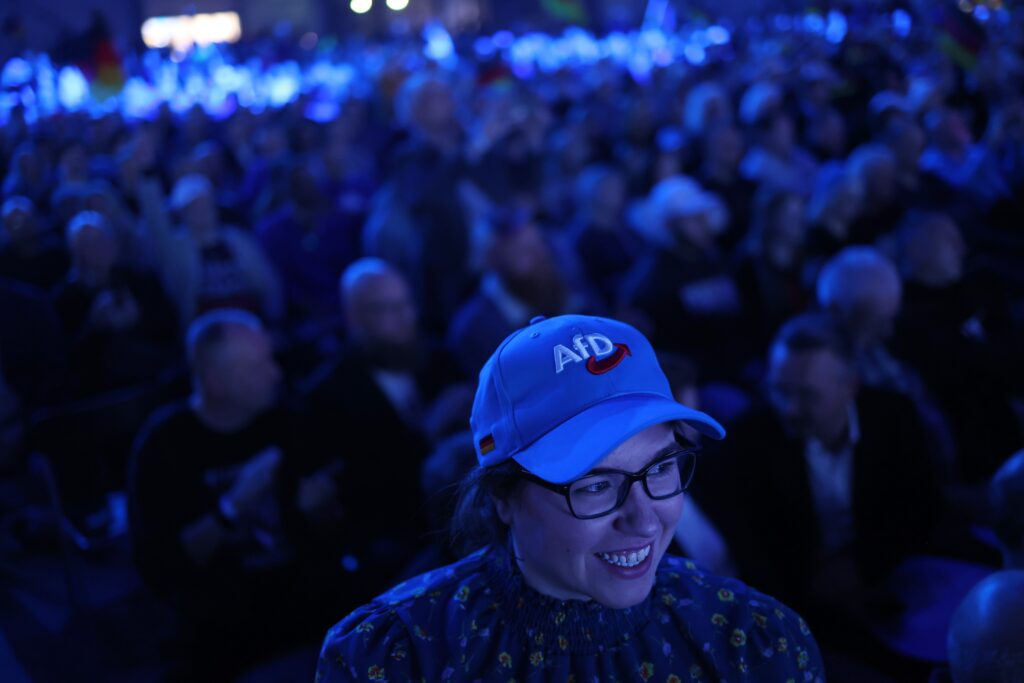
BERLIN — For the 13 years since its founding, the nationalist Alternative for Germany (AfD) party — labeled “right-wing extremist” by the country’s domestic intelligence agency and accused by others of xenophobia, antisemitism and Islamophobia — has stood in opposition. Opposition to the European Union. Opposition to immigration. And, as the largest party outside the governing coalition after last year’s federal elections, opposition to Chancellor Friedrich Merz.
This year, the AfD is looking to lead for the first time — by winning control of a state government. That in turn could undermine the fragile coalition that governs the country and open a path to power for the AfD at the federal level.
Five German states will hold elections in 2026. In two eastern states — Saxony-Anhalt and Mecklenburg-Western Pomerania — the AfD leads by wide margins in opinion polls.
If it wins control of either state, German politics may never be the same.
“It would massively challenge the institutional framework of consensus democracy in Germany,” said Benjamin Höhne, a political scientist at the Chemnitz University of Technology who has advised the parliaments of several eastern German states.
In classifying the AfD as a far-right extremist group, the domestic intelligence agency, the BfV, said that the party considers Muslim residents “non-equal members of the party’s ethnically defined German population.” There are widespread calls for the AfD to be banned. Germany’s mainstream parties, including Merz’s center-right Christian Democratic Union (CDU), have imposed a “fire wall” against collaborating with the AfD.
But amid growing disillusionment with the establishment parties, discontent at three straight years of economic stagnation, and discomfort with a wave of migration under Angela Merkel’s chancellorship more than a decade ago, the AfD now sits in a virtual tie with the CDU as the most popular party in Germany. In the states of the former East Germany, which lag economically behind what was once West Germany, polls show the AfD is far and away the front-runner.
Many observers believe the AfD will finish in first place in Saxony-Anhalt and Mecklenburg-Western Pomerania in September. The question is whether it will win enough votes for an absolute majority of seats in the state parliaments and control of the state governments.
If it doesn’t, other parties will face the even thornier question of whether to break the fire wall to form a coalition with the AfD.
Either scenario would send shock waves through the German political system and could destabilize the fragile coalition between the CDU and the center-left Social Democratic Party (SPD) that governs the country. Federal elections aren’t scheduled until 2029, but some AfD leaders hope the reordering of German politics and divisions between the governing partners will hasten a collapse of the coalition — opening the door to an AfD effort to take control of the federal government as soon as this year.
“This administration is finite,” AfD deputy leader Beatrix von Storch said in an interview. “It will eventually come to an end. And that will be before ’29. I’d bet on ’26.”
Across Europe, right-wing parties have been on the rise. In recent years, they have led or joined governing coalitions in Italy, Austria, the Netherlands, Hungary and Finland, among other nations. But in Germany, where memories of the Nazis still loom large, no far-right party has governed at the state or national level since World War II.
In state elections, the AfD sees its best chances in Saxony-Anhalt, which has the lowest per capita GDP of any state and has steadily lost population since German reunification in 1990. Polls in the state show support for the AfD hovering at 40 percent. In Germany’s multiparty system, in which parties receiving less than 5 percent of the vote are excluded from parliament, it often doesn’t take an outright majority of votes to win a majority of seats. So the AfD could win power in Saxony-Anhalt by overperforming its polling numbers by a few points.
“If I had to guess, I’d say it’ll happen in Saxony-Anhalt,” predicted Hannes Gnauck, an AfD lawmaker in the Bundestag, the German parliament.
The AfD’s popularity soared as it lobbed criticism at the government from the outside. Party members are keenly aware of the pressure they will face to deliver results if they assume power. Gnauck said that if the party takes control in Saxony-Anhalt, it will send its best people from across the nation to form the state administration.
“If we form a single-party government in Saxony-Anhalt … and we fail, then that will have repercussions at the federal level,” Gnauck said. “People will say, ‘Look over there, they’re governing there, they can’t do it either.’ And that’s why it’s so important that if we win this election, all the breadth and expertise of the party goes to Saxony-Anhalt.”
If the AfD falls short of a majority, exceptionally delicate coalition negotiations will kick off. Theoretically, all the other parties could band together in an anti-AfD coalition, but that would require the CDU to break its pledge to avoid working with the surging Die Linke, or “The Left,” the successor to the East German socialist party.
The AfD might persuade the CDU to break its fire wall and help form a center-right/hard-right coalition. But Höhne, a Saxony-Anhalt native, said a likelier prospect is a coalition of the AfD and the Sahra Wagenknecht Alliance (BSW), a left-wing populist party that split from Die Linke in 2024 and has substantial support in the former east.
Although the AfD and the BSW might appear on opposite ends of the spectrum, they have more in common than the AfD does with the CDU, Höhne said, including a history of pro-Russian and E.U.-skeptic views as well as conservative stances on climate change and social issues.
The AfD has already finished in first place in one state election, in Thuringia in 2024. But there, winning 33 percent of the vote share wasn’t enough to stop the CDU from forming a coalition with the SPD and the BSW, shutting out both the AfD and Die Linke. In Saxony-Anhalt and Mecklenburg-Western Pomerania, that math is not likely to hold.
The AfD has been deepening its ties with the Trump administration, with frequent visits to Washington by its Bundestag members. Part of the goal, party leaders say, is to have a strong relationship in place for when they begin to govern. They also take inspiration from the 2024 Trump campaign’s preparations for assuming power, including the Heritage Foundation’s controversial Project 2025 blueprint, which they see as a model for laying the groundwork to quickly implement their policies.
For all its talk of mass deportation and independence from the E.U., the AfD would have trouble enacting that grand vision on the state level, where issues such as education and policing tend to dominate. Still, it would gain control of the state’s interior ministry and intelligence agency and would send representatives to the Bundesrat, the upper house of Germany’s parliament. Perhaps more importantly, it would gain a major stamp of legitimacy, further boosting its national profile and increasing pressure on the CDU to rethink its fire wall.
The first test of the AfD’s strength will be in March, when the western states of Baden-Württemberg and Rhineland-Palatinate hold elections. Polls show the AfD with about 20 percent support in those states, trailing the CDU. But if the AfD outperforms, mainstream parties could begin to change their thinking about cooperation with it.
“If we manage to achieve a result on par with the CDU, then there will be a political earthquake,” said Markus Frohnmaier, an AfD deputy leader who is running for minister-president of Baden-Württemberg.
Even if the AfD doesn’t take power in western states or at the federal level just yet, Frohnmaier said, the days are numbered for coalitions of mainstream parties. “If the CDU has to govern with the Greens, the Left Party and the SPD in order to form majorities, then their core voter groups will abandon them,” he said. “And the AfD will continue to grow.”
“If we aren’t banned, we’ll eventually have to be involved,” von Storch said, “because there simply won’t be any other majorities.”
The post Germany’s nationalist AfD party hopes to take power in 2026 appeared first on Washington Post.