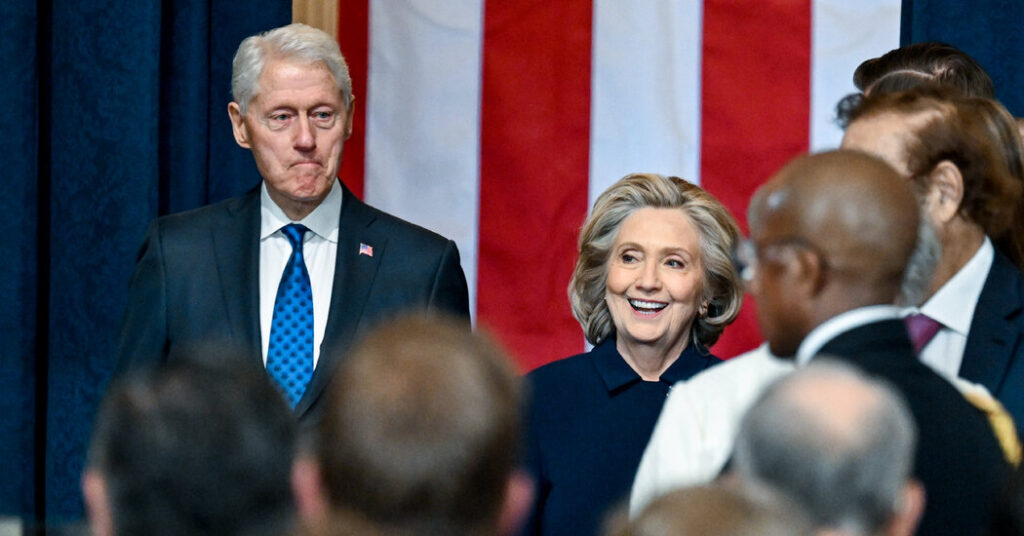
Bill and Hillary Clinton refused on Tuesday to testify in the House’s Jeffrey Epstein investigation, escalating a monthslong battle with Representative James R. Comer, Republican of Kentucky, and effectively daring him to follow through on his threats to hold them in contempt of Congress.
“Every person has to decide when they have seen or had enough and are ready to fight for this country, its principles and its people, no matter the consequences,” the Clintons wrote in a lengthy letter to Mr. Comer, which was obtained by The New York Times. “For us, now is that time.”
Mr. Comer’s relentless efforts to force them to testify reflect his overall approach to his panel’s Epstein inquiry. As the chairman of the House Oversight Committee, Mr. Comer has sought to shift the focus from President Trump’s ties to the convicted sex offender and his administration’s decision to close its investigation into the matter without releasing key information. Instead, he has sought to shift the spotlight onto prominent Democrats who once associated with Mr. Epstein and his longtime companion Ghislaine Maxwell.
Mr. Comer has repeatedly threatened to hold the Clintons in contempt if they failed to appear for live depositions behind closed doors, typically a first step in referring someone to the Justice Department for prosecution. He had set a deadline of Tuesday for Mr. Clinton to appear, and Wednesday for Mrs. Clinton.
But hours before the deadline, the Clintons made clear that they had no intention of presenting themselves on Capitol Hill to be questioned by Mr. Comer and members of his committee. They did so by submitting an eight-page legal letter laying out why they considered the subpoenas “invalid and legally unenforceable,” then followed up with a scorching missive that they signed jointly, promising to fight Mr. Comer on the issue for as long as it took.
In the letter, the Clintons noted that they had proactively provided Mr. Comer with sworn statements similar to ones he had accepted from seven or eight other former law enforcement officials he had also subpoenaed and then excused from testifying before the committee. The Clintons have repeatedly said they have no knowledge relevant to the investigation.
But on Tuesday, they went further, publicly going to war against Mr. Comer on the matter with moves that appeared to lay the predicate for what could be a messy legal battle. In a letter that touched on Mr. Trump’s immigration crackdown, his use of the Justice Department to prosecute his enemies and even Republicans’ opposition to extending health care subsidies, the Clintons accused Mr. Comer of potentially bringing Congress to a halt to pursue a politically driven process “literally designed to result in our imprisonment.”
“We are confident that any reasonable person in or out of Congress will see, based on everything we release, that what you are doing is trying to punish those who you see as your enemies and to protect those you think are your friends,” they wrote.
In the letter, the Clintons said they had anticipated that Mr. Comer would still direct his committee to seek to hold them in contempt, and they expected him to “release irrelevant, decades-old photos that you hope will embarrass us.”
Indeed, on Tuesday morning Mr. Comer was planning to hold a deposition at the time that Mr. Clinton had been summoned, with a chair left empty to illustrate his absence, and move quickly to hold the couple in contempt should he fail to show up.
“The Clintons have not confirmed their appearances for their subpoenaed depositions,” a spokeswoman for the House Oversight Committee said in a statement. “If the Clintons do not appear for their depositions, the House Oversight Committee will begin contempt of Congress proceedings.”
The Clintons said in their letter that they anticipated Mr. Comer would argue that the decision about whether to testify was not theirs to make.
“But we have made it,” they wrote. “Now you have to make yours.”
The Clintons had worked to beef up their legal team before Mr. Comer’s deadline. They brought on Ashley Callen, co-chair of the congressional investigations practice at Jenner & Block, who had previously worked as general counsel for Speaker Mike Johnson and other top Republicans, to interface with G.O.P. members on the House Oversight Committee. Ms. Callen also previously worked as a deputy staff director on the House Oversight Committee under Mr. Comer.
They also sought assistance from Abbe Lowell, the veteran lawyer famous for representing clients in the middle of political scandals.
Before that, the Clintons had been working behind the scenes for months to avoid appearing on Capitol Hill to testify. Their longtime lawyer David E. Kendall previously sent three letters explaining in detail his argument that the Clintons should be required to provide only sworn statements to the committee.
In a more aggressive legal letter sent to Mr. Comer at 11 p.m. on Monday, Ms. Callen and Mr. Kendall wrote that the subpoenas were “invalid and legally unenforceable” because they did not have any valid legislative purpose. They also said they were “unwarranted because they do not seek pertinent information, and an unprecedented infringement on the separation of powers.”
Mr. Comer’s insistence over months that the Clintons appear, the lawyers said, “brings us toward a protracted and unnecessary legal confrontation.”
Citing specific case law about congressional subpoenas and constitutional precedents, the lawyers wrote that the subpoenas were nothing more than “an effort to publicly harass and embarrass President and Secretary Clinton and an impermissible usurpation of executive law enforcement authority.”
The committee’s attempt to compel the Clintons to testify in person ran afoul of limitations on Congress’ investigative power that have been outlined in cases before the Supreme Court, the lawyers said.
And they noted that the Supreme Court had stated in the past that there must be a “nexus” between the investigations’ legislative aims and the witnesses from whom information was sought. Mr. Comer had not established why the Clintons’ appearance would be relevant, they said.
The lawyers encouraged Mr. Comer to “de-escalate this dispute.”
Annie Karni is a congressional correspondent for The Times.
The post Facing Contempt Threat, Clintons Refuse to Testify in Epstein Inquiry appeared first on New York Times.