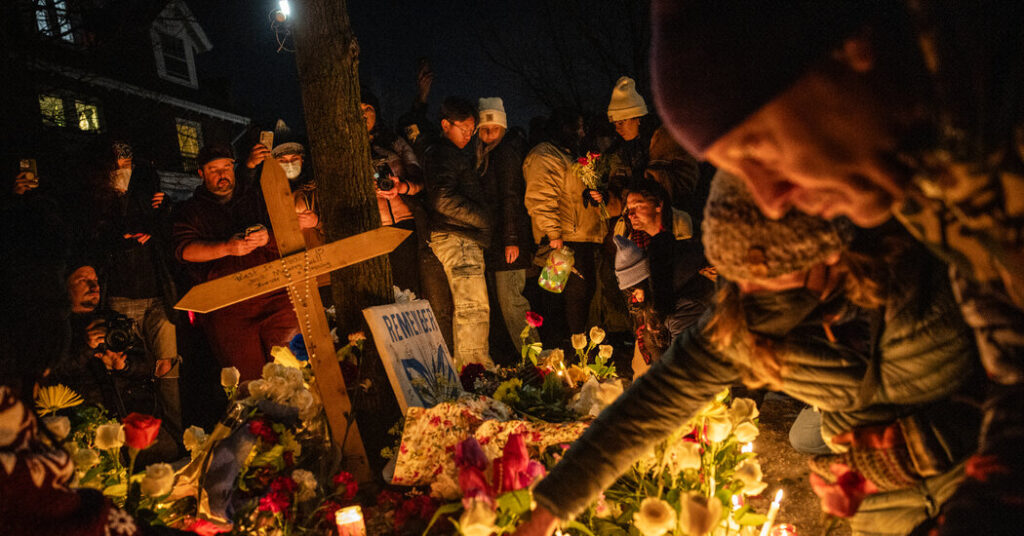
Federal investigators assigned to the fatal shooting of a 37-year-old Minneapolis woman are looking into her possible connections to activist groups protesting the Trump administration’s aggressive immigration enforcement, in addition to the actions of the federal agent who killed her, people familiar with the situation said.
It seems increasingly unlikely that the agent who fired three times at the unarmed woman, Renee Nicole Good, will face criminal charges, although that could change as investigators collect new evidence, the people added.
On Sunday, President Trump described Ms. Good and her wife, Becca Good, as being “professional agitators,” adding that the authorities would “find out who’s paying for it.” He offered no evidence to support his claims.
The decision by the F.B.I. and the Justice Department to scrutinize Ms. Good’s activities and her potential connections to local activists is in line with the White House’s strategy of deflecting blame for the shooting away from federal law enforcement and toward opponents they have described as domestic terrorists, often without providing evidence.
Justice Department officials under Mr. Trump have long maintained that investigating and punishing protesters who organized efforts to physically obstruct or disrupt immigration enforcement is a legitimate subject of federal inquiries. But casting a broad net over the activist community in Minneapolis, former department officials and critics of the administration said, raises the specter that forms of political protest traditionally protected by the First Amendment could be criminalized.
Federal officials, who have blocked local investigators from reviewing the evidence they are collecting, have said that they are conducting a thorough inquiry that includes an analysis of the actions of the Immigration and Customs Enforcement agent Jonathan Ross and of physical evidence, including the handgun he used to kill Ms. Good.
Mr. Trump and his adviser Stephen Miller have repeatedly described those protesting the administration’s immigration crackdown as a shadowy and violent cabal.
In recent months, Trump administration officials have repeatedly vowed to crack down on left-wing activists. They have filed criminal charges against the purported members of what prosecutors described as an “antifa cell” in Texas who fired at immigration officers and activists in California accused of plotting to set off homemade bombs outside two companies near Los Angeles on New Year’s Eve.
But the investigation into protesters in Minneapolis might be different, if only because it has the potential to involve people not accused of committing any violence or even those without a close connection to Ms. Good.
Mr. Trump and many in his administration — particularly Vice President JD Vance — have already made clear that they believe Ms. Good, who was shot at three times at close range, was unambiguously responsible for her own death.
Speaking to reporters on Sunday, when the inquiry was less than one week old, Mr. Trump called Ms. Good “very violent” and “very radical” even though a video analysis by The New York Times suggested it was likely that she was trying to drive away from officers, not to intentionally harm them.
The civil rights division of the Justice Department, which has investigated law enforcement officials for killing or injuring citizens in the past, has not opened an investigation into whether the agent violated Ms. Good’s rights under federal law, according to a federal law enforcement official who spoke on the condition of anonymity to discuss internal deliberations. The official added that the division was not expected to initiate a case.
It is unclear how deeply Ms. Good was involved in activism in Minneapolis beyond participating with her wife in the protest against immigration officers on the day she was killed. In a group chat used by local residents to monitor ICE movements, her wife was described as a “helper” in that action.
In a statement issued to The Associated Press, Becca Good suggested that the two women took part in some sort of protest on the day of the shooting.
“On Wednesday, Jan. 7, we stopped to support our neighbors,” she said. “We had whistles. They had guns.”
But even though investigators have not made public a specific allegation that anyone aside from Ms. Good and her wife were involved in an encounter with federal agents that day, the Justice Department is still planning to examine a wide group of activists who took part in the neighborhood watch activities, believing they were “instigators” of the shooting, the people familiar with the inquiry said.
Complicating matters further, some senior administration officials immediately labeled Ms. Good a “domestic terrorist” after she was killed — even though investigators barely had time to collect and assess the facts about the case.
On Thursday, for example, Mr. Vance said that Ms. Good had interfered with a law enforcement operation, likening her actions to other acts of violence against immigration officers.
“This is classic terrorism,” Mr. Vance said.
Over the weekend, Kristi Noem, the homeland security secretary, echoed Mr. Vance’s remarks, asserting that Ms. Good had “weaponized” her vehicle and that the ICE agent, Mr. Ross, had “defended his life.”
“If you look at what the definition of domestic terrorism is,” Ms. Noem said, “it completely fits the situation on the ground.”
Experts in domestic terrorism cases said the administration had jumped the gun in lodging accusations like that and failed to follow the traditional procedures for determining whether a case should be classified as domestic terrorism.
“It’s not appropriate for officials to characterize this incident as domestic terrorism before the investigation is complete,” said Thomas E. Brzozowski, the former counsel for domestic terrorism in the Justice Department’s national security division. “There used to be a process, deliberate and considered, to figure out if behavior could be legitimately described as domestic terrorism.”
“And when it’s not followed,” Mr. Brzozowski said, “then the term becomes little more than a political cudgel to bash one’s enemies.”
Mr. Brzozowski raised concerns that the inquiry in Minneapolis was coming a little more than a month after Attorney General Pam Bondi issued a memo that greatly expanded the traditional definition of domestic terrorism. Ms. Bondi’s memo classified as domestic terrorism not only recognizably violent crimes like rioting and looting, but also things like impeding law enforcement officers or even simply doxxing them.
The memo also asserted that domestic terrorists use violence or the threat of violence to advance certain “political and social agendas” — all of them traditionally associated with left-wing activism. Among the causes listed were opposition to immigration enforcement, anticapitalism and “hostility towards traditional views on family, religion and morality.”
It remains unclear whether the inquiry in Minnesota will include allegations of domestic terrorism. But if it does, Ms. Bondi’s memo could give investigators latitude to move beyond the customary practice of focusing such investigations only on people engaged in or plotting violence.
“When you have a memo like this, it complicates things because it builds in a set of assumptions about what domestic terrorism is and what it is not,” Mr. Brzozowski said. “If you’re an investigator in the field, you can’t simply run away from this new definition. You have to deal with it.”
Nicholas Bogel-Burroughs contributed reporting from Minneapolis.
Alan Feuer covers extremism and political violence for The Times, focusing on the criminal cases involving the Jan. 6 attack on the Capitol and against former President Donald J. Trump.
The post F.B.I. Inquiry Into ICE Shooting Is Examining Victim’s Possible Ties to Activist Groups appeared first on New York Times.