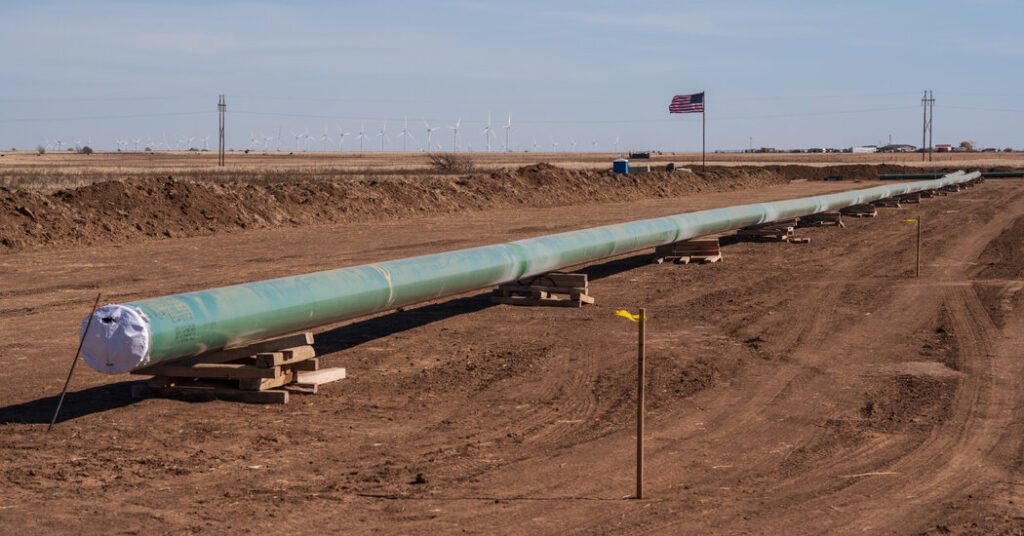
The Trump administration on Tuesday moved to limit the ability of states to block the construction of oil pipelines, coal export terminals and other energy projects that could pollute local waterways.
The proposed rule from the Environmental Protection Agency would curtail a section of the Clean Water Act that states have used for decades to restrict fossil fuel development. It is expected to set up a legal battle with Democratic state officials across the country.
The proposal was the second part of a one-two punch against the Clean Water Act, which Congress passed in 1972 to protect all “waters of the United States” from harmful pollution. In November, the E.P.A. announced plans to strip federal protections from millions of acres of wetlands and streams under the landmark environmental law.
The proposed rule would narrow the scope of Section 401 of the Clean Water Act. This section allows states and tribes to review, and ultimately to approve or veto, federal permits for energy projects that could discharge pollutants into nearby waterways.
“This proposed rule is the next step in ensuring that states and tribes only utilize 401 for its statutory purpose, and not as a weapon to shut down projects,” Jess Kramer, the E.P.A. assistant administrator in charge of the agency’s Office of Water, said on a call with journalists on Tuesday.
Under the E.P.A. plan, states and tribes would have the authority to address the direct water quality effects of a given project but not other factors like air pollution or traffic. The agency also would give states and tribes a maximum of one year to act on certification requests for federal permits.
Ms. Kramer said the changes were important to supply electricity to data centers, adding that the E.P.A.’s leading priority was to “maximize efficiencies” and eliminate delays in permitting. “Those projects, they need to be able to move forward with certainty,” she said.
In recent years, Democratic governors have used the Clean Water Act to prevent a number of oil, gas and coal projects from moving forward. In 2017, for instance, Gov. Jay Inslee of Washington refused to approve a permit for an enormous coal export terminal proposed to be built on the Columbia River, citing concerns about both water and air pollution.
In 2020 another Democrat, Andrew Cuomo, who was governor of New York at the time, denied a permit for a pipeline that would have shipped natural gas into his state from Pennsylvania, saying its construction would result in “significant water quality impacts.” Governor Cuomo also noted that the project would have jeopardized the state’s climate goals, which called for curbing the use of fossil fuels, the main driver of global warming.
Some in the gas industry have accused Democratic governors of misusing their authority over water quality to dictate national energy policy. They have blocked pipelines “for reasons unrelated to water quality, such as for the project’s perceived climate change impacts or general opposition to fossil fuels,” the American Gas Association and the Interstate Natural Gas Association of America wrote in a comment about a clean-water rule issued by the Biden administration.
Trump Administration: Live Updates
Updated
- Greenland’s leader says before White House meeting that the island would choose Denmark over the U.S.
- Obamacare enrollment dropped by 1.4 million as premiums surged.
- Trump urges Iranians to keep up antigovernment protests.
The governors have said they have denied permits based on legitimate concerns about water pollution. Kathy Hochul, a Democrat and the current governor of New York, recently granted a permit for the same pipeline that Mr. Cuomo had blocked.
The project, called the Northeast Supply Enhancement pipeline, was proposed by Williams Companies, an energy company based in Oklahoma. It would deliver gas from Pennsylvania to the New York City region, running for about 23 miles under Raritan Bay in New Jersey and New York Harbor.
Environmentalists said the rule threatened to increase pollution because local officials would have less oversight in how water supplies are protected.
“The list of environmental protections getting axed seems to grow longer every day,” said Hawk Hammer, a spokesman for the conservation group American Rivers. “The bigger picture here is that polluters are getting free run of our nation’s waterways and the last time that happened, rivers caught on fire.”
Jim Murphy, senior director of legal advocacy for the National Wildlife Federation, an environmental group, said the E.P.A.’s proposed action ran counter to promises by the Trump administration to prioritize clean water and grant states more power.
“Leaving the current rule alone would help meet these goals, while this new proposal would do the opposite,” Mr. Murphy said in a statement. “It promises to undercut the rights of states and tribes while putting our drinking water at risk.”
The scope of states’ rights under the Clean Water Act has fluctuated in recent years, depending on whether a Republican or a Democrat occupied the White House.
In 2020, the first Trump administration finalized a rule that drastically reduced the ability of states to consider the broader effects of federally permitted energy projects. The rule effectively barred states from studying how dams could block the movement of fish, among other things.
Environmental groups challenged the rule, and it was vacated by a district court. The U.S. Supreme Court then temporarily reinstated the Trump administration’s rule while appeals were pending.
In 2023, the Biden administration reversed these changes, saying states and tribes should have more power to protect their own waterways.
Now, the proposed rule would largely reinstate the requirements from Mr. Trump’s first term.
The E.P.A. plans to solicit public feedback on the proposal for 30 days. The agency is aiming to finalize the rule by spring, Ms. Kramer said.
Maxine Joselow covers climate change and the environment for The Times from Washington.
The post E.P.A. Moves to Limit States’ Ability to Block Pipelines appeared first on New York Times.