Awards are silly, harmless fun — unless someone gives one to me. Then they are solemn business deserving of respect.
That’s been my position, more or less. I like to watch the hosts of the Tonys or the Oscars make jokes and enjoy an actorly speech as much as anyone, but I don’t expend much energy getting upset at injustices in, say, the best supporting actor category.
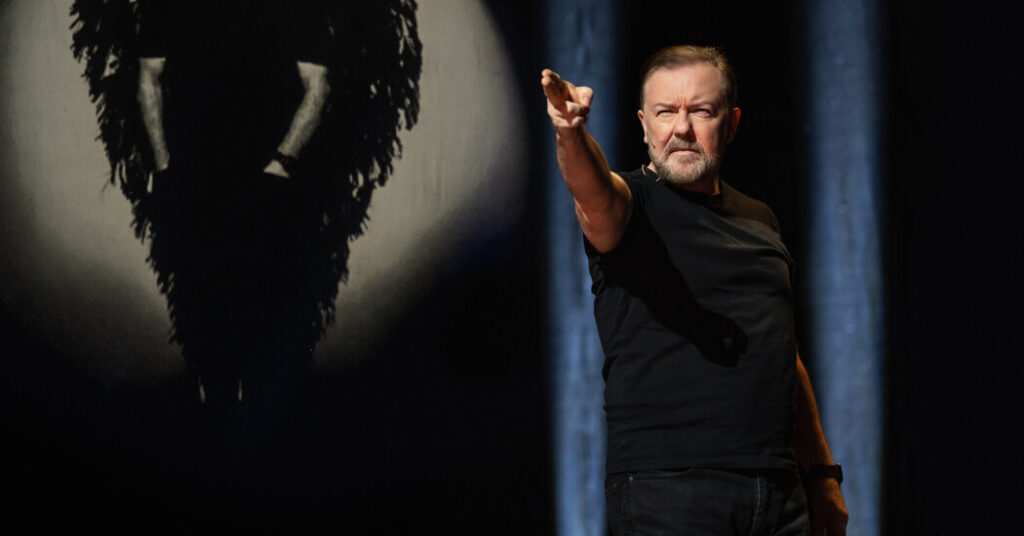
But on Sunday, when the Golden Globe for best stand-up comedy on television went to Ricky Gervais for the second time in three years, the win shook me out of my indifference. That his dismal, meandering laundry list of jokes was even nominated was absurd. That it won, perverse.
Imagine if Steven Seagal received the Oscar for best actor — twice. Or if “The Alto Knights” won for best picture. Taste is subjective, of course, but how can anyone who watched more than a dozen stand-up specials this year think that Ricky Gervais’s pretentiously titled “Mortality” set the standard?
Maybe the fact that he hosted the Globes five times earned him good will. Amy Poehler, another former host, won the first Globe for podcasting on Sunday. And yet, this celebration of one of the worst Netflix specials of the year sends a different message, about the lack of respect afforded stand-up. Out of thousands of hours sweated over by comedians, the one that receives the Globe includes a joke that bombed so badly, Gervais himself says, “Needs a bit of work that one.”
I am a huge admirer of his version of “The Office,” and while he has never been an elite stand-up, he has made me laugh. But in “Mortality,” Gervais is mailing it in, getting some of his biggest laughs with lines delivered years ago at the Golden Globes. Is that what persuaded the organization’s voters? It couldn’t have been when he tells the audience to expect his “most honest and confessional show so far,” then proceeds to say nothing we don’t already know.
The real purpose of this comment is to set up a dull joke about Edinburgh Festival Fringe shows wallowing in victimhood that has been done better countless times.
Then again, no one plays the victim with more persistence than Gervais. “They’ve tried to cancel me for 15 years,” he says in the special. Who has? Not Netflix, which pumps out his specials every couple of years. Maybe the Golden Globes? No, he says, not a single punchline he wrote for them was cut. He can’t even commit to his own nonsense.
The intent behind this lazy writing is vague, but it seems that Gervais is aiming for a special that’s not just funny but also important. (Again, notice the title.) But he has nothing new to say. He speaks soberly of the danger of people who get their feelings hurt over jokes and casts himself as leader of the cultural pushback. “We won,” he announces, before immediately warning viewers to stay vigilant against the mysterious “they” who, he claims, are “licking their wounds” and will be “back with something madder.”
He is hardly the only one to do this, but most of his compatriots fighting so-called cancel culture have moved on. A few, like Dave Chappelle, still lean on the subject but have other tricks. Gervais beats this one drum over and over again, incapable of seeing anything in the world today that might threaten free speech beyond people upset at his jokes. No news will shake him of this view.
The most revealing joke in “Mortality” involves what sounds like an ideal meal. He’s sitting down all alone in a restaurant, with no one to bother him. Perfection. Suddenly, a busboy shows up and — get ready for the punchline — sniffles. This is the whole joke: Don’t you hate it when a busboy gets a cold? What rich misanthrope can’t relate? Being around a sniffle isn’t the worst part, though. No, it’s not being able to say anything about the sniffle because of censorious etiquette.
Look, it’s possible to create a funny joke about being in a room with someone sniffling — and I don’t believe in ironclad rules about punching up or down — but there isn’t much of an effort here. There’s no cleverness to this bit or unexpected twists, just smug anger and dopey cruelty.
Why does this matter? Bad or boring art gets rewarded with prizes all the time. And no one takes the Golden Globes seriously, right?
Part of the issue is that in a culture that pays so much attention to award shows, stand-up comedy doesn’t have its own. And the awards that do celebrate specials pit comics against other entertainers (the Emmys) or focus on albums (the Grammys). The prize for stand-up is one of the few trophies that the Golden Globes give out that doesn’t have a more prestigious analogue.
If you were a casual fan using awards as a guide to the best in the field, you might think that Gervais is on a historic run and that his oblivious-rich-guy observational humor is what passes for excellence. This is not a good advertisement for the art form.
To judge by the comics nominated this year (Brett Goldstein, Kevin Hart, Bill Maher, Kumail Nanjiani, Sarah Silverman), the Globes are more interested in fame, not humor. Goldstein is best known as an actor. Maher is a late-night host. Hart is a multihyphenate mogul. This doesn’t mean they aren’t funny, but there seems to be a different standard here. There’s no stand-up equivalent of the arty “It Was Just an Accident” getting nominated. And compared with the major acting categories, it’s much more likely that the comedy nominees are moonlighting at stand-up.
There are so many funny people who do this as their day job. They would benefit from exposure on CBS, which broadcast the Globes. So would audiences. You got the sense that the annoyed irreverence with which Wanda Sykes introduced the nominees of this category was itself a statement: If there are going to be awards for comedy, those who dole them out should try a little harder.
Jason Zinoman is a critic at large for the Culture section of The Times and writes a column about comedy.
The post Did the Worst Netflix Special of the Year Win the Golden Globe? appeared first on New York Times.