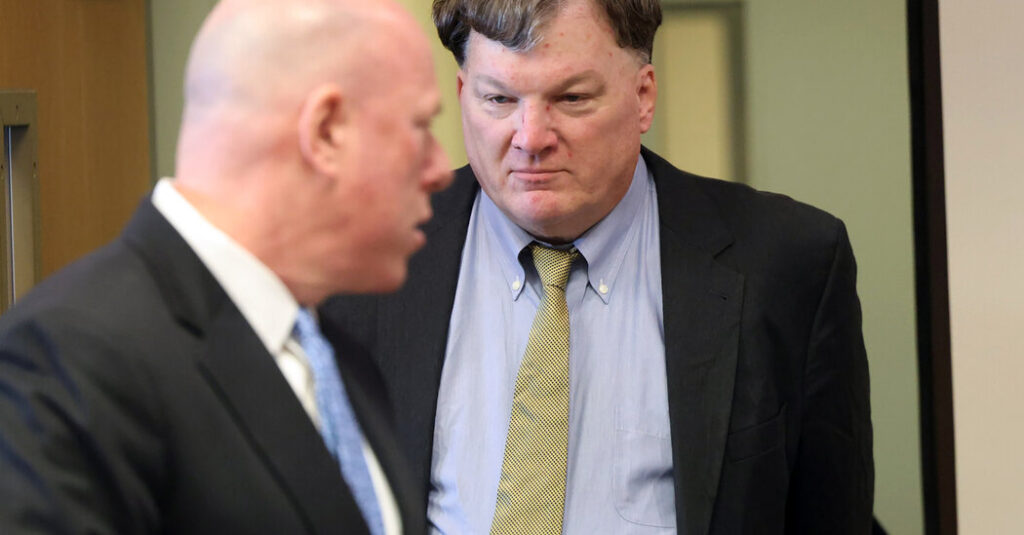
Facing a mountain of lurid details and an approaching trial, lawyers for Rex Heuermann, who is charged with seven murders in the Gilgo Beach serial killing case, on Tuesday challenged some of the prosecution’s strongest evidence.
Mr. Heuermann’s lawyers filed a motion in advance of a court hearing that questioned key aspects of the prosecution’s case, from how investigators seized Mr. Heuermann’s discarded pizza crust from a Midtown Manhattan trash can before his arrest, to their portrayal of Mr. Heuermann as a porn-obsessed fiend.
Mr. Heuermann, 62, was arrested in July 2023 in the Gilgo murders, which occurred from the early ’90s until around 2010 along Ocean Parkway east of Jones Beach.
He has pleaded not guilty to all of them and has remained in county jail since his arrest.
On Tuesday, the judge in the case, Justice Timothy P. Mazzei, said the trial would begin “right after Labor Day come hell or high water.”
Mr. Heuermann appeared in Suffolk County Criminal Court, in Riverhead, N.Y., in a charcoal suit, along with his lawyers. Seeking to have key evidence suppressed, his legal team also attacked a slew of warrants the authorities obtained to search Mr. Heuermann’s home, the Midtown Manhattan offices of his architectural consulting firm and his storage facilities, phones and electronic devices.
The lawyers argued that the search warrants were broad, speculative fishing expeditions.
Their motion also objected to the way investigators helped build a DNA profile for Mr. Heuermann by snatching the pizza remains and fishing empty bottles out of the curbside recycling bin in front of his suburban Long Island home, in Massapequa Park.
In addition to Mr. Heuermann’s phone records and internet activity, prosecutors are basing much of their case on cutting-edge nuclear DNA findings. Prosecutors say their DNA analysis links hairs found with the remains of most of the victims to Mr. Heuermann.
Justice Mazzei ruled that prosecutors had until March 3 to file their response to the defense’s motion. When a joke was made about setting the conference after that for March 17, St. Patrick’s Day, the usually stoic Mr. Heuermann audibly chuckled.
After the conference, lawyers for both the prosecution and defense told reporters they were ready for trial.
District Attorney Raymond A. Tierney said his team would “absolutely not” be seeking to enter into a plea deal with Mr. Heuermann, adding that the trial would last “certainly weeks.”
He said he expected to oppose “the vast majority if not all of the motion.”
A lawyer for Mr. Heuermann, Michael J. Brown, said, “There’s some real significant issues that have been brought to the court’s attention,” adding that Mr. Heuermann had use of the jail law library and was helping mount his own defense.
Mr. Brown said Mr. Heuermann spends 23 hours a day alone “in a restricted area” with only one hour for outdoor recreation but does see family members. None of them were at Tuesday’s proceeding.
Mr. Brown has disparaged the whole genome sequencing technology used by prosecutors in the DNA analysis as unreliable and invalid as legal evidence in New York State. But he was unsuccessful last year in his attempt to get the DNA information thrown out.
Now Mr. Heuermann’s lawyers are trying a different tack, arguing that their client’s DNA was improperly obtained and violated his constitutional right to privacy.
After the conference on Tuesday, another attorney for Mr. Heuermann, Danielle Coysh, called the defense filing unique in that it sought the expansion of Fourth Amendment protections to keep pace with technological advancements in DNA analysis.
“Rex Heuermann abandoned his pizza crust,” she said. “But he didn’t abandon all that information in his DNA.”
The motion also asked Justice Mazzei to dismiss an indictment in the death of Sandra Costilla, one of the seven victims, whom Mr. Heuermann was charged with killing in 2024.
Lawyers claim that case is based on insufficient evidence: a DNA match from a single hair that prosecutors said was found on her shirt when her body was found in the woods in Southampton in 1993.
The grand jury in the Heuermann case had already sat through more than 10 months of “highly inflammatory and extraordinarily prejudicial material wholly unrelated to the Costilla charge,” the lawyers argued.
This included gruesome testimony painting Mr. Heuermann as a deviant obsessed with sadistic pornography and a description of a computer file prosecutors said he created as a grisly manual on how to hunt, kill and dispose of his victims.
The motion argues that prosecutors deliberately structured their case to the grand jury so that it considered the Costilla charge only after being exposed to “extensive, inflammatory, and highly prejudicial evidence” relating to the other victims.
Mr. Heuermann’s lawyers also requested information about a former Suffolk County police chief, James Burke, who oversaw the Gilgo investigation years before Mr. Heuermann’s arrest, from 2012 to 2015. Mr. Brown has suggested that the Gilgo investigation may have been tainted by Mr. Burke, who became a symbol of police corruption and spent time in federal prison.
Corey Kilgannon is a Times reporter who writes about crime and criminal justice in and around New York City, as well as breaking news and other feature stories.
The post Defense Challenges Pizza Evidence in Gilgo Beach Serial Killings Case appeared first on New York Times.