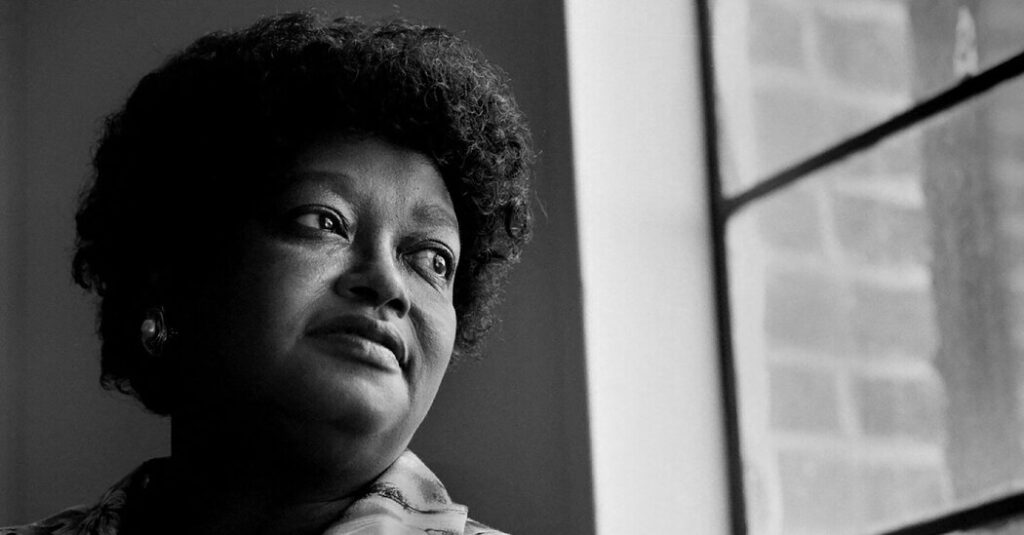
Claudette Colvin, whose refusal in 1955 to give up her seat to a white woman on a segregated bus in Montgomery, Ala., came months before it was overshadowed by a similar act of resistance in the same city by Rosa Parks, a historic moment that helped galvanize the civil rights movement, died on Tuesday in Texas. She was 86.
Her death, in hospice care, was confirmed by Roseboro Holdings, a company that represents the Claudette Colvin Foundation.
She went on to become a star witness in a landmark anti-segregation lawsuit whose successful outcome was affirmed by the United States Supreme Court.
Ms. Colvin was just 15 years old when she boarded a Montgomery city bus on March 2, 1955. The seating was segregated, with Black riders forced to the back, and if the white section filled up, the driver could order Black riders to give up their seats if they were in the rows known as “no man’s land,” between the two sections.
To add to the indignity, Black riders were not allowed to occupy the same row as white riders, which meant that they had to move back even if there were empty seats next to them.
That’s exactly what happened when a white woman boarded Ms. Colvin’s bus. The driver ordered Ms. Colvin and the three other Black people in her row to move. Two of them did. Ms. Colvin and another woman remained seated.
Ms. Colvin was active in her school’s N.A.A.C.P. Youth Council, which had been considering ways to protest the city’s segregation laws. She had also been close with a classmate, Jeremiah Reeves, who had recently been caught having sex with a white woman. The woman claimed that he had raped her. He was convicted, sentenced to death and executed in 1958.
All of this was on her mind when Ms. Colvin refused the driver’s order. He stopped the bus and called the police.
Other passengers, white and Black, murmured in disapproval of her defiance. The other remaining Black passenger relented. But Ms. Colvin stayed.
“History had me glued to the seat,” she told The New York Times in 2021.
The officers had to drag her backward and screaming off the bus and into a police car. On the way to the station, the two men made lewd comments about her appearance, and one sat in the back beside her. She worried that they would take her somewhere secluded and assault her.
“I didn’t know if they were crazy, if they were going to take me to a Klan meeting,” she told The Guardian in 2000. “I started protecting my crotch. I was afraid they might rape me.”
They did not, but the police did book her for disturbing the peace, violating segregation laws and assaulting an officer. She was quickly convicted in juvenile court. Her lawyer, Fred Gray, who would later represent Ms. Parks, managed to get the first two charges dropped on appeal, but the third was upheld. She was given a fine and probation.
Her arrest was big news in Montgomery, especially in the city’s Black community. Many felt that the time was ripe for a mass protest against local segregation laws, starting with public transit.
But local civil rights leaders decided not to make Ms. Colvin their symbol of discrimination. She was, she later said, too dark-skinned and too poor to win the crucial support of Montgomery’s Black middle class. (She was not, as some later claimed, pregnant at the time, though she did become pregnant later that year.) Instead, the leaders waited.
In December, Ms. Parks boarded a Montgomery bus and entered history. She, too, was arrested, and in the coming months the city’s Black community rallied around a boycott against the city’s transit system. The boycott, led by the Rev. Dr. Martin Luther King Jr., lasted more than a year and was a turning point in struggle that would lead to passage of the Civil Rights Act of 1964, which, among other things, prohibited discrimination in public places.
In 1956, Ms. Colvin was one of four Black plaintiffs in a federal lawsuit brought by Mr. Gray against the city’s bus system, saying its segregation rules were unconstitutional. Ms. Colvin was a star witness who vividly recounted her treatment the year before.
They won the case, known as Browder v. Gayle, which was affirmed by the Supreme Court at the end of 1956 — paving the way not only for the end of segregation on Montgomery buses, but also on public transportation nationwide.
All the attention made life difficult for Ms. Colvin. Whites shunned her, but so did many Black residents, who she said considered her a troublemaker.
In 1958, with a young child to raise — her son Raymond was born in March 1956 — she moved to the Bronx, where her older sister Velma lived. Ms. Colvin worked for a while as a domestic servant, and later, for about 30 years, as a nurse. For much of that time, she spoke little about her pivotal role in the civil rights movement.
“My mother told me to be quiet about what I did,” she said in an interview with The New York Times in 2009. “She told me: ‘Let Rosa be the one. White people aren’t going to bother Rosa — her skin is lighter than yours, and they like her.’”
Only later did she begin telling her story.
“Young people think Rosa Parks just sat down on a bus and ended segregation, but that wasn’t the case at all,” Ms. Colvin added. “Maybe by telling my story — something I was afraid to do for a long time — kids will have a better understanding about what the civil rights movement was about.”
Claudette Austin was born on Sept. 5, 1939, in Birmingham, Ala. Her father, C.P. Austin, left the family when she was still a baby, at which point her mother, Mary Jane Gadson, unable to care for Claudette and her younger sister, Delphine, sent them to live with their great-aunt and uncle, Mary Ann (Vaughn) and Quentiss P. Colvin. Claudette eventually took their surname.
At first, the family lived in Pine Level, a small town northwest of Montgomery, where, coincidentally, Ms. Parks had also spent part of her childhood. When Claudette was 8, the Colvins moved to King Hill, an African-American neighborhood in Montgomery.
She is survived by her son Randy; seven grandchildren; eight great-grandchildren; and her sisters Mary Ellen Russell, Joann Coretta Lawson, Theresa Diane Lovejoy Johnson, Carolyn Russell, Gloria Jean Laster and Bernice Foster Chambliss. Raymond Colvin, her older son, died in 1993.
Awareness of Ms. Colvin’s role in civil rights history has grown in recent years. In 2009, Phillip Hoose’s biography, “Claudette Colvin: Twice Toward Justice,” won the National Book Award for Young People’s Literature.
In 2019, Montgomery unveiled a marker commemorating Ms. Colvin and the other plaintiffs in Browder v. Gayle, and in 2021 a local court expunged her assault conviction from her record. A crowd awaited her outside the courthouse.
“I guess you can say that now I am no longer a juvenile delinquent,” she told the well-wishers.
Ash Wu contributed reporting.
Clay Risen is a Times reporter on the Obituaries desk.
The post Claudette Colvin, Who Refused to Give Her Bus Seat to a White Woman, Dies at 86 appeared first on New York Times.